Written by: Luis Teran, Co-founder, CEO, TenantEvaluation
Key Takeaways for Florida CAMs and Boards
- Florida CAMs and boards lose hours to disconnected spreadsheets and missing lease documents, which creates compliance risks under state records laws.
- TenantEvaluation Lease Tracking connects application intake, board review, and lease execution into one centralized, audit-ready workflow.
- Automated expiration reminders and real-time status tracking remove manual calendar checks and prevent missed renewals across the portfolio.
- QuickApprove accelerates board approvals with a dedicated dashboard while preserving oversight and compliance review.
- Replace fragmented lease management with TenantEvaluation’s connected platform, and see how Lease Tracking works for your portfolio.
The Problem: Manual Lease Tracking Creates Real Risk for Florida Associations
Manual lease management is a structural liability, not a minor inconvenience. Property managers spend 30–40% of their time on manual data entry, reconciliation, and administrative reporting, and 60% of U.S. multifamily property managers encounter monthly financial discrepancies according to a 2025 CRETI/SurfaceAI survey of 325 professionals, including billing errors and rent-roll mismatches. When lease data sits across folders, inboxes, and spreadsheets, locating a single expiration date takes real time, and that effort multiplies across an entire portfolio.
For Florida associations, the stakes are higher. Under Florida §718.111(12) and §720.303(4), associations must produce requested official records within 10 business days, with statutory damages of $50 per calendar day, capped at $500 per request, for failure to comply. Lease approval records fall within the broad definition of official records under those statutes. Associations that manage age-restricted communities also face added documentation consistency requirements. 55+ Communities Verification inside TenantEvaluation standardizes how age-restricted requirements are handled across applications, which reduces manual work and improves documentation consistency for Florida condos and HOAs.

The core issue is simple. Lease data is disconnected from the onboarding process itself. TenantEvaluation Lease Tracking connects every stage, from application intake through occupancy, inside one platform so records stay complete and accessible.
Three Connected Phases That Match Florida Board Workflows
To address the fragmentation described above, TenantEvaluation Lease Tracking follows three operational phases that match how Florida CAMs and boards already work.
Phase 1: Application Intake. When a prospective tenant submits an application, TenantEvaluation automatically collects lease documentation as part of onboarding. Association processing clocks do not start until every required document is received, so automated collection at intake removes the back-and-forth that delays approvals. The system flags incomplete packets before they reach the review queue.
Phase 2: Board Review. Once a complete application package is assembled, it moves into the board review stage. Board meetings at Florida HOAs and COAs often occur at least quarterly under statute or common recommendation, with no fixed 2–3 week cycle, so meeting frequency varies by community and directly affects approval timelines. TenantEvaluation’s QuickApprove workflow gives boards a dedicated dashboard with real-time application status, summarized applicant reports, and a structured voting panel. Review moves faster while boards keep full control and visibility.
Phase 3: Execution and Expiration. After approval, the executed lease is stored centrally inside TenantEvaluation and linked to the unit and occupancy record. Automated reminders track expiration dates and remove the manual calendar checks that cause missed renewals. Every lease stays connected, searchable, and audit-ready from execution through the end of the term.
Clear Lease Status Stages for Faster Board Decisions
Real-time lease visibility for CAMs and boards depends on a clear, consistent status framework. TenantEvaluation Lease Tracking tracks every lease across four operational stages:
| Status | Definition | Operational Implication |
|---|---|---|
| Active | Executed lease on file, within term dates | Unit occupancy confirmed, no action required |
| Pending | Application submitted, board review in progress | Awaiting approval, lease not yet executed |
| Expired | Lease term has ended, no renewal on file | Renewal or vacancy action required |
| Missing | Unit occupied but no lease document on record | Compliance risk, document collection needed immediately |
This status framework gives CAMs and boards an immediate operational picture across the entire community portfolio. Instead of opening individual files or querying spreadsheets, managers see the full lease landscape in one view, and boards can identify which units need attention before a scheduled meeting.
Before-and-After View of Lease Tracking Performance
The shift from manual processes to TenantEvaluation Lease Tracking is measurable across every part of lease administration.
| Dimension | Before TenantEvaluation | After TenantEvaluation |
|---|---|---|
| Lease storage | Folders, inboxes, and disconnected spreadsheets | Centralized digital records inside one platform |
| Expiration tracking | 30+ minutes to locate expiration dates across a portfolio | Automated reminders and real-time status visible instantly |
| Audit readiness | Spreadsheet-based audit preparation often takes two weeks instead of two hours | Searchable digital history with records produced on demand |
| Application-to-lease connection | No direct link between applications and active leases | Onboarding, approvals, and lease documentation fully connected |
Spreadsheets used in business often contain errors, and that reality undermines defensibility for Florida associations that must respond quickly to records requests. For communities subject to Florida’s 10-business-day production requirement, a spreadsheet baseline is not enough.
See the before-and-after shift for your community with a TenantEvaluation Lease Tracking demo that shows how these improvements apply to your portfolio.
QuickApprove: Faster Board Approvals with Full Oversight
QuickApprove is TenantEvaluation’s accelerated approval workflow for CAMs, boards, and property management teams. It replaces email chains and spreadsheets with a single connected approval process inside TenantEvaluation, with real-time application tracking, automated communication support, customized approval letters, and a personalized welcome package.

For boards, QuickApprove provides a dedicated review and voting dashboard where members access summarized applicant reports and cast votes without waiting for emailed PDFs or manually compiled packets. HOA tenant approval timelines in Palm Beach County communities typically run 5 to 15 business days, with some boards stretching to 30 days. Those delays often come from incomplete packets and manual coordination. QuickApprove reduces those delays by keeping applications in a structured, board-ready workflow that is faster, clearer, more consistent, and easier to manage while preserving board oversight, compliance review, and decision authority.
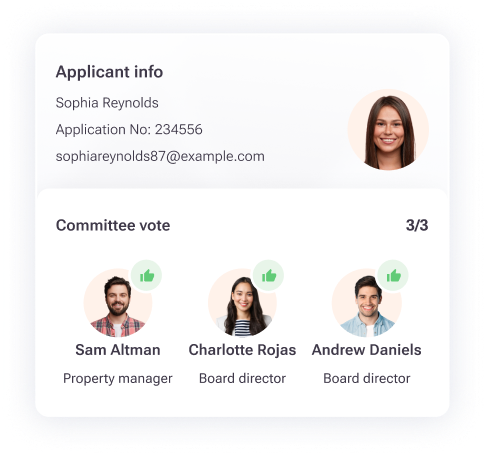
The lease tracking and approval workflows operate together inside TenantEvaluation. The moment a board approves an application, the lease documentation lifecycle starts automatically, so there is no handoff gap between approval and lease record creation.
Automated Expiration Reminders and Audit-Ready Lease Records
Missed expirations and incomplete records at audit time create two of the most expensive failures in manual lease management. TenantEvaluation addresses both issues directly for Florida communities.
Automated lease expiration reminders remove the need for manual calendar tracking. If a landlord does not open a rental tracking spreadsheet for five days, they will not see a late payment or expiring lease for five days, because spreadsheets do not send alerts. TenantEvaluation triggers reminders based on lease term data and gives CAMs and boards advance notice to start renewals or plan for vacancy.
On the audit-readiness side, Florida associations must retain accounting records, contracts, and related documents for 7 years under §718.111(12)(b) and §720.303(4), with records stored inside Florida and produced within 10 business days of a written request. TenantEvaluation’s searchable digital history keeps every lease, amendment, and document trail organized and immediately accessible. CAMs and boards can meet the statutory timeline discussed earlier without manual filing or retrieval work.
Florida property managers should maintain a single source of truth for every interaction, including leases, by standardizing templates, timestamping communications, and centralizing records to support audit readiness. TenantEvaluation Lease Tracking delivers that structure for Florida community associations instead of relying on generic rental tools.
Frequently Asked Questions
What stages usually appear in a Florida condo or HOA lease approval workflow?
Florida condo and HOA lease approval workflows usually follow five sequential stages. First, the owner submits a Notice of Intent to Lease with a complete packet that includes tenant applications for all adults, government-issued photo ID, an executed or draft lease, income and background documentation, and any community-specific forms such as vehicle registration or pet disclosures. Second, the association performs tenant screening, which can include criminal background checks, credit evaluations, and reference verification. Third, the board reviews the complete package to confirm compliance with the governing documents. Fourth, the board issues written approval or denial, with timelines that vary by community and often fall in the 5 to 15 business day range, though some boards require up to 30 days depending on meeting schedules. Fifth, the executed lease is filed and occupancy is permitted. Florida law does not require written board approval before tenant occupancy; any such requirement must appear in the condominium or HOA’s governing documents. Failure to obtain required approval before move-in can result in fines or legal action. TenantEvaluation Lease Tracking connects all five stages inside one platform and removes the document gaps and manual handoffs that slow each transition.
How long does the typical Florida condo or HOA lease approval process take?
Approval timelines vary by community type and governing documents. In many Central Florida and Orlando-area associations, complete packets move within 24 to 72 hours or up to 5 business days. In communities where board review ties to scheduled meeting cycles, such as boards that meet every 2 to 3 weeks, the full timeline from tenant selection to approved move-in often runs 3 to 4 weeks. Palm Beach County HOA communities typically require 5 to 15 business days, with some older or larger boards taking up to 30 days. The most common cause of delay is an incomplete application packet, because associations cannot start processing until every required document arrives. TenantEvaluation’s automated document collection during onboarding and QuickApprove’s board-ready dashboard reduce both the document-gap delays and the board-coordination delays that extend these timelines.
What are the risks of relying on spreadsheets for lease expiration tracking?
Spreadsheet-based lease tracking creates four categories of operational risk for Florida community associations. First, there are no automated critical date alerts, so managers must manually check files to find upcoming expirations, and missed checks lead to missed renewals or unexpected vacancies. Second, version fragmentation appears when multiple team members keep separate copies of the same spreadsheet, which produces conflicting data and decisions based on stale information. Third, manual calculation errors build up over time, especially when lease amendments never reach the tracking file. Fourth, there is no audit trail that shows who changed what and when, which weakens defensibility when associations face records requests under Florida statute. As noted earlier, the high error rate in spreadsheet-based systems and the longer preparation time compared with centralized digital tools create direct problems for associations that must meet Florida’s 10-business-day production requirement and 7-year retention mandate.
How does TenantEvaluation Lease Tracking support audit-ready records for Florida associations?
TenantEvaluation Lease Tracking supports audit readiness through four connected capabilities. Centralized lease records store every executed lease, amendment, and document trail inside one searchable platform and remove the folder and inbox searches that slow records production. Unit-level tracking ties each lease to its occupancy record and the original application, which creates a complete chain of documentation from intake through occupancy. Automated lease document collection during onboarding captures lease copies at the point of application instead of chasing them after the fact. Searchable digital history lets CAMs and boards retrieve any lease record on demand and meet the statutory timeline discussed earlier. Florida associations must retain official records for at least 7 years, and TenantEvaluation’s organized digital infrastructure supports that requirement without manual filing systems that degrade over time or through board turnover.
Conclusion: One Connected Workflow for Florida Lease Approvals
Fragmented spreadsheets and email chains no longer support Florida condo and HOA teams that manage lease approvals, occupancy tracking, and audit-ready records. The administrative burden is measurable, the compliance exposure is statutory, and the operational blind spots created by disconnected systems are avoidable.
TenantEvaluation Lease Tracking replaces that fragmentation with one centralized, real-time workflow that connects applications, board approvals, and lease documentation from intake through occupancy. Combined with QuickApprove and automated lease expiration reminders, Florida CAMs and boards gain the visibility, control, and audit readiness their communities require without adding headcount or complexity.
Request your Lease Tracking demo and see how TenantEvaluation delivers centralized, real-time lease visibility and lifecycle control for Florida community associations.
