Written by: Luis Teran, Co-founder, CEO, TenantEvaluation
Key Takeaways for Florida CAMs and Boards
- Spreadsheet-based lease tracking creates blind spots that cause missed expirations, delayed renewals, and compliance risks for Florida community associations.
- An automated lease renewal system moves through four stages: tracking, outreach, signing, and record update. Each stage replaces manual tasks with system-driven actions.
- Lease renewal responsibility spans CAMs, boards, and owners. A centralized dashboard removes fragmented data sources and gives every stakeholder real-time visibility.
- TenantEvaluation’s Lease Tracking centralizes lease status, automates document collection, and maintains searchable, audit-ready records from application through occupancy.
- Eliminate spreadsheet chaos and missed renewals. Schedule a demo at TenantEvaluation to modernize your Florida community association’s lease management.
Four Stages of an Automated Lease Renewal Workflow
An automated lease renewal lifecycle follows four clear stages. Each stage replaces a manual step with a system action and reduces the chance of human error.
Stage 1: Tracking
- The system flags leases approaching expiration at 90 to 120 days out so CAMs can start renewals early.
- Every unit shows a real-time status such as active, pending, expired, or missing, which keeps the portfolio view current.
- The unit-level dashboard updates automatically as data changes, so no one needs to adjust a spreadsheet by hand.
Stage 2: Outreach
- Automated notifications go to owners, tenants, and realtors, which removes the need for one-off emails.
- Digital renewal offers present clear options, so staff do not have to draft custom terms for each unit.
- Follow-up reminders run on a defined schedule until the system records a response, which keeps outreach consistent.
Stage 3: Signing
- Renewal documents route for e-signature inside the platform, so no one prints, scans, or chases signatures manually.
- The system collects the executed lease and stores it automatically as soon as all parties sign.
- Where association rules require board sign-off, a board-ready approval workflow activates through QuickApprove.
Stage 4: Record Update
- Lease status updates in real time across all dashboards, which ensures every stakeholder sees the current state immediately.
- This status change links the occupancy record to the new lease term at the unit level and keeps data aligned.
- The searchable digital history records the executed document and timestamp, creating an audit trail tied to the unit’s full occupancy history.
How CAMs, Boards, and Owners Share Lease Renewal Duties
Florida community associations divide lease renewal responsibility across three main roles. CAMs handle the operational workflow, which includes tracking expirations, coordinating outreach, collecting documents, and confirming occupancy. Board members hold approval authority in communities whose governing documents require board consent before a lease is executed or renewed. Unit owners and their tenants must respond to renewal offers and return executed documents on time.
Breakdowns occur when each role works from a different information source. CAMs rely on spreadsheets, boards receive PDF attachments by email, and owners use separate communication channels. A centralized dashboard removes this fragmentation by giving every stakeholder real-time visibility into the same lease status data, without long email chains to distribute updates. This fragmented responsibility structure is also the reason manual lease management creates systemic problems for many associations.
Why Manual Lease Management Creates Risk
Manual lease management in community associations usually produces four compounding problems.
Spreadsheet chaos. Lease expiration dates stored in shared spreadsheets stay accurate only when someone updates them correctly. A single missed entry creates a gap that may not appear until a lease has already expired.
Manual follow-ups. Without automated outreach, CAMs spend large amounts of time contacting owners, tenants, and realtors one by one. This workload does not scale across big portfolios and produces inconsistent communication records.
Lack of board visibility. Boards cannot make informed decisions about occupancy or renewal approvals when they only see periodic email summaries from the CAM. Real-time visibility requires a connected system instead of forwarded attachments.
Compliance risk from incomplete records. Florida community associations face audits and disputes where complete, timestamped lease documentation is required. Scattered records across folders and inboxes do not qualify as an audit-ready archive.
An automated system addresses these problems together by centralizing data, automating outreach, and maintaining a searchable digital history from application through occupancy.
How TenantEvaluation’s Lease Tracking Replaces Spreadsheets
TenantEvaluation’s Lease Tracking provides a centralized operational hub inside the broader TenantEvaluation ecosystem. It connects resident onboarding, unit data, approvals, and lease documentation into one streamlined, real-time workflow. This structure replaces spreadsheets and scattered email chains so every lease stays connected, searchable, trackable, and audit-ready from application through occupancy.
Core capabilities include:
- Real-time lease status visibility, where every unit displays active, pending, expired, or missing at a glance.
- Automated lease document collection, so executed leases are gathered during onboarding without repeated manual requests.
- Unit-level tracking, which ties occupancy records directly to lease terms and resident history.
- Searchable digital history, so staff can retrieve every lease, document trail, and resident activity record instantly.
- Audit-ready records, with organized digital documentation that supports compliance readiness while still leaving room for legal guidance.
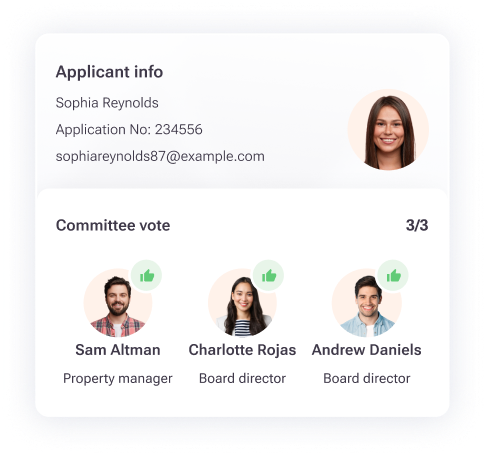
When a renewal requires board approval, QuickApprove accelerates resident approvals inside the same platform. Board members use a dedicated review and voting dashboard with summarized applicant data, which removes the need to request information through email. The result is faster, clearer, and more consistent approvals, while boards keep control, compliance, and visibility.

TenantEvaluation is built specifically for community associations and management companies, with FCRA compliance as the foundation. With more than 5,000 communities and about 100,000 applications processed each year, the platform matches the scale and complexity Florida CAMs manage daily.
Schedule a demo today to see Lease Tracking and QuickApprove in action.
Best Practices for Automating Lease Renewals
A property manager lease renewal system delivers the most consistent results when you follow a clear timeline and operational standards.
Implementation Checklist
- Set expiration alerts at the recommended timeline, so the system flags upcoming expirations early enough to allow multi-round outreach before the lease end date.
- Configure automated notifications, and define the outreach schedule for owners, tenants, and realtors so staff do not need to initiate contact manually.
- Build multi-option renewal offers, and present owners with structured renewal terms digitally to reduce negotiation delays and create a documented offer record.
- Route documents for e-signature, and ensure executed leases are collected and stored inside the platform immediately after signing instead of arriving as separate emails.
- Activate board approval workflows, and connect renewal approvals to the QuickApprove workflow described above for communities that require board consent.
- Archive all records digitally, and confirm that every executed lease, communication log, and status change is stored in a searchable, audit-ready format inside the platform.
Comparing Generic Suites and Specialized Lease Tracking
Generic property management platforms offer broad feature sets for multifamily landlords. They do not reflect the governance structures, board approval requirements, or Florida-specific compliance workflows that define community association management. The table below outlines key differences between native suite tools and a specialized lease-tracking layer like TenantEvaluation.
| Evaluation Criteria | Generic Native Suites (e.g., AppFolio, Buildium) | TenantEvaluation Lease Tracking | Practical Impact |
|---|---|---|---|
| Association-Specific Compliance | Designed for multifamily landlords, Florida HOA and condo workflows not native | Built exclusively for Florida community associations and management companies | CAMs avoid workarounds that try to fit generic tools into association governance structures |
| Board Dashboard | No dedicated board review or voting panel | Board-ready approval dashboard with summarized applicant data and voting workflow via QuickApprove | Boards make faster decisions without relying on email summaries from CAMs |
| Onboarding Integration | Lease data disconnected from application and screening records | Lease Tracking connects directly to resident onboarding, unit data, approvals, and document collection | No data re-entry, because lease records populate from the application lifecycle automatically |
| Real-Time Lease Visibility | Static reports or manual status updates required | Live lease status per unit, including active, pending, expired, or missing | CAMs and boards see current occupancy status without generating a report or checking a spreadsheet |
Frequently Asked Questions
What timelines should Florida CAMs follow for lease renewals?
Florida CAMs managing community association portfolios generally start the lease renewal process 90 to 120 days before a lease expiration date. This window allows time for multi-round outreach to owners and tenants, collection of executed renewal documents, board approval where required by governing documents, and record updates before the current lease term ends. Starting earlier than 90 days works well for large portfolios or communities with complex approval requirements. An automated property manager lease renewal system handles expiration flagging and outreach scheduling automatically, so the 90 to 120 day window triggers from the system instead of a manual reminder.
How does Lease Tracking integrate with QuickApprove?
TenantEvaluation’s Lease Tracking and QuickApprove operate inside the same platform and share resident onboarding data, unit records, and approval history. When a lease renewal requires board consent, QuickApprove activates a board-ready approval workflow that connects directly to the lease record in question. Board members use a dedicated review and voting dashboard with summarized applicant information, cast their decision inside the platform, and trigger a real-time lease status update upon approval. This structure removes the email chain that usually connects CAMs and boards during renewal approvals and keeps the executed lease stored alongside the approval record in one searchable, audit-ready location.
What compliance considerations apply to lease records in community associations?
Florida community associations must follow governance requirements under their bylaws and state statutes that usually mandate complete, accessible records of lease agreements and occupancy history. Incomplete or missing lease records create exposure during audits, board disputes, and legal proceedings. A centralized lease tracking system that maintains searchable digital records with timestamps and document trails supports compliance readiness by keeping documentation organized and consistently structured. TenantEvaluation’s Lease Tracking provides audit-ready digital records as a standard capability while FCRA compliance remains the foundation of the broader platform. Lease Tracking supports documentation and operational consistency, but it does not replace legal guidance or guarantee regulatory compliance.
How much time can automation save property management teams?
TenantEvaluation’s platform has shown that it can free as much as 50 hours of staff time per day for management companies that replace manual processes with automated workflows. One Florida-based management company cut processing time by 50 percent after switching to TenantEvaluation and generated 240,000 dollars in annual savings. These results reflect the combined impact of removing manual document collection, follow-up calls, spreadsheet updates, and disconnected approval workflows, not only lease renewal automation. For CAMs managing large portfolios, time savings from automated lease tracking, outreach, and record updates compound across every unit in the portfolio at the same time.
Conclusion: Moving Your Association Beyond Spreadsheets
Fragmented lease records and manual renewal workflows create real operational risk for Florida community associations. Missed expirations, incomplete documentation, and disconnected board approval processes increase compliance exposure and slow down teams that already manage high application volumes.
TenantEvaluation’s Lease Tracking delivers centralized, real-time lease visibility and lifecycle control from application through occupancy, built for CAMs, boards, and property management companies operating in Florida. Integrated with QuickApprove, it replaces spreadsheets and email chains with one connected, audit-ready platform that keeps every lease searchable, trackable, and current, without adding operational complexity.
No spreadsheets. No missing leases. No operational guesswork.
