Written by: Luis Teran, Co-founder, CEO, TenantEvaluation | Last updated: August 21, 2026
Key Takeaways for 2026 Florida Condo Approvals
- Condo approval delays in Florida’s 2026 market stem from manual workflows, stricter lender full-project reviews effective August 3, 2026, and misaligned board meeting calendars that extend timelines beyond contract deadlines.
- Buyers avoid many delays by ordering estoppel letters immediately, inserting approval-deadline clauses in contracts, tracking lender reviews separately, and submitting complete application packets on the first attempt.
- Associations cut approval times by up to 70% when they digitize workflows, add real-time board dashboards, use biometric identity verification, and centralize lease and payment collection.
- The 2026 lending rule changes, including Fannie Mae and Freddie Mac retiring Limited and Streamlined Reviews, require more documentation and parallel processing that extends closing timelines for Florida condo buyers.
- Associations and buyers streamline the entire approval process with TenantEvaluation’s all-in-one FCRA-compliant platform that connects QuickApprove, IDVerify, Lease Tracking, and TEpayments in a single workflow.
8-Step Buyer Checklist to Prevent Florida Condo Approval Delays
This checklist applies to buyers of Florida condos and HOA-governed properties in 2026. Each step targets a specific, documented source of delay.
- Order the estoppel letter on Day 1. Under Fla. Stat. §718.116(8) for condominiums and §720.30851 for HOAs, associations must deliver an estoppel certificate within 10 business days of a written or electronic request. Requesting it immediately after contract execution starts that clock and surfaces any delinquency issues before they become closing blockers.
- Insert an approval-deadline clause in the contract. Florida condo approval timing is generally set by the association’s governing documents. Buyers and their realtors should negotiate a specific association-approval deadline into the purchase contract and tie the closing date to it, which makes any delay visible and actionable.
- Track lender full-project review timing separately. Effective August 3, 2026, Fannie Mae retired its Limited Review process and Freddie Mac retired its Streamlined Review process for established condo projects. Full Review now requires lenders to examine various HOA documents and data. This review runs parallel to, and often longer than, the association’s own approval process. Buyers should confirm their lender has initiated the project review within the first week of contract execution.
- Monitor the board meeting calendar. The practical constraint on approval timing usually comes from the board’s meeting calendar rather than the substantive review itself. Buyers should ask the CAM when the board next meets and when written approval will issue after that meeting. They should then set the closing date against those dates.
- Submit a complete application packet on the first attempt. An incomplete application package causes most approval delays because many managers will not start the review clock until every signature and fee is received. To avoid this reset, buyers should ensure the first submission includes the association’s application form, the fully executed purchase contract, government-issued ID for every adult occupant, authorization for credit and background checks, and personal or professional references. If the building has strict financial requirements, buyers should also prepare tax returns, bank statements, or lender pre-approval so those documents do not hold up the file.
- Know your statutory rights as a Florida buyer. Under Fla. Stat. §718.503(2), resale condo buyers have a non-waivable right to void the contract within 7 days, excluding Saturdays, Sundays, and legal holidays, after receipt of the required condominium documents. Developer sales provide a 15-day cancellation window.
- Escalate stalled applications through documented channels. When no statutory approval deadline exists, contract enforcement depends on the association’s own procedures, meeting cadence, and written response expectations set forth in the declaration. A timely estoppel request is one of the strongest practical escalation tools available because it imposes a 10-business-day statutory response deadline on the association. When a denial arrives without a stated basis, buyers should consult a Florida community association attorney.
- Ask for digital workflows from the association. Associations that still run paper-based or email-chain approvals create the single largest controllable source of delay. Buyers and their realtors have standing to ask whether the association uses a digital onboarding platform and to factor the answer into contract timeline negotiations.
See how TenantEvaluation eliminates these eight bottlenecks in a live demo.
Key 2026 and 2027 Lending Rule Changes for Florida Condos
The table below summarizes the main changes to conventional condo financing rules effective in 2026 and 2027. Every data point is cited inline.
| Rule / Change | Effective Date | What It Requires | Impact on Florida Buyers |
|---|---|---|---|
| Fannie Mae Limited Review retired; Freddie Mac Streamlined Review retired | August 3, 2026 (loan application date) | Full Review required for established condo projects | Longer lender timelines and more documentation required from associations before closing |
| Waiver of Project Review expanded | March 18, 2026 | Projects with 10 or fewer units may qualify to bypass full project review entirely | Faster loan approval for buyers in smaller buildings if agency conditions are met |
| Reserve funding minimum increases | January 4, 2027 | Fannie Mae requires that, for loan applications dated on or after January 4, 2027, condo/co-op budgets must fund replacement reserves at least 15% of annual budgeted assessment income (up from 10%) | Many Florida projects currently fall below this threshold, risking loss of warrantable status |
| Master insurance policy deductible cap | July 1, 2026 | Fannie Mae and Freddie Mac cap the per-unit deductible on Florida condominium master insurance policies at $50,000 for conventional loan applications on or after July 1, 2026 | Associations with non-compliant policies may fail Full Review, blocking conventional financing for buyers |
If a condo building loses warrantable status, buyers may be limited to portfolio or DSCR loans that typically require higher down payments than conventional financing. As Philip Bennett, President of Bennett Capital Partners Mortgage Brokers, stated: “The biggest closing risk is no longer just borrower qualification. It is whether the building can prove its financial and physical condition on time.”
Five Association Upgrades That Cut Approval Times by Up to 70%
These five steps outline a practical modernization path for Florida condo and HOA associations in 2026. TenantEvaluation’s all-in-one platform, built specifically for community associations with FCRA compliance as the foundation, delivers each capability inside a single connected workflow.
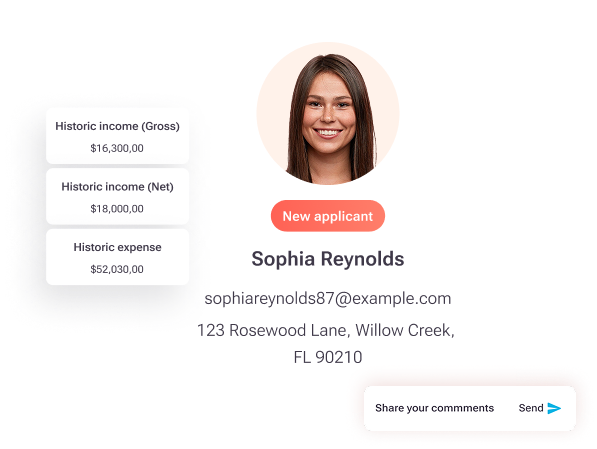
- Digitize the entire application workflow. Paper applications and email-based document collection are the primary source of the delays described in Step 5 of the buyer checklist above. TenantEvaluation’s 100% online application platform, accessible via web and mobile, automates document collection, e-signatures, and completeness checks. The system rejects incomplete submissions before they enter the review queue. Associations that switch to a full digital infrastructure platform report significant reductions in administrative task time.
- Use real-time board dashboards for faster decisions. Board meeting cadence is the most common bottleneck in Florida condo approvals. QuickApprove is TenantEvaluation’s accelerated approval workflow for CAMs, boards, and property management teams inside one connected platform. It provides real-time application tracking, a board-ready approval process with a dedicated voting panel, automated communication support, customized approval letters, and a personalized welcome package. These tools reduce manual follow-ups and keep applications moving while preserving control, compliance, and visibility. Board members access AI-generated applicant summaries and cast votes directly inside the platform, which replaces email chains and spreadsheets with a connected, auditable approval process.
- Add biometric identity verification to screening. Traditional screening that relies on document uploads cannot reliably prevent impersonation or synthetic identity fraud. IDVerify is TenantEvaluation’s biometric identity verification layer, embedded directly into the screening workflow. It combines government ID validation, AI-powered liveness detection, and biometric facial matching, all natively inside TenantEvaluation with no external portals or workflow disruption. CAMs see verification results, including ID authenticity confirmation, liveness status, and biometric match result, embedded directly within the screening report. This strengthens approval confidence and reduces liability exposure before residents enter the community.
- Centralize lease and payment collection. Fragmented lease records and disconnected payment collection add days to every approval cycle. TenantEvaluation’s Lease Tracking capability connects resident onboarding, unit data, approvals, and lease documentation in one centralized, real-time workflow. It delivers real-time lease status visibility, automated lease document collection, unit-level tracking, and audit-ready digital records that replace spreadsheets and scattered email chains. TEpayments is a connected payment workflow integrated into TenantEvaluation that collects application fees, deposits, and other required resident payments within the onboarding process associations already use. Payments go directly from the applicant to the association’s designated account, and TenantEvaluation never holds the funds, which eliminates the manual payment chasing that delays approvals.
- Make accelerated approval your standard workflow. The combination of digitized intake, real-time board dashboards, biometric verification, centralized lease tracking, and connected payments enables TenantEvaluation to deliver up to 70% faster approvals across 5,000+ Florida communities and approximately 100,000 applications per year. Associations that implement this full workflow stop treating approval as a sequential process and start running it as a parallel, automated one. That shift is the only reliable way to meet the tighter timelines that 2026 lender full-project reviews demand.
See QuickApprove, IDVerify, Lease Tracking, and TEpayments in action in a platform demo.

Downloadable Buyer Checklist for Florida Condo Approvals
The 8-step buyer checklist above is available as a downloadable PDF for buyers, realtors, and CAMs navigating Florida condo approval timelines in 2026. Share it with clients at the time of contract execution to reduce the most common sources of delay before they occur.
Frequently Asked Questions
How long does condo approval take in Florida in 2026?
Florida condo and HOA approval timelines often run several weeks for the association’s own review process, depending on the governing documents, board meeting schedule, and completeness of the application. In 2026, lender full-project review, now required for nearly all conventional condo loans following the retirement of Limited and Streamlined Review processes effective August 3, 2026, adds a parallel timeline that can extend the overall closing process further. Buyers should plan for a minimum of 30 to 45 days from contract execution to closing in most Florida condo transactions, and longer in buildings with complex governing documents, delinquency issues, or reserve funding below Fannie Mae’s 15% threshold for applications dated on or after January 4, 2027. Associations using digital onboarding platforms like TenantEvaluation can reduce their portion of that timeline by up to 70%.
What documents speed up HOA approval?
Submitting a complete application packet on the first attempt is the single most effective way to accelerate HOA approval. The documents listed in Step 5 of the buyer checklist above constitute a complete first submission. The key is ensuring every item, from the application form through references, is included before you submit because managers typically do not start the review clock until every required document and fee is received. Buyers who use associations running TenantEvaluation benefit from smart application form logic that automatically checks for completeness and rejects incomplete submissions before they enter the review queue, which prevents the silent clock reset that costs buyers weeks.
What are my rights if a Florida condo board stalls my application?
Florida law does not impose a uniform statutory deadline for condo board approval of a buyer application, and the governing documents typically set the review window. However, buyers have several practical and statutory tools available. First, the estoppel certificate request imposes a 10-business-day statutory response deadline on the association under Fla. Stat. §718.116(8) and §720.30851 and can be used as an escalation tool when the association is unresponsive. Second, under Fla. Stat. §718.503(2), condo resale buyers have a non-waivable right to void the contract within 7 days, excluding Saturdays, Sundays, and legal holidays, after receipt of the required condominium documents, which preserves exit rights while the approval process runs. Third, buyers should ensure their purchase contract includes a specific association-approval deadline tied to the closing date, making any delay visible and actionable under the contract. When a denial arrives without a stated basis, consulting a Florida community association attorney is the appropriate next step rather than negotiating directly with the manager.
Can technology like QuickApprove really reduce approval times without losing compliance?
QuickApprove is TenantEvaluation’s accelerated approval workflow, designed specifically for CAMs, boards, and property management teams inside one connected platform. It accelerates resident approvals by replacing email chains, spreadsheets, and manual follow-ups with real-time application tracking, a board-ready approval process with a dedicated voting panel, automated communication support, and customized approval letters, while preserving board oversight, screening, and legal or compliance review. TenantEvaluation is built with FCRA compliance as the foundation, not an afterthought. It is a direct reseller of TransUnion and Equifax data, maintains built-in audit trails for every application, and includes automated adverse action workflows. The platform has processed the volume mentioned earlier across thousands of Florida communities, generating $150 million for those communities, which shows that speed and compliance can work together when the workflow is properly designed.
Conclusion: Closing on Time in Florida’s 2026 Condo Market
Florida’s 2026 condo approval environment is more demanding than any prior year. Buyers face association timelines that often run several weeks, lender full-project reviews that now require complete HOA financial documentation for nearly every conventional loan, and board meeting calendars that do not bend to contract deadlines. The buyers and realtors who close on time are the ones who submit complete applications on Day 1, insert approval-deadline clauses, track lender and association timelines in parallel, and work with associations that have modernized their workflows. The associations that protect their communities, and their buyers’ closings, are the ones that have replaced paper and email chains with a single connected digital platform. TenantEvaluation is that platform: all-in-one, FCRA-compliant, built exclusively for Florida community associations, and capable of delivering the approval acceleration described above through QuickApprove, IDVerify, Lease Tracking, and TEpayments. Request your platform demo to see how TenantEvaluation delivers the faster approvals outlined above.
