Written by: Luis Teran, Co-founder, CEO, TenantEvaluation | Last updated: September 3, 2026
Key Takeaways for Community Associations
- Rental history verification systems review payment history, evictions, and lease compliance so property managers can reduce risk and approve with confidence.
- These systems support financial stability by flagging high-risk applicants before move-in, which can save associations thousands in eviction-related costs.
- Behavioral patterns revealed through landlord references help maintain community harmony by preventing disruptive tenancies that affect all residents.
- Automated platforms like TenantEvaluation cut screening time dramatically and replace manual processes that create administrative burden and compliance risk.
- Community associations can manage screening and lease workflows in one place with TenantEvaluation’s FCRA-compliant platform built for HOAs and condos. See the platform in action.
What Rental History Verification Is and How It Works
Rental history verification confirms an applicant’s past rental behavior so boards can better predict future reliability. Manual workflows often stretch across several days and create significant administrative work.
The standard verification process follows this sequence:
- Collect applicant consent and authorization.
- Contact previous landlords for references and payment records.
- Check eviction records and public court databases.
- Verify income and employment through direct employer contact.
- Run credit and background checks through a screening platform.
- Cross-reference identity documents to prevent fraud.
Modern platforms automate these steps inside a single digital workflow. TenantEvaluation combines background checks, credit reports, income verification through its IncomeEV report, and biometric identity verification through IDVerify into one FCRA-compliant process. This structure removes the paper-based back-and-forth that slows manual screening.

TenantEvaluation focuses on HOAs and condos rather than generic single-family rentals. Boards gain voting dashboards and governing document customization that general-purpose platforms do not provide.
TenantEvaluation consolidates every step into one FCRA-compliant platform. Explore an automated screening workflow in a live demo.
How Rental History Verification Supports Financial Stability
On-time payment history strongly predicts future rent behavior. Applicants with patterns of late payments or unpaid balances to previous landlords introduce measurable financial risk for community associations.
Eviction screening adds another layer of protection. A single eviction proceeding can cost a community association thousands of dollars in legal fees, lost assessments, and unit downtime.
Consider a practical scenario. A condo association reviews an applicant with two prior evictions on record. A manual process might miss that history. TenantEvaluation’s comprehensive screening surfaces the evictions immediately so the board can avoid a potential $5,000 or more in eviction-related costs before move-in.
Income verification through TenantEvaluation’s IncomeEV solution goes beyond self-reported data. The system contacts employers directly and confirms long-term affordability instead of relying on documents that can be altered or misrepresented. This combination of payment history review, eviction screening, and verified income creates a financially defensible approval process.

Protect your association’s bottom line with TenantEvaluation’s comprehensive screening. See how the numbers work for your portfolio.
How Rental History Verification Supports Community Harmony
Financial risk represents only one dimension of a problematic tenancy. Lease violations, noise complaints, unauthorized occupants, and property damage create friction that affects every resident in a community.
Previous landlord feedback reveals behavioral patterns that credit scores alone cannot capture. An applicant with a documented history of noise complaints at a prior luxury high-rise presents a predictable risk for a similar community. Surfacing that history before approval helps preserve the environment that existing residents expect and protects property values tied to community reputation.
TenantEvaluation allows communities to customize screening criteria based on their governing documents. The standards applied reflect each community’s specific rules rather than a generic template. This alignment between screening criteria and community standards supports a resident base that is more likely to follow the rules they agree to.
Support a calm, well-run community with TenantEvaluation’s customizable screening. Review sample criteria in a guided demo.
Streamlining Operations with Automated Verification Workflows
Manual screening processes create administrative overhead that compounds with every application. Staff juggle document collection via email, landlord and employer follow-ups, spreadsheet-based lease tracking, and disconnected board approval chains.
TenantEvaluation’s platform reduces processing time by up to 70% and frees as many as 50 staff hours per day, according to company case studies. One Florida-based management company illustrates the impact. After switching to TenantEvaluation, it cut processing time by 50%, saved $10 per hour per property, and reached $240,000 in annual savings while removing the liability of handling sensitive resident information on paper.
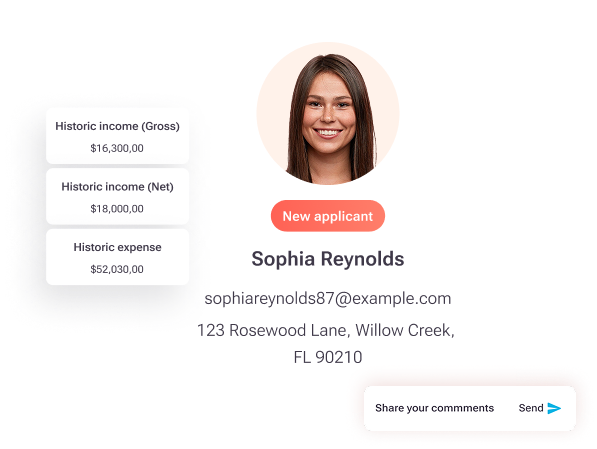
The QuickApprove accelerated approval workflow moves applications from submission to decision faster. It bundles real-time application tracking, automated communication support, customized approval letters, and a personalized welcome package inside one connected platform. Boards use a dedicated review and voting dashboard instead of navigating long email chains.
Once applications receive approval, Lease Tracking takes over. It connects resident onboarding, unit data, approvals, and lease documentation into one centralized, audit-ready workflow. Associations replace scattered spreadsheets with real-time lease status visibility across active, pending, expired, or missing leases.
Legal and Fair Housing Requirements for Screening Systems
Rental history verification intersects with federal consumer protection law and creates real liability for community associations. The Fair Credit Reporting Act (FCRA) governs the use of consumer report data, including tenant screening reports, and imposes specific obligations on anyone who uses that data to make housing decisions.
Key FCRA requirements include establishing a permissible purpose before accessing a consumer report, providing applicants with required disclosures, and following adverse action procedures when a screening report contributes to a denial. The CFPB’s compliance resources serve as an authoritative hub for federal consumer-finance rules. These resources centralize regulatory guidance, statutes, and supervisory documents that apply when rental history verification systems use consumer report data.
A common pitfall involves assuming that any tenant-screening or rental-history tool falls outside consumer-finance oversight. Compliance depends on the exact data source, purpose, and workflow, as the CFPB’s guidance explains.
Fair housing law adds a parallel requirement. Screening criteria must be applied consistently to all applicants. Inconsistent application of standards, even unintentionally, can create disparate impact liability under the Fair Housing Act.
TenantEvaluation is built specifically for community associations and management companies, with FCRA compliance built into every workflow from the start. As a direct reseller of TransUnion and Equifax data, TenantEvaluation accesses bureau data under strict rules with no gray-market or offshore sources. Automated adverse action workflows, strict permissible purpose controls, and built-in audit trails for every application help keep community associations protected from liability exposure.
Align your screening process with FCRA and fair housing rules. Walk through the compliance workflows in a demo.
Implementation Steps for Rental History Verification in Associations
Successful rental history verification in a community association requires a structured rollout, not just a software purchase. CAMs and boards can follow these steps.
- Choose a system built for community associations. Generic rental platforms lack board voting dashboards, governing document customization, and Florida-specific compliance workflows. Select a platform purpose-built for HOAs and condos.
- Customize screening criteria. Align credit score requirements, income thresholds, and required documents with your governing documents. TenantEvaluation configures each community’s specific criteria into the platform.
- Configure compliance workflows. Set up automated adverse action notifications and confirm that audit trails are active for every application.
- Train your team and board. Ensure CAMs and board members understand the dashboard, the QuickApprove workflow, and their roles in the approval process.
- Establish a dispute process. Applicants have the right to dispute inaccurate information in screening reports. Define a clear internal process for handling those disputes in line with FCRA requirements.
- Monitor and refine. Review screening outcomes periodically and adjust criteria as community needs evolve.
Applicants with no rental history can still move forward through alternative verification. Income documentation and personal references provide a workable path. For data accuracy concerns, choosing a direct credit bureau reseller rather than a third-party aggregator reduces the risk of stale or incorrect data.
TenantEvaluation’s 100% online platform, available via web and mobile with 24/7 AI chat support in 11 languages, also reduces applicant friction throughout the process.
TenantEvaluation manages the complex pieces of screening and lease tracking. Talk through your rollout plan in a demo.
Common Challenges and Pitfalls to Avoid
Several recurring issues affect community associations that implement rental history verification without adequate preparation.
- Data inaccuracies. Screening reports can contain errors from outdated or incorrectly matched records. Choosing a provider with direct bureau relationships and a strong dispute resolution process reduces this risk.
- Legal exposure from non-compliant workflows. Failing to deliver required adverse action notices or applying screening criteria inconsistently can result in FCRA lawsuits or fair housing complaints. Automated adverse action workflows remove many of the manual steps where errors occur.
- Applicant friction. Screening processes that lack transparency can lead to applicant complaints and pushback from real estate professionals. Transparent communication about criteria and status through automated notifications reduces friction without adding staff workload.
- Over-reliance on automated decisions. Automated screening supports board judgment and does not replace it. Boards retain decision-making authority, and platforms like TenantEvaluation are designed to inform that judgment rather than override it.
- One-size-fits-all criteria. Each community has unique governing documents and resident standards. Screening criteria should match those documents rather than come from a generic template.
Frequently Asked Questions
How do property managers verify rental history?
Property managers verify rental history by contacting previous landlords for payment records and references, checking eviction records through public court databases, verifying income and employment through direct employer contact, and using tenant screening platforms that aggregate credit reports, background checks, and rental history data. Modern systems automate these steps into a single digital workflow, reducing the process from days to hours while maintaining FCRA compliance and generating audit-ready documentation for every application.
What are red flags on rental history reports?
Red flags include prior evictions, patterns of late or missed rent payments, unpaid balances owed to previous landlords, property damage claims, documented lease violations, and frequent moves without clear explanation. Landlord references that cite noise complaints, unauthorized occupants, or pet policy violations also indicate behavioral patterns that may repeat in a new community. Income verification failures, where reported income cannot be confirmed through direct employer contact, represent an additional financial risk flag that credit scores alone may not surface.
Can a landlord or community association require rental history verification?
Community associations may require rental history verification as part of tenant screening when the requirement is applied consistently to all applicants and authorized by governing documents. This authority remains subject to state-law limits. For example, Texas associations cannot require tenant approval or submission of credit reports or rental applications, and Washington associations cannot require the screening report be furnished to the association.
Consistent application of screening criteria is essential for compliance with fair housing laws, which prohibit policies that produce a disparate impact on protected classes. Applicants who decline to provide consent for background checks or rental history verification can be denied on that basis when the policy is uniformly enforced and documented in the community’s governing documents or screening criteria.
How long does rental history verification take?
Traditional verification through manual landlord contact typically takes 2 to 5 business days. The overall traditional referencing process can extend to 5 to 7 days, and longer when landlords are unresponsive or documentation is incomplete.
Automated platforms shorten this timeline by instantly accessing eviction records, credit data, and income verification while enabling digital landlord reference collection. Automated systems cut processing time dramatically compared with manual workflows, often compressing a multi-day process into hours without reducing the depth of the screening review.
What makes a rental history verification system suitable for community associations specifically?
Community associations have requirements that generic rental screening platforms are not designed to address. These needs include board approval workflows, governing document compliance, age-restricted community verification, and audit trails that satisfy both FCRA requirements and association recordkeeping standards.
A system built for community associations integrates board voting dashboards, customizable screening criteria aligned to governing documents, automated adverse action workflows, and centralized lease tracking. Generic tools designed for single-family or multifamily rentals typically lack these capabilities. Florida-specific regulatory requirements add another layer of complexity that calls for a platform configured for that environment.
Conclusion: Turning Screening into a Risk Management Advantage
Rental history verification systems create measurable value across the three pillars of effective community management. Associations gain financial stability through eviction and payment history screening, community harmony through behavioral pattern identification, and operational efficiency through workflow automation that replaces manual processes with audit-ready digital records.
Manual, paper-based screening leaves community associations exposed to financial losses, disruptive residents, and compliance liability. The shift to a purpose-built verification system represents a risk management decision as much as an operational one. As identity fraud increases and regulatory scrutiny of tenant screening practices grows, the gap between compliant, automated platforms and manual processes will continue to widen.
TenantEvaluation’s FCRA-first design, built for community associations and management companies, keeps compliance central to every workflow. As a direct reseller of TransUnion and Equifax data, and with automated adverse action workflows, biometric identity verification through IDVerify, accelerated approvals through QuickApprove, and centralized lease lifecycle control through Lease Tracking, TenantEvaluation brings these capabilities together in one platform so associations can screen, onboard, and manage residents without adding headcount.
Ready to modernize your community’s screening and lease management? Request a customized TenantEvaluation demo and see how 5,000+ communities run their workflows online.
