Written by: Luis Teran, Co-founder, CEO, TenantEvaluation | Last updated: August 25, 2026
Key Takeaways
- Florida 55+ communities must maintain an 80 percent occupancy threshold under HOPA, with age-verification documents stored in audit-ready formats to preserve protected status.
- FCRA compliance requires a structured adverse-action workflow that includes pre-adverse notices, individualized assessments, and final adverse-action notices before any denial.
- Biometric identity verification through IDVerify+ strengthens fraud prevention by confirming physical presence and matching applicants to government-issued IDs before screening starts.
- QuickApprove streamlines board decision-making with real-time tracking, voting panels, and automated communication, replacing fragmented email chains with a single connected workflow.
- TenantEvaluation combines HOPA age verification, FCRA compliance, biometric checks, and board-ready tools in one platform. Learn more and standardize screening for your Florida community.
The Problem: Inconsistent 55+ Screening Creates Real Risk in Florida
Incomplete submissions, delayed document collection, manual review burdens, and identity-fraud risk create structural vulnerabilities for 55+ communities. When age-verification records sit in email threads and paper files, a single audit request or familial-status complaint can expose documentation gaps that threaten HOPA-protected status. Informal handling of FCRA adverse-action steps exposes the association to direct legal risk. Manual review of identity documents without biometric confirmation leaves communities open to impersonation and synthetic-identity fraud.
Florida’s high concentration of 55+ communities amplifies these risks for CAMs and boards. A community that loses its HOPA exemption immediately reverts to standard Fair Housing Act rules and can no longer restrict occupancy based on familial status. Rebuilding protected status requires re-establishing all three qualifying elements at the same time. The operational and legal cost of that failure far exceeds the investment in a consistent, standardized screening process. Understanding the specific regulatory requirements that create this exposure helps CAMs design a defensible workflow.
HOPA 80/20 Rule and Ongoing Re-Verification Duties
Under 24 C.F.R. § 100.305(a), at least 80 percent of occupied units in a qualifying 55+ community must house at least one person age 55 or older. The calculation uses occupied units only. One qualifying occupant per unit is enough for that unit to count toward the 80 percent threshold. Vacancies are generally excluded, except for temporarily vacant units that meet the primary-occupant return test under § 100.305(b).
Florida law provides a parallel exemption that also relies on an 80 percent occupancy threshold. Communities must publish policies that show intent to operate as housing for older persons and must verify ages through reliable surveys and affidavits. All three elements must remain in place at the same time. Losing any one element ends the exemption.
Per 24 C.F.R. § 100.307(c), communities must update initial occupancy information on a regular basis through surveys or similar methods. The rule does not set a fixed schedule such as every two years. Under § 100.307(a), records must be producible if a familial-status complaint is filed. TenantEvaluation’s 55+ Communities Verification standardizes application handling, reduces manual work, supports documentation consistency, and strengthens internal processes for Florida condos and HOAs that manage these requirements at scale.

Florida Age-Verification Documents and Re-Verification Steps
Reliable age-verification documents for HOPA 55+ communities can include:
- Driver’s license
- Birth certificate
- Passport
- Immigration card
- Military identification
- Comparable official government-issued documents
- A signed certification by a household member age 18 or older stating that at least one occupant is 55 or older
Re-verification steps that support ongoing HOPA compliance include:
- Conducting occupancy surveys or equivalent verification on a regular basis as described in 24 C.F.R. § 100.307(c)
- Retaining copies of all age-verification documents in a format that supports rapid production upon request
- Updating records when unit occupancy changes due to sale, lease renewal, or new household members
- Maintaining a summary of survey results that can be produced as needed
TenantEvaluation’s 55+ Communities Verification automates document collection during onboarding and organizes records into searchable, audit-ready digital files. This approach improves operational efficiency and reduces the administrative burden of manual recordkeeping across large community portfolios.
FCRA Adverse-Action Workflow for Florida Associations
FCRA compliance for any consumer report used in resident screening starts with clear disclosure and written authorization before ordering the report. If the board or CAM is considering a denial, the applicant must receive a pre-adverse notice with the full consumer report and the current CFPB Summary of Rights. The applicant then receives time to dispute any inaccuracies with the consumer reporting agency. When criminal history is involved, the association should perform an individualized assessment that considers the nature and gravity of the offense, the time elapsed, and the relationship of the offense to the housing opportunity. If the decision proceeds to denial, the association must issue a final adverse-action notice that identifies the consumer reporting agency, explains the right to a free copy of the report within 60 days, and provides dispute instructions.
TenantEvaluation keeps a clear separation between data provision and decision-making. The platform supplies data, and the association makes the decision. Built-in audit trails record every application step. As a direct reseller of TransUnion and Equifax data, not a third-party scraper, TenantEvaluation accesses consumer data under strict bureau rules and helps protect community associations from liability exposure.
Board Decision Workflow with QuickApprove
The board approval stage often creates delays and weak documentation. Applications sit in email threads, board members lack a consolidated view of pending items, and approval letters require separate manual preparation. QuickApprove provides an accelerated approval workflow for CAMs, boards, and property management teams inside one connected platform.

QuickApprove delivers real-time application tracking that gives CAMs visibility into each application’s status. This tracking flows into a board-ready approval process with a dedicated voting panel, so board members can review summarized applicant reports and cast votes inside the platform. Once a decision is made, automated communication tools send status updates, customized approval letters, and a personalized welcome package. The workflow keeps control, compliance, and visibility intact while supporting faster, clearer, and more consistent approvals during high-volume seasons and complex onboarding cycles.
Schedule a demo today to see QuickApprove’s board-ready dashboard in action.
Biometric Identity Verification with IDVerify+
Document-based screening alone no longer protects modern community associations. A 2025 Gartner survey of cybersecurity leaders found that 62% of organizations experienced a deepfake attack in the prior 12 months. About 65% of organizations already use identity verification somewhere in their stack, yet many apply it to only a fraction of users.

IDVerify+ moves Florida 55+ communities from document-only review to biometric-backed identity confirmation. The process combines government-issued ID validation, AI-powered liveness detection, facial landmark recognition, and biometric selfie-to-ID comparison. All checks run natively inside TenantEvaluation, so CAMs avoid external portals and workflow disruption. Verification results appear directly in the screening report, including ID authenticity confirmation, liveness status, and biometric match results.
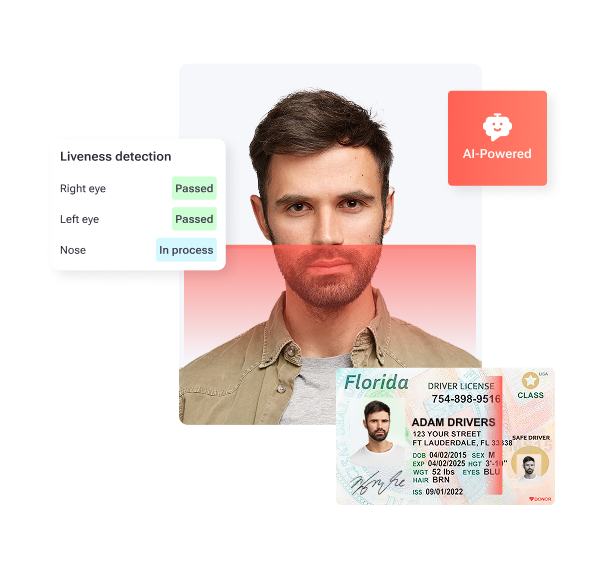
IDVerify+ can be enabled per condo or HOA and configured per property portfolio to match each community’s risk profile. It strengthens fraud prevention while supporting FCRA-aligned workflows by confirming identity before screening authorization.
Common Screening Failures and Practical Fixes
The most common operational failures in 55+ community screening follow predictable patterns. Each pattern has a practical mitigation approach:
- Incomplete submissions: Smart application form logic rejects incomplete applications before they reach the review queue, which removes back-and-forth that slows processing.
- Documentation delays: Automated document collection during onboarding gathers age-verification records, executed leases, and required IDs at the point of application instead of after the fact.
- Communication gaps: Real-time notifications keep applicants, realtors, CAMs, and board members informed of status changes without manual follow-up calls.
- Manual review burdens: Automated workflows reduce repetitive document handling. One Florida-based management company reported 50 hours of daily staff time recovered after switching to TenantEvaluation.
- Identity-fraud risk: IDVerify+ confirms physical presence and biometric identity match before any approval decision, which reduces exposure to stolen IDs, synthetic identities, and impersonation attempts.
Best Practices for Implementing a Defensible Workflow
Governance recommendations for Florida 55+ communities in 2026 focus on objective criteria, consistent documentation, and scalable recordkeeping. Communities should establish written screening criteria before the application cycle begins. They should apply those criteria consistently across all applicants and retain all decision documentation in a format that supports rapid production.
Manual approaches often rely on email attachments, paper files, and ad hoc spreadsheets. TenantEvaluation replaces these tools with automated digital collection at application, built-in adverse-action workflows with audit trails, a board-ready dashboard with a voting panel, and biometric identity confirmation. Together, these capabilities create searchable records, complete application files, timestamped decisions, and embedded identity results that support audit readiness.
TenantEvaluation’s platform enforces consistency by design. Customizable community profiles reflect each association’s governing documents and Florida-specific requirements, so CAMs and boards can follow the same defensible process for every application.
Frequently Asked Questions
What documents satisfy HOPA age verification in Florida 55+ communities?
Commonly accepted documents for age verification match those listed in the Florida Age-Verification Documents section above. These include government-issued IDs and, when needed, a signed certification from a household member age 18 or older stating that at least one occupant is 55 or older. Florida communities should confirm that their published age-verification policy lists accepted documents and that staff apply the policy consistently across all applicants. TenantEvaluation’s 55+ Communities Verification streamlines this collection and improves documentation consistency across the portfolio.
How often must 55+ communities re-verify occupant ages under federal rules?
Under 24 C.F.R. § 100.307(c), HOPA-qualified 55+ communities must provide for regular updates of initial occupancy information through surveys or similar methods. The regulation does not require a specific frequency such as every two years. Records must be stored so that a summary of occupancy surveys can be produced on reasonable notice. Re-verification should also occur when unit occupancy changes, such as a sale, lease renewal, or the addition of a new household member. Communities that allow re-verification cycles to lapse may be unable to demonstrate the 80 percent occupancy threshold if a familial-status complaint arises.
What FCRA steps are required before denying an application based on a background check?
Before issuing a final denial based on a consumer report, the association must provide a standalone disclosure and obtain written authorization before ordering the report. If a denial is under consideration, the applicant must receive the full consumer report and the current CFPB Summary of Rights, along with time to dispute inaccuracies. When criminal history appears, an individualized assessment should consider the nature and gravity of the offense, the time since the offense or completion of sentence, and how the offense relates to the housing opportunity. If the denial proceeds, a final adverse-action notice must identify the consumer reporting agency, explain the applicant’s right to a free copy of the report within 60 days, and provide dispute instructions. TenantEvaluation’s adverse-action workflow automates these steps and maintains a complete audit trail for every application.
Can adult children or caregivers under 55 live in a HOPA-qualified community?
HOPA does not require every occupant in a unit to be 55 or older. Only one occupant per unit must meet the age threshold for that unit to count toward the 80 percent calculation. Adult children age 18 or older may be allowed to reside with a qualifying 55+ occupant, subject to community rules. Communities may adopt stricter standards, including higher minimum ages, day caps, or prohibitions, based on the CC&Rs and written age policies.
Live-in caregivers under 55 may be permitted as a reasonable accommodation when a resident requires assistance, usually with HOA approval and documentation. Surviving spouses or partners under 55 do not automatically gain the right to remain after the qualifying resident leaves. That outcome depends on the community’s governing documents and applicable state law. All exceptions should follow written policies and be applied consistently across applicants to maintain defensible records.
Conclusion: One Connected Platform for 55+ Screening in Florida
A repeatable, audit-ready resident screening process for Florida 55+ communities requires more than a basic background check vendor. CAMs and boards need a platform that unites HOPA age-verification workflows, FCRA-compliant adverse-action steps, biometric identity confirmation, and board-ready approval tools in a single connected system with documentation that withstands regulatory review.
TenantEvaluation delivers that complete workflow. Its 55+ Communities Verification improves documentation consistency and centralizes age records. IDVerify+ upgrades communities from document-only review to biometric-backed identity confirmation. QuickApprove accelerates board decisions while preserving control, compliance, and visibility. FCRA compliance supports every step of the process.
With 5,000+ communities and approximately 100,000 applications processed annually, TenantEvaluation gives Florida CAMs and boards a specialized platform that replaces fragmented manual processes with consistent, documented outcomes. Schedule a demo today and see how TenantEvaluation standardizes the complete 55+ screening workflow for your Florida community.
