Written by: Luis Teran, Co-founder, CEO, TenantEvaluation | Last updated: July 17, 2026
Key Takeaways
- Florida HOAs face significant FCRA liability when eviction-history screening lacks documented, board-approved criteria applied uniformly to every applicant.
- A compliant seven-step workflow uses written consent, verified court records from an FCRA-compliant agency, individualized assessment, and properly formatted adverse-action notices.
- Eviction judgments remain permanent public records in Florida, but FCRA § 605 limits consumer reports to seven years, so boards must define lookback windows in writing.
- Disqualifying criteria must be set in governing documents. Blanket policies that ignore the distinction between filings and judgments create fair-housing exposure under HUD guidance.
- TenantEvaluation embeds the entire FCRA-compliant workflow into one connected platform purpose-built for Florida HOAs. Request a walkthrough of the full screening workflow.
7-Step FCRA-Compliant Eviction History Screening Workflow for Florida HOAs
| Step | Action | Governing Reference | Key Requirement |
|---|---|---|---|
| 1. Policy Adoption | Board votes to adopt written eviction-history criteria tied to governing documents | Chapter 720, Fla. Stat. | Criteria must be in CC&Rs, bylaws, or community regulations before screening begins |
| 2. Application Intake | Collect complete rental application including employment, rental history, and references | FCRA § 604 | Application establishes permissible purpose for pulling consumer reports |
| 3. Written Consent | Obtain standalone written authorization from each adult applicant naming the consumer reporting agency | 15 U.S.C. § 1681b | Keep consent separate from the rental application and retain signed forms for at least three years |
| 4. Verified Record Pull | Order eviction-history report through an FCRA-compliant consumer reporting agency with direct bureau data | FCRA § 605 | Confirm data source and verify accuracy of case dates, outcomes, and identity match |
| 5. Individualized Assessment | Evaluate findings against written criteria: filing vs judgment, recency, severity, and evidence of rehabilitation | HUD 2016 Guidance | Apply identical standards to every applicant and document specific rationale for each decision |
| 6. Adverse Action (if applicable) | Issue pre-adverse notice with report and FCRA Summary of Rights, allow a reasonable response period, then issue final adverse notice | 15 U.S.C. § 1681m | Notice must name the CRA, state the CRA did not make the decision, and inform applicant of 60-day free report right |
| 7. Record Retention | Store application, consent, report, assessment notes, and any adverse-action correspondence in a secure, searchable audit trail | FCRA & Fla. Stat. § 720.303 | Maintain uniform documentation for every applicant, including approvals and denials |
One of the most common questions boards face after mapping this workflow involves the legal lookback period for eviction records and how it interacts with FCRA rules.
Florida HOA Eviction Lookback Rules and the FCRA Seven-Year Window
Florida law places no statutory time limit on eviction history. Eviction judgments are permanent public court records, so a Florida HOA may consider a ten-year-old eviction judgment when the criteria apply that standard consistently to every applicant.
The FCRA creates a separate constraint. Under FCRA § 605, civil suits, civil judgments, and records of arrest may appear on a consumer report for seven years from the date of entry or until the governing statute of limitations has expired, whichever is longer. Most major screening databases, including TransUnion ResidentHistory and AAOA, follow this seven-year standard as their reporting ceiling. Records older than seven years do not appear on a compliant consumer report, even though the underlying court record remains accessible.
The practical compliance standard relies on two connected requirements that create defensible decisions:
- Written criteria that define exactly how eviction records of different ages and types are weighted. This language establishes your baseline standards.
- An individualized assessment for each applicant that considers recency, severity, and evidence of rehabilitation, consistent with HUD guidance against blanket denial policies. This step ensures those standards are applied with context instead of as automatic disqualifiers.
The written criteria protect you from inconsistency claims. The individualized assessment protects you from fair housing exposure. Boards need both.
A Florida property manager who applies different lookback windows to different applicants, or who cannot produce written criteria, carries significant exposure even when the underlying screening decisions were reasonable.
Florida 2026 HOA Rule Changes and Their Impact on Screening
Florida HB 1203 under Chapter 720 went fully into force on July 1, 2024 and amends Chapter 720 to require newly elected or appointed HOA directors to complete a DBPR-approved educational course within 90 days and, for HOAs with 100 or more parcels, to post governing documents and other official records on a website or app by January 1, 2025, among many other changes. Neither provision alters tenant-screening authority, fee caps, or background-check procedures.
No 2025 or 2026 amendments to Chapter 720 modified tenant screening or background check requirements. Screening authority still derives entirely from the association’s governing documents, including CC&Rs, bylaws, and community regulations, under the Homeowners’ Association Act.
The practical implication for CAMs and board presidents is straightforward. The updates increase board accountability and transparency obligations, which makes documented, board-voted screening criteria more important, not less. An HOA’s authority to screen applicants must typically be found in the declaration of covenants to be enforceable, and any new screening requirement imposed on long-term residents faces a high retroactivity hurdle under Florida law.
Additionally, proposed legislation that would have restricted screening fees for applicants using reusable screening reports was not enacted. Florida law books contain no fee restrictions tied to portable reports as of the 2026 leasing season.
With the legislative landscape clarified, boards can focus on which specific eviction-history findings should trigger denial and how to document those decisions while staying compliant with Florida law and federal fair housing requirements.
Eviction Findings That Commonly Disqualify Applicants in Florida HOAs
Florida law permits associations to evaluate applicants using objective factors including past evictions, when the same standards are applied consistently to every applicant based on risk and property-related considerations. Statutes do not define a universal list of disqualifying criteria. Each association sets its own criteria through governing documents and a board-approved screening policy.
Because those criteria must be written and applied uniformly, boards need to understand a critical distinction that many screening databases obscure. The difference between an eviction filing and an eviction judgment affects how criteria should treat each record type.
The distinction between an eviction filing and an eviction judgment is critical. Eviction screening databases typically report the filing of an unlawful detainer action regardless of outcome, so dismissed cases, cases where the tenant prevailed, and settled cases often still appear as eviction records. A board-approved criteria matrix must address this distinction explicitly.
| Record Type | Typical Weight | Recommended Board Action | Governing Document Tie-In |
|---|---|---|---|
| Eviction judgment (within 7 years) | High | Deny unless individualized assessment shows rehabilitation | List explicitly as disqualifying criterion in CC&Rs or bylaws |
| Eviction filing, case dismissed | Low–Medium | Proceed with individualized review and document rationale | Policy should distinguish filings from judgments in writing |
| Multiple filings, no judgment | Medium | Conduct individualized assessment and consider pattern versus isolated incident | Written criteria should define threshold number of filings |
| Eviction judgment (beyond 7-year FCRA window) | Not reportable via consumer report | Exclude from decisions because it cannot appear on an FCRA-compliant report | Policy should note FCRA § 605 reporting ceiling |
When a denial or less-favorable terms result from eviction-history findings, the FCRA adverse-action process requires two notices. The pre-adverse notice delivers the report and the FCRA Summary of Rights before the final decision. The final adverse notice, delivered promptly after the decision, must include:
- A statement that adverse action was taken based on the consumer report
- The name, address, and telephone number of the consumer reporting agency
- A statement that the agency did not make the decision
- Notice of the applicant’s right to a free copy of the report within 60 days and the right to dispute inaccuracies
A Tampa landlord faced a discrimination lawsuit after applying different income standards to different applicants, and a Florida property manager who ran eviction checks only on some applicants paid a large settlement. Uniform application of written criteria remains the only defensible position.
The TenantEvaluation Advantage for Florida HOA Eviction Screening
TenantEvaluation is built specifically for community associations and management companies, with FCRA compliance as the foundation, not an afterthought. The platform delivers the complete seven-step eviction-history screening workflow inside a single connected system designed for Florida HOAs and CAMs.
The platform’s IDVerify biometric identity verification layer confirms applicant identity before screening authorization proceeds. This control reinforces permissible-purpose rules and audit defensibility at the point of consent. Government ID validation, AI-powered liveness detection, and biometric selfie-to-ID comparison run natively inside TenantEvaluation, so boards avoid external portals and workflow disruption.

SafeCheck+ delivers FCRA-compliant background reports, including eviction history, sourced through TenantEvaluation’s direct reseller relationships with TransUnion and Equifax. Data is accessed under strict bureau rules with no gray-market or offshore sources, which protects community associations from liability tied to inaccurate or impermissible data.
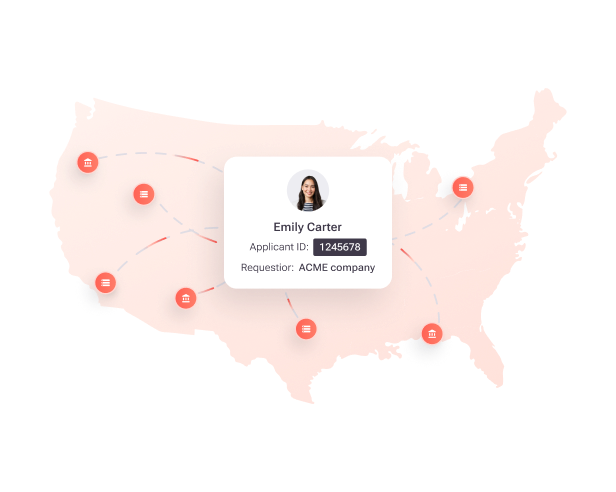
QuickApprove accelerates resident approvals while preserving board control. Board members use a dedicated review and voting dashboard with AI-generated applicant summaries, real-time application tracking, and automated communication support. This setup replaces email chains and spreadsheets with a board-ready approval process inside one connected platform without sacrificing control, compliance, or visibility.

Automated adverse-action workflows generate pre-adverse and final adverse notices that meet the exact requirements of 15 U.S.C. § 1681m, with every action timestamped in a built-in audit trail. Lease Tracking then connects approved applicants’ onboarding, unit data, and lease documentation into one centralized, real-time, audit-ready workflow. This approach removes spreadsheets, missing leases, and operational guesswork from application to occupancy.
TenantEvaluation has processed more than 100,000 applications annually across over 5,000 communities and has generated $150M for those communities through its revenue-sharing model. The platform also includes 55+ Communities Verification, a built-in capability that helps Florida condos and HOAs standardize age-restricted application handling, reduce manual work, and improve documentation consistency across communities.

Frequently Asked Questions
How far back do HOA background checks go in Florida?
Florida statutes impose no lookback limit on eviction history. Eviction judgments are permanent public court records that an association may consider regardless of age when criteria apply that standard consistently to every applicant. The FCRA limits consumer reports to seven years for civil judgments and suits, as explained in the main article, although Florida statutes place no limit on the underlying court records themselves. Boards should adopt written criteria that define how records of different ages are weighted and require an individualized assessment for each applicant that considers recency, severity, and evidence of rehabilitation.
What is Florida’s 2026 HOA rule change?
HB 1203, effective July 1, 2024, increased board education and transparency requirements but did not change tenant-screening authority or background-check procedures. Screening authority still comes from the association’s governing documents under Chapter 720, so board-voted, documented screening criteria remain operationally important.
What disqualifies you from passing a background check in FL?
Florida law does not specify a universal list of disqualifying factors for HOA background checks. Each association sets disqualifying criteria in its governing documents and board-approved screening policy. Common criteria include eviction judgments within the seven-year FCRA reporting window, patterns of multiple eviction filings, and specific criminal history categories defined in the association’s CC&Rs or bylaws. Blanket denial policies that do not distinguish between eviction filings and judgments, or that ignore recency and rehabilitation, create fair housing exposure under HUD guidance. Every denial based on a consumer report requires a two-step FCRA adverse-action notice process, and all criteria must be applied uniformly to every applicant.
Does an HOA need board approval to screen for eviction history?
Yes. Under Chapter 720 of the Florida Statutes, an HOA’s authority to require and review eviction history must appear explicitly in the association’s governing documents. Screening criteria that are not grounded in the CC&Rs, bylaws, or community regulations are not enforceable. Boards should vote to adopt written screening criteria and document that vote in meeting minutes before accepting applications. Any amendment to governing documents enacted after July 1, 2021 that adds new rental restrictions applies only to owners who acquire title after the amendment’s effective date or who individually consent in writing.
What happens if a Florida HOA skips the adverse-action notice?
Failing to provide a proper adverse-action notice after denying an applicant based on a consumer report violates the FCRA. Willful violations expose the association to statutory damages of $100 to $1,000 per violation, plus possible punitive damages and attorney fees, even without proof of actual harm to the applicant. The adverse-action notice must name the consumer reporting agency, state that the agency did not make the decision, and inform the applicant of the right to a free copy of the report within 60 days and the right to dispute inaccuracies. Both a pre-adverse notice and a final adverse notice are required when eviction-history findings influence a denial or less-favorable lease terms.
Conclusion: Turning Eviction Screening From Risk to Repeatable Process
Manual, undocumented eviction-history screening creates active liability for Florida HOAs. Associations that lack board-approved written criteria, verified court records, and a documented adverse-action process face FCRA statutory penalties, fair housing claims, and selective-enforcement challenges that a single inconsistency can trigger.
The seven-step workflow in this guide converts a high-risk manual process into a defensible, repeatable operation. Board-voted criteria grounded in governing documents, biometric identity confirmation before consent, verified records from direct bureau sources, individualized assessment documented for every applicant, and automated adverse-action notices together meet the exact requirements of 15 U.S.C. § 1681m.
TenantEvaluation is the only platform purpose-built for Florida HOAs that embeds this entire workflow, from application intake through record retention, inside one connected, FCRA-first system. With more than 100,000 applications processed annually, direct TransUnion and Equifax reseller status, automated adverse-action workflows, and a board-ready approval dashboard, TenantEvaluation turns eviction-history screening from an operational drag into a streamlined, revenue-generating, and fully defensible process.
Request a personalized walkthrough of the complete FCRA-compliant workflow for your Florida HOA.
