Written by: Luis Teran, Co-founder, CEO, TenantEvaluation | Last updated: July 20, 2026
Key Takeaways for Florida CAMs and Boards
- AppFolio’s document-upload workflow lacks biometric liveness detection, government-ID forensic validation, and FCRA-first audit trails, which creates fraud exposure and compliance gaps for Florida HOAs.
- Document-only verification cannot confirm physical presence or detect deepfakes, synthetic identities, or AI-generated documents, so CAMs and boards remain vulnerable to rental fraud.
- Biometric identity verification platforms add layered controls with government-ID validation, liveness detection, and facial matching that confirm identity in under 30 seconds and strengthen screening integrity.
- Switching to biometric verification reduces manual document review, automates PII redaction, and delivers board-ready dashboards with timestamped audit trails, which can cut processing time by up to 70%.
- Florida CAMs and boards can move to a biometric-first workflow with built-in 55+ documentation standardization by visiting TenantEvaluation.
The Problem: AppFolio’s Document-Only Workflow in a High-Fraud Market
AppFolio’s resident screening workflow asks applicants to upload government-issued ID documents and, in some configurations, submit a selfie for basic matching. That process authenticates a credential but cannot confirm the person presenting it is physically present or actually owns the ID. Document-only verification leaves openings for deepfake selfies, device emulators, and synthetic identities that combine a legitimate ID number with fabricated personal details.
The fraud environment makes this gap consequential. Industry data shows rental fraud has reached crisis levels: a 2024 NMHC Pulse Survey found that 93% of members reported experiencing rental fraud in the previous year, and Greystar reported that up to half of all rental applications were fraudulent in select Atlanta buildings. Traditional verification systems struggle with AI-generated fraudulent documents, so document-only workflows are especially exposed.
For CAMs, the operational impact is direct. Manual document review consumes staff hours, incomplete FCRA audit trails create liability exposure, and inconsistent handling of 55+ age-restricted documentation introduces compliance risk at the community level. AppFolio does not provide a native biometric liveness detection layer, a board-ready approval dashboard, or Florida-specific 55+ documentation standardization.
Where AppFolio Falls Short: 7-Step Identity Workflow Breakdown
To see exactly where these gaps appear in daily operations, the workflow below maps AppFolio’s current document-upload process and highlights the points where biometric validation would strengthen identity confirmation.
The table below maps the current AppFolio document-upload process and identifies where it stops short of biometric validation.
| Step | AppFolio Action | Verification Method | Gap vs. Biometric Standard |
|---|---|---|---|
| 1 | Applicant receives screening invitation via email | Email delivery only | No identity confirmation at invitation stage |
| 2 | Applicant uploads government-issued ID document | Document image upload | No forensic authenticity check on document security features |
| 3 | Applicant submits selfie photo | Static image capture | No liveness detection, so a deepfake or printed photo can pass |
| 4 | Platform performs basic selfie-to-ID photo comparison | Image-to-image match | No biometric facial landmark mapping and no real-time presence confirmation |
| 5 | Background and credit check runs on submitted data | Database query | Identity not biometrically confirmed before screening authorization |
| 6 | CAM manually reviews uploaded documents | Human review | No automated redaction of SSN or PII, and manual work increases breach risk |
| 7 | Board receives application package for approval decision | Email or portal notification | No dedicated board voting dashboard and no timestamped audit trail per reviewer |
Ready to see a biometric-first workflow in action? Schedule a demo today.
How Biometric Identity Verification Platforms Work
Biometric identity verification platforms embed KYC-grade checks directly into the HOA screening workflow instead of treating identity as a separate manual step. The category relies on a three-layer verification approach that addresses different fraud attack surfaces.
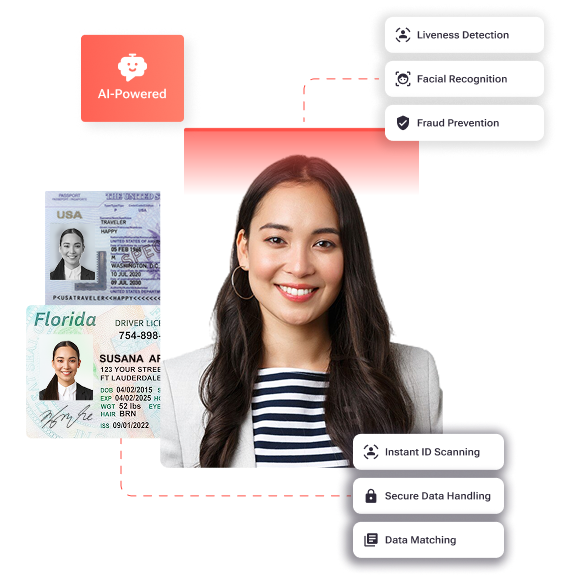
- Government-ID validation: AI checks security features, fonts, holograms, and microprint on the submitted document to detect altered, fabricated, or AI-generated IDs before any biometric session begins.
- Biometric liveness detection: Liveness detection shifts verification from static validation to real-time proof of presence and blocks spoofing attacks such as deepfakes, masks, and replayed media.
- Biometric facial matching: A one-to-one comparison between a live selfie and the photograph extracted from the submitted government-issued ID confirms the presenter matches the claimed identity.
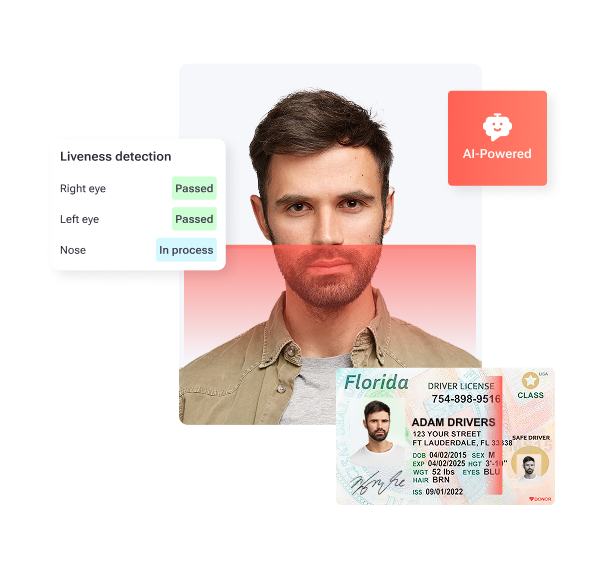
Document-Only vs Biometric Liveness: Side-by-Side Comparison
| Capability | AppFolio Document-Only | Biometric Liveness Detection (IDVerify+) |
|---|---|---|
| Government-ID forensic check | Image upload with no security-feature analysis | AI validates holograms, fonts, microprint, and document authenticity |
| Liveness detection | Not present | AI-powered liveness confirms physical presence in real time |
| Biometric facial matching | Basic selfie-to-photo comparison | Facial landmark biometric mapping with selfie-to-ID comparison |
| Synthetic identity detection | Not addressed | Layered KYC checks flag mismatched or fabricated identity elements |
| SSN / PII redaction | Manual CAM review required | Automatic redaction with PCI Level 1 compliance |
| FCRA audit trail | Incomplete with no per-step timestamping | Built-in audit trail with verification status embedded in the screening report |
| Board approval dashboard | Not available natively | Dedicated board voting panel with timestamped actions via QuickApprove |
Operational Impact for CAMs, Boards, and Applicants
The shift from document-only to biometric verification produces measurable efficiency gains for every role in the approval chain. CAMs, boards, and applicants each experience a simpler and more reliable process.
For CAMs, automated ID authenticity validation and liveness detection remove the manual document review step that consumes the most staff time. TenantEvaluation’s workflow automation frees up to 50 hours of staff time per day and reduces application processing cycles by up to 70%. Verification results, including ID authenticity confirmation, liveness status, biometric match result, and a redacted ID copy, appear directly inside the screening report with no external portal required.
For boards, QuickApprove delivers a board-ready approval process with a dedicated review and voting dashboard, real-time application tracking, and automated communication support. Email chains and spreadsheets give way to a connected workflow inside TenantEvaluation while boards keep control, compliance, and visibility.

For applicants, the guided biometric verification step stays inside the same application workflow. No external portals, no separate logins, and 24/7 AI chat support in 11 languages reduce abandonment and follow-up volume.
Risk Reduction, FCRA Alignment, and HOPA Support
FCRA compliance requires that permissible purpose be established before screening data is accessed, that adverse action workflows are documented, and that audit trails are maintained for every application decision. AppFolio’s document-upload workflow does not natively confirm identity before screening authorization runs, which creates a gap in permissible-purpose validation. IDVerify+ strengthens permissible-purpose validation by confirming biometric identity before screening authorization, which reinforces FCRA-aligned workflows and audit defensibility.
TenantEvaluation is a direct reseller of TransUnion and Equifax data, not a third-party scraper, and follows strict bureau rules with regular compliance audits. Automated adverse action workflows and built-in audit trails for every application create a clear separation between decision-making by the association and data provision by TenantEvaluation. That separation reduces liability exposure for boards and management companies.
For HOPA obligations, 24 CFR § 100.307 requires 55+ communities to verify compliance with the 80% occupancy rule through reliable surveys and affidavits and to provide for regular updates of occupancy information. Inconsistent manual handling of those documents across applications creates documentation gaps that surface during HUD audits or fair housing complaints. TenantEvaluation’s structured workflow standardizes how those records are collected and retained.
Florida 55+ Communities: Standardizing Age Verification
HOPA requires 55+ communities to maintain ongoing age verification procedures and regular updates of occupancy information to support compliance with the familial-status exemption. Communities also need appropriate records that can demonstrate compliance on request.
AppFolio provides no native capability for standardizing 55+ age-restricted documentation across a portfolio. CAMs managing multiple age-restricted communities must handle eligibility documentation through manual email chains, PDFs, and follow-ups. That approach produces inconsistent records and growing risk exposure that becomes visible during audits or disputes.
TenantEvaluation’s 55+ Communities Verification is a built-in capability that reduces manual work, standardizes application handling, supports documentation consistency, and improves operational efficiency for Florida condos and HOAs with age-restricted requirements. It is designed for Community Association Managers and built for Florida condos and HOAs, not a generic tool retrofitted for community association workflows. It supports documentation and consistency while not replacing legal guidance.
AppFolio vs TenantEvaluation IDVerify+: Feature-Level Comparison
| Feature | TenantEvaluation IDVerify+ | AppFolio |
|---|---|---|
| Biometric liveness detection | AI-powered and native to workflow | Not present |
| Government-ID forensic validation | Automated and checks security features | Document upload only |
| Biometric facial landmark matching | 68-point facial mapping with selfie-to-ID | Basic image comparison |
| FCRA-first audit trail | Built-in with per-step timestamping | Incomplete with no biometric verification record |
| Board voting dashboard | Dedicated panel via QuickApprove | Not available natively |
| 55+ documentation standardization | Built-in 55+ Communities Verification | Not available |
| SSN / PII auto-redaction | Automatic with PCI Level 1 | Manual CAM review |
| Florida HOA specialization | Built exclusively for Florida community associations | General property management platform |
See how IDVerify+ would work for your specific portfolio mix and schedule a personalized walkthrough. Book a demo.
Frequently Asked Questions
Does AppFolio ask for SSN in HOA applications?
AppFolio collects Social Security numbers as part of its background and credit check workflow. The platform does not provide automatic redaction of SSN or other personally identifiable information from uploaded documents. CAMs must manually review and handle that data, which increases the risk of a data breach and creates gaps in PCI-level data security. TenantEvaluation automatically redacts SSNs and sensitive PII from uploaded documents using end-to-end encryption and PCI Level 1 compliance, which removes that manual burden from CAMs and reduces liability exposure for the association.
How do Florida HOAs handle identity verification for 55+ communities?
Under 24 CFR § 100.307, 55+ communities must produce verification of the 80% occupancy rule from § 100.305 via reliable surveys and affidavits, and Florida communities must also conduct surveys at least every two years to maintain status under state law. In practice, many Florida HOAs and condos handle this through manual email follow-ups and PDF submissions, which produces inconsistent records. TenantEvaluation’s 55+ Communities Verification standardizes how those requirements are handled across applications, reduces manual work, and improves documentation consistency while supporting internal compliance-related processes without replacing legal guidance.
What is biometric liveness detection and why does it matter for HOA screening?
Biometric liveness detection is a real-time verification step that confirms a live human is physically present during identity verification, not a printed photograph, pre-recorded video, mask, or deepfake. Standard document-upload workflows, including AppFolio’s, capture a selfie image but do not run liveness analysis, so a fraudster can pass by submitting a high-quality photo or AI-generated image alongside a stolen or fabricated ID. Liveness detection closes that gap by analyzing texture, depth, micro-movements, and reflection patterns to confirm physical presence before the application proceeds to screening. For Florida HOA boards, this means approval decisions rely on verified identities, not just uploaded documents.
What FCRA obligations apply to Florida HOA resident screening?
FCRA requires Florida HOAs to establish permissible purpose before accessing screening data, provide adverse action notices when denying applications based on report findings, and maintain audit trails for each decision. As discussed in the Risk Reduction section, AppFolio’s workflow creates gaps in these requirements because it does not natively confirm identity before screening authorization. TenantEvaluation addresses this with built-in FCRA compliance, automated adverse action workflows, and comprehensive audit trails.
Can IDVerify+ be configured for different communities in a management portfolio?
IDVerify+ can be enabled per condo or HOA, configured per property portfolio, and adapted to each community’s risk profile. A management company overseeing a mix of standard residential communities and age-restricted 55+ properties can apply different verification configurations without a one-size-fits-all approach. All verification results, including ID authenticity confirmation, liveness status, biometric match result, and a redacted ID copy, appear directly inside the TenantEvaluation screening report. CAMs gain a consistent view across their entire portfolio without switching platforms or portals.
Conclusion: Moving Florida HOAs from Documents to Verified Identities
AppFolio’s document-upload-only identity verification workflow leaves Florida HOAs and condos exposed to identity fraud, incomplete FCRA audit trails, and inconsistent 55+ documentation handling. The platform captures document images and basic selfie photos but provides no biometric liveness detection, no government-ID forensic validation, no automatic PII redaction, and no board-ready approval dashboard, which creates measurable fraud exposure and administrative burden.
Biometric identity verification platforms address those gaps by embedding the three-layer KYC-grade verification approach, described earlier, directly into the screening workflow. TenantEvaluation’s IDVerify+ delivers that capability inside one connected platform built exclusively for Florida community associations, with FCRA compliance as the foundation, a board-ready approval process through QuickApprove, and built-in 55+ Communities Verification for age-restricted documentation standardization.
Florida CAMs and boards ready to move from document-based review to biometric-confirmed identity verification can see the full workflow in a live environment. Ready to upgrade your verification workflow? Book a demo to see IDVerify+ in action for your communities.
