Written by: Luis Teran, Co-founder, CEO, TenantEvaluation | Last updated: July 13, 2026
Key Takeaways
- Florida self-managed HOAs now face heavier workloads and stricter 2026 regulations, so fragmented software stacks become costly and risky.
- Effective rules management depends on integrated functions: violation tracking, document storage, board approval workflows, and FCRA-compliant resident screening.
- Standalone tools create compliance gaps because they do not connect lease management, screening, and violation enforcement in one audit-ready system.
- Hidden costs from multiple subscriptions, failed integrations, and manual work often outweigh the apparent savings of low-cost standalone platforms.
- TenantEvaluation consolidates screening, Lease Tracking, and board workflows into one FCRA-compliant platform, and you can schedule a demo to reduce total cost of ownership.
Why Florida HOAs and Community Associations Are Moving to Affordable Digital Tools
The self-management trend continues to accelerate across Florida. Boards managing 25–100 unit associations now resist full-service management fees when purpose-built software can automate their most time-consuming workflows. At the same time, Florida House Bill 1203 and its 2025–2026 implementing rules raise documentation and recordkeeping standards, so manual processes now create legal exposure instead of minor inconvenience.
A 2026 TownSq industry survey reports that 89% of community managers and 75% of boards now use some form of HOA software, with violation management among the most requested capabilities. The decision no longer centers on whether to adopt software. Boards now need to determine which platform delivers the lowest total cost of ownership without creating new compliance gaps.
Four Core Functions Behind HOA Rules Management
To answer that cost-of-ownership question, boards first need to understand what effective “rules management” actually requires. Effective HOA rules management rests on four interconnected functions, and seeing how they connect explains why fragmented tools create compliance gaps.
- Rules enforcement: Translating governing documents into repeatable, documented workflows that apply consistently to every homeowner.
- Violation tracking: Logging incidents with timestamped photos, generating notices, tracking cure deadlines, and maintaining an immutable audit trail.
- Document storage: Centralizing governing documents, meeting minutes, financial reports, and resident records in a searchable, access-controlled repository.
- Board approval workflows: Routing applications, architectural requests, and fine decisions through a structured review and voting process with full audit visibility.
These four functions do not operate in isolation. A violation logged without any link to the resident’s screening record or lease status leaves the board with an incomplete audit trail and higher legal risk. Integrated platforms reduce that risk because they connect violations, leases, and applications inside one system.

Manual violation logging consumes time. A manager opens a spreadsheet, adds a row, and then searches for the right photo. Dedicated software shortens this process with a mobile app that captures and links the photo directly to the record. Manual notice generation also takes time, while dedicated software produces notices faster by auto-populating details from the violation record.
How Rules, Screening, and Leases Work Together in One System
Speed alone does not solve the deeper problem. Most standalone violation trackers treat rules enforcement as an isolated function. In reality, enforcement connects directly to who lives in the community, whether each lease is current, and whether the association’s onboarding process created a defensible paper trail.
An expired or missing lease, an unverified occupant identity, or a screening process that bypassed FCRA requirements can each create liability that no violation tracker can fix after the fact. TenantEvaluation addresses this risk by connecting resident onboarding, screening, Lease Tracking, and board approval workflows inside one platform, with FCRA compliance as the foundation rather than an add-on.
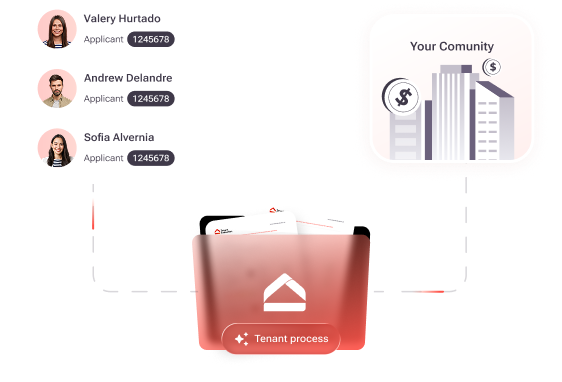
2026 Market Landscape: Self-Managed Boards and Pressure on Management Fees
Purpose-built community-association software now represents the largest category by spend and serves as the primary anchor for most Florida management companies. Onboarding times vary by product tier. Tools like PayHOA and Buildium often onboard in 1–2 weeks, while management-company-tier products like Vantaca and CINC can require 8–12 weeks. For self-managed boards with volunteer treasurers, a long implementation timeline becomes a real cost.
Meanwhile, condominium associations with 25 or more units must now operate a password-protected website or secure member portal that provides access to official records, effective January 1, 2026, under amended Florida Statute 718.111(12)(g). This requirement alone removes spreadsheet-only management as a viable long-term option.
Schedule a demo today to see how TenantEvaluation centralizes the workflows your board uses every week.
Daily Operations: How Fragmented Tools Slow Boards and Managers
A typical week for a self-managed Florida CAM or board treasurer includes three recurring pain points that fragmented tools fail to resolve.
- Violation notice review: Board members receive PDFs by email, add comments in separate threads, and lose version control before sending the final notice.
- Missing lease copies: Managers search across email inboxes, shared drives, and personal folders to confirm whether a unit’s lease is active, expired, or missing.
- Application fee reconciliation: Treasurers manually match incoming payments to applicant records and often discover discrepancies weeks later.
TenantEvaluation’s Lease Tracking solves all three pain points. Boards review applications and violations in one system with full version control. Managers see current lease status without digging through email. Treasurers reconcile fees automatically because screening, payments, and lease data live in the same platform.
Compliance, Risk, and Governance Requirements for Florida HOAs
Florida’s regulatory environment for HOAs tightened substantially between 2024 and 2026. Key requirements now in force include the following items.
- Fourteen days’ written notice of the right to a hearing before any fine or suspension is imposed.
- Violation hearings must be held within 90 days after issuance of the notice before an independent three-member committee.
- If a violation is cured before the scheduled hearing, the association may not impose a fine.
- Fines are capped at $100 per violation with a $1,000 aggregate cap, and fines under $1,000 cannot become liens.
- Within seven days after a fines hearing, the committee must issue written findings, unless the governing documents specify a different period.
- Florida HOAs with 100 or more parcels must, by January 1, 2025, post the documents specified in Fla. Stat. §720.303(4)(b) on a website or owner portal.
- CS/HB 657, effective July 1, 2026, adds further provisions for community associations that boards should review with legal counsel.
FCRA requirements add another compliance layer for any association that runs background checks during the application process. TenantEvaluation acts as a legitimate reseller of TransUnion and Equifax data and uses strict permissible purpose controls, automated adverse action workflows, and built-in audit trails for every application. Generic violation trackers do not provide these protections.

Common Challenges with Fragmented HOA Software Stacks
Self-managed HOAs commonly log violations in spreadsheets and handwritten notes, store unorganized photos on board members’ phones, and draft notices manually in Word using outdated templates. A Condo Control 2026 State of Resident Experience Report found that 43% of HOA residents view enforcement as unfair, compared to 38% who view it as fair. Inconsistent, undocumented workflows directly create that perception gap.
Hidden costs in fragmented stacks accumulate quickly. A board that uses separate tools for violation tracking, document storage, accounting, screening, and lease management pays subscription fees for each tool. The board also absorbs integration failures between them and carries compliance risk when those tools do not communicate.
Emerging Best Practices for Digital Records and Age-Restricted Communities
Best practice for violation documentation requires boards to record every violation immediately with dated photos and a written description of the violation type and location. Automated enforcement workflows centralize inspections, notices, appeals, and follow-ups in one system. GPS-enabled mobile inspections with timestamped photos create objective, verifiable records.
For age-restricted communities, the best practice is to standardize age verification across all applications instead of handling it ad hoc through email and manual review. TenantEvaluation’s 55+ Communities Verification automates this standardization, reduces manual work, improves documentation consistency, and strengthens internal processes for Florida condos and HOAs. It supports Community Association Managers while leaving legal guidance in the hands of counsel.

How to Evaluate True Cost of Ownership for 25–100 Unit Associations
A complete cost-of-ownership analysis for a 25–100 unit Florida association should include the following criteria.
- Base subscription cost: Monthly or annual platform fee, including whether pricing is flat-rate or per-unit. For a 50-unit association, PayHOA charges $65/month ($59 billed annually) for 26–50 units. DoorLoop uses contact-for-quote per-unit pricing for associations, while its published rental Starter plan (~$59–69 billed annually) is limited to 10–20 units.
- Per-transaction fees: Payment processing charges that grow with volume. PayHOA charges $2.45 per incoming ACH payment and 3.5% plus $0.50 per card payment.
- Screening and onboarding costs: Whether background checks, ID verification, and application processing require a separate vendor contract.
- Lease management costs: Whether lease tracking requires a separate tool or comes built into the platform.
- FCRA compliance infrastructure: Whether the platform provides adverse action workflows, audit trails, and direct bureau data access, or whether the association carries that liability alone.
- Integration and migration costs: Even when platforms claim to integrate, the reality often looks messy. Data migration frequently fails for multi-year historical financial data, custom workflows, and payment processing relationships, and each failure creates hidden transition costs through manual re-entry, dual-system operation, and lost historical reporting.
- Revenue offset: Whether the platform generates revenue through application fee sharing that reduces or eliminates net cost.
TenantEvaluation’s revenue-sharing model deducts its service fee from collected application fees and rebates the remainder to the association. Many communities therefore experience the platform as cost-neutral or revenue-generating. Across its network, TenantEvaluation has already generated $150M for communities.
2026 Pricing and Feature Comparison for Leading HOA Platforms
The table below highlights a key pattern. Platforms with the lowest visible subscription fees usually lack native screening and lease management functions that Florida associations rely on most. Boards then either pay separately for those capabilities or operate without them, which increases both workload and risk. All pricing figures are cited to their published sources as of mid-2026.
| Tool | Monthly Price for 50 Units | Violation Tracking | Integration with Screening / Leases |
|---|---|---|---|
| TenantEvaluation | Revenue-sharing model; cost-neutral or revenue-generating per application | Built-in board approval workflows, QuickApprove, audit-ready records | Native, with screening, Lease Tracking, and FCRA-compliant workflows in one platform |
| PayHOA | $65/month ($59 billed annually) for 26–50 units | Included, with automated violation reminders and timestamped history | No native screening or lease tracking integration |
| DoorLoop | Contact-for-quote per-unit pricing for associations; rental Starter (~$59–69 annually) limited to 10–20 units | Available on higher tiers | Rental-first platform that lacks HOA-specific screening and lease workflows |
| ManageCasa | $80/month (Growth Plan, billed annually) plus per-unit charges above 25 units | Included on Growth and Premium plans | No native FCRA-compliant screening or lease tracking |
| Condo Control | Pricing requires sales contact and is not publicly listed per unit | Included, with GPS-enabled mobile inspections | No native screening or FCRA-compliant lease integration |
Condo Control’s per-unit pricing is not publicly listed and therefore cannot be compared directly on a per-unit basis. TenantEvaluation’s pricing model also differs structurally from subscription tools. Its revenue-sharing approach means associations with active application volume may generate net positive cash flow instead of paying a monthly fee.
Florida Compliance Checklist for Rules, Screening, and Age-Restricted Handling
Florida associations managing rules enforcement and resident onboarding in 2026 should confirm the following items.
- Member portal requirement (Fla. Stat. §718.111(12)(g)) is met.
- Florida HOAs with 100 or more parcels meet the Fla. Stat. §720.303(4)(b) website or owner portal posting requirement.
- Every violation notice cites the specific rule or covenant section and describes the exact non-conforming element.
- Fourteen days’ written notice of hearing rights is documented and timestamped for every fine or suspension action.
- Violation hearings are scheduled within 90 days after issuance of the notice before an independent three-member committee.
- Cure-before-hearing outcomes are documented to confirm that no fine was imposed.
- Fine amounts do not exceed $100 per violation or $1,000 aggregate for continuing violations.
- Background checks run through an FCRA-compliant platform with adverse action workflows and audit trails.
- Age-restricted (55+) application documentation stays standardized and consistent across all applicants, not handled informally by email.
- Lease records remain centralized, searchable, and audit-ready instead of scattered across personal inboxes and shared drives.
- CS/HB 657 (effective July 1, 2026) compliance is reviewed with association counsel.
Where Pure Rule-Management Software Falls Short
Standalone violation trackers solve one narrow problem while leaving adjacent risks unaddressed. A platform that tracks violations but does not connect to resident screening cannot confirm whether an occupant was properly vetted. A platform that stores documents but does not track leases cannot tell a board whether a unit’s lease is active, expired, or missing. A platform with no FCRA infrastructure cannot protect an association when a denied applicant files a complaint.
HOA-built software differs from rental-first platforms because rental platforms handle basic dues and violations but lack HOA-specific workflows such as architectural review chains, eVoting, and special assessment billing. TenantEvaluation is built exclusively for community associations rather than adapted from a generic rental tool.
Schedule a demo today and see how TenantEvaluation closes the integration gaps that standalone tools leave open.
Choosing HOA Management Software for Florida Associations
The best HOA management software for a Florida self-managed association in 2026 covers the full operational surface. That surface includes violation tracking, document storage, board workflows, resident screening, lease management, and FCRA compliance, without separate vendor contracts for each function. PayHOA and DoorLoop serve associations that need basic dues collection and violation logging at low monthly cost. ManageCasa adds per-unit pricing that scales with community size. Condo Control provides strong mobile inspection tools. None of these platforms include native resident screening, FCRA-compliant adverse action workflows, or centralized lease tracking.
TenantEvaluation covers all of these functions in one platform, has processed 100,000+ applications annually across 5,000+ communities, and holds a 4.8/5 Google rating. For associations where screening and lease management are active operational needs, which describes most Florida HOAs, TenantEvaluation delivers lower total cost of ownership than any combination of standalone tools.
Is QuickBooks Good for an HOA?
QuickBooks handles general ledger accounting but does not support HOA-specific workflows. It lacks violation tracking, board approval workflows, resident portals, document storage, screening integration, and lease management. Associations that use QuickBooks for HOA accounting typically add two or three more tools to cover the missing functions, and each tool brings its own subscription fee, integration work, and data migration risk. Payment processing relationships often need re-establishing during HOA platform integration, and homeowner portal login credentials rarely migrate cleanly between systems.
For a 25–100 unit Florida association, purpose-built HOA software with integrated accounting usually offers a more cost-effective and coherent choice than QuickBooks combined with supplementary tools.
What Is the Least Expensive Property Management Software?
PayHOA’s entry-level plan starts at $49/month for associations with up to 25 units on annual billing, which makes it one of the lowest-cost options for very small communities. ManageCasa’s Base Plan starts at $45/month for up to 25 units. However, “least expensive” by subscription price alone differs from lowest total cost of ownership. Associations that pay $59–$109/month for a violation tracker and then pay separately for screening, lease management, and FCRA compliance infrastructure often spend more overall than an association using TenantEvaluation’s revenue-sharing model, which can be cost-neutral or revenue-generating.
For mid-size condominium associations, total annual cost for management software plus professional services varies widely. An integrated platform that removes separate screening and lease management contracts can reduce overall costs in a measurable way.
What Software Is Replacing QuickBooks for HOAs?
Florida HOA boards increasingly replace QuickBooks with association management platforms that handle accounting alongside the operational functions QuickBooks cannot address. PayHOA, ManageCasa, and DoorLoop each offer accounting modules designed for HOA workflows. For associations where resident onboarding, screening, and lease management are active needs, TenantEvaluation’s integrated platform replaces not only QuickBooks but also the fragmented stack of screening vendors, lease trackers, document storage tools, and board approval workflows. All of these functions operate in one system with a revenue-sharing model that offsets cost.
Frequently Asked Questions
What are the cheapest options for managing HOA rules and regulations in Florida?
For very small associations under 25 units, ManageCasa’s Base Plan at $45/month and PayHOA’s entry-level plan starting at $49/month for up to 25 units on annual billing rank among the lowest-cost subscription options. Both include violation tracking and document storage. Neither includes resident screening, FCRA-compliant workflows, or lease tracking, which Florida associations with active rental activity typically need. TenantEvaluation’s revenue-sharing model means associations with regular application volume may pay nothing net and even generate revenue, which often makes it the most cost-effective option when the full operational scope is considered.
What are real monthly costs for 25–100 unit associations?
For a 50-unit association, PayHOA charges $65/month on monthly billing or $59 when billed annually. DoorLoop uses contact-for-quote per-unit pricing for associations, and its published rental Starter plan (~$59–69 billed annually) covers only 10–20 units. ManageCasa’s Growth Plan charges $80/month (billed annually) plus per-unit charges above 25 units. These figures cover only the base platform. After adding per-transaction payment processing fees, such as PayHOA’s $2.45 per ACH and 3.5% plus $0.50 per card payment, plus any separate screening, lease management, or compliance tools, monthly costs for a 50-unit association can reach $200–$400 or more across a fragmented stack.
How does TenantEvaluation compare on total cost of ownership?
TenantEvaluation uses a pay-per-application, revenue-sharing model instead of a monthly subscription. Its service fee comes out of the application fee collected from applicants, and the association receives the remainder. Associations with regular onboarding activity can therefore generate net revenue instead of paying monthly platform costs. Beyond pricing, TenantEvaluation removes the need for separate screening vendors, lease management tools, and FCRA compliance infrastructure. This consolidation reduces total cost of ownership by eliminating multiple vendor contracts, integration maintenance, and separate audit trails.
Which platforms already include Lease Tracking and screening workflows?
Among the platforms commonly evaluated by Florida self-managed HOAs, TenantEvaluation is the only one that includes native Lease Tracking with real-time lease status visibility, automated lease document collection during onboarding, unit-level tracking, and audit-ready digital records. It also includes FCRA-compliant resident screening, biometric identity verification through IDVerify, and an accelerated board approval workflow through QuickApprove. PayHOA, ManageCasa, DoorLoop, and Condo Control do not include these functions natively and require separate vendor integrations to reach similar coverage.
Conclusion: Why TenantEvaluation Fits Florida Self-Managed HOAs
Florida self-managed HOA boards and CAMs managing 25–100 unit associations now face a clear choice in 2026. They can continue paying for fragmented tools that each solve one problem while creating integration gaps, compliance blind spots, and hidden costs. Or they can consolidate onto a platform built specifically for community associations that handles screening, Lease Tracking, board approval workflows, and FCRA compliance in one connected system.
With that scale of proven performance, and $150M generated for communities through its revenue-sharing model, TenantEvaluation delivers both operational maturity and financial alignment that standalone tools cannot match. It is built for Florida rather than adapted from a generic rental tool. Its FCRA-first design, direct credit bureau reseller relationships, built-in adverse action workflows, and biometric identity verification through IDVerify+ create a compliance infrastructure that pure violation trackers cannot replicate.
Boards that feel tired of chasing missing leases, reconciling application fees manually, and managing violation workflows across email chains and spreadsheets gain a simpler path with TenantEvaluation. The platform delivers lower total cost and higher compliance in one place.
Schedule a demo today and see how TenantEvaluation replaces your fragmented stack with one platform built for Florida community associations.
