Written by: Luis Teran, Co-founder, CEO, TenantEvaluation | Last updated: July 18, 2026
Key Takeaways for Florida Associations
- A tenant background check is a single data report. A tenant screening service is a full workflow platform that bundles checks, compliance, document handling, and approvals into one auditable process.
- Florida community associations that rely on standalone background checks face higher operational costs, FCRA compliance risk, identity fraud exposure, and fragmented lease tracking that creates occupancy blind spots.
- Full tenant screening services combine credit, criminal, eviction, income, and identity verification in automated workflows with built-in FCRA controls, permissible-purpose enforcement, and audit trails.
- TenantEvaluation offers Florida-specific capabilities such as 55+ Communities Verification, QuickApprove board dashboards, biometric IDVerify, and centralized lease tracking that generic screening tools do not provide.
- Florida community associations can streamline tenant screening and lease management on TenantEvaluation’s FCRA-first platform at TenantEvaluation.
The Problem: Why Standalone Background Checks Fall Short in Florida
Florida community associations that rely on standalone background checks face compounding operational and legal exposure. Manual screening processes require an average of 3–5 hours of staff time per turnover, while NARPM’s 2025 Operations Benchmark shows property managers spend 4.8 hours of administrative labor per vacancy on screening and leasing tasks alone.
The compliance risk is equally significant. FCRA lawsuits have doubled over the last decade. From January 2019 to September 2022, the CFPB received approximately 26,700 complaints related to tenant screening, and about 65% (roughly 17,200) concerned incorrect information on reports. Willful violations of FCRA adverse action notice requirements expose associations to statutory penalties up to $1,000 per instance.
Identity fraud compounds the problem further. The National Apartment Association estimates that rental fraud costs the U.S. property management industry $16 billion annually, and one in eight rental applications contains fraudulent alterations. Standalone document-based checks verify data, not people.
Fragmented lease tracking creates another layer of operational blind spots. When lease records live across folders, inboxes, and spreadsheets disconnected from the application workflow, boards lose real-time occupancy visibility and associations accumulate compliance risk tied to incomplete records.
The Solution Category: Full Tenant Screening Services Built for Workflow
These operational and compliance challenges reveal a core gap in traditional approaches. Standalone background checks were never designed to support the full workflow that Florida community associations require.
A full tenant screening service integrates multiple verification components, including credit, criminal, eviction, income, and identity, into one automated workflow with built-in FCRA compliance controls, permissible-purpose enforcement, and audit trails. Landlords implementing a comprehensive six-step screening process can reduce default rates to as low as 2.5%, achieving a 64% risk reduction.

TenantEvaluation is built specifically for community associations and management companies, with FCRA compliance as the foundation, not an afterthought. As a legitimate reseller of TransUnion and Equifax data accessed under strict bureau rules, TenantEvaluation provides direct credit bureau relationships, automated adverse action workflows, strict permissible-purpose controls, and built-in audit trails for every application. The platform serves more than 5,000 communities and processes approximately 100,000 applications per year across Florida.
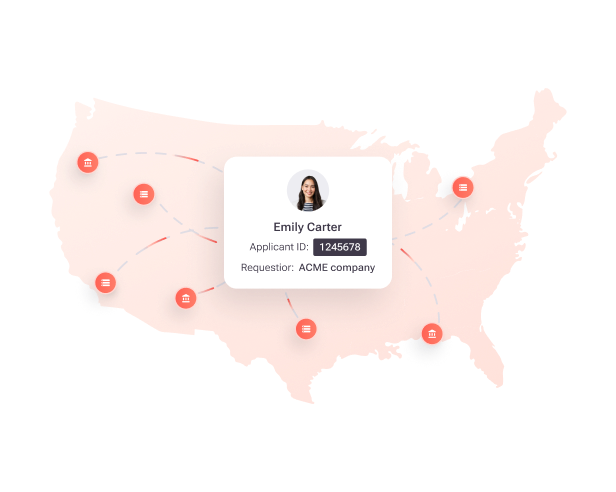
Key Differences Between Background Checks and Screening Services
| Attribute | Standalone Background Check | Full Tenant Screening Service (TenantEvaluation) |
|---|---|---|
| Scope | Single data report (criminal, credit, or eviction, rarely all three bundled) | Five-component bundle: credit, eviction database, criminal (370+ jurisdictions), income verification, and rental history |
| FCRA Handling | Manual consent and adverse action steps placed on the user | Automated written consent, pre-adverse notice, and final adverse action notice per FCRA §1681b and §1681m |
| Workflow Automation | Raw data delivery, with interpretation and follow-up handled manually | Staff time per application is reduced with full automation |
| Board Visibility | No embedded approval workflow or real-time status tracking | Dedicated board voting dashboard with real-time application status, AI-generated summaries, and timestamped audit trail |
| Florida-Specific Considerations | No built-in handling for 55+ documentation, HOA fee caps, or lease lifecycle tracking | Built-in 55+ Communities Verification, Florida statute alignment, and centralized lease tracking from application to occupancy |
Common Causes Behind Screening and Lease Management Breakdowns
The multi-hour manual burden per application mentioned earlier stems from several root causes that appear across many associations.
- Manual follow-ups: Leasing teams spend significant time per application on document collection, follow-up, and decision communication, which compounds across dozens of applications during peak seasons and pulls staff away from resident service.
- No biometric verification: Traditional document-based review cannot detect synthetic identities or impersonation. Modern identity verification adds biometric proof, including government ID capture, AI document authentication, selfie biometric matching, and liveness detection, returning results in under 30 seconds.
- Disconnected lease records: Missing or outdated lease copies, manual expiration tracking, and no direct connection between applications and active leases create occupancy blind spots and compliance exposure.
- Inconsistent criteria application: Manual screening can introduce human bias and inconsistent standards, while automation applies criteria the same way for every applicant.
- Fragmented board approval processes: Applications stuck in email chains and spreadsheets delay decisions, and many qualified applicants accept competing offers when they do not receive a timely response.
Key Benefits of Full Tenant Screening Services
- Risk reduction: Portfolios that move from manual to automated screening report fewer eviction filings because income and credit thresholds are applied consistently.
- Compliance advantages: Properties using automated screening report fewer Fair Housing complaints, with consistent documented criteria serving as a strong defense against discrimination claims.
- Efficiency improvements: Manual tenant screening can take more than a week to complete, while automated processing compresses this to 4–24 hours.
- Revenue enablement: TenantEvaluation’s revenue-sharing model turns application processing into a compliant, controlled income stream, with no upfront fees and application fees collected automatically through the platform.
Operational Impact on CAMs, Boards, and Applicants
Each stakeholder group feels the difference between a standalone check and a full screening service in specific ways.
- CAMs and property managers eliminate most manual follow-ups, reduce processing cycles by up to 70%, and free as much as 50 hours of staff time per day for higher-value work across large portfolios.
- Boards of directors gain a dedicated review and voting dashboard through QuickApprove, replacing email chains with real-time application visibility, AI-generated applicant summaries, and a timestamped voting workflow while maintaining control and compliance.
- Applicants and realtors use a 100% online process accessible via web and mobile, receive automated status notifications in 11 languages, and complete applications at higher rates than with manual processes.

Risk Reduction and Compliance Advantages for Florida Associations
FCRA obligations apply to any Florida community association that uses consumer reports in housing decisions. Florida landlords must provide a standalone written disclosure, obtain written authorization before running checks, and deliver a two-step adverse action sequence, including pre-adverse notice followed by a final adverse action notice, when denying or conditionally approving an application based on a consumer report.
Under the Florida Condominium Act (Chapter 718), condominium associations may charge a screening or transfer fee capped at $150 per applicant as of 2025. The Fair Housing Act requires that screening criteria be applied uniformly to every applicant regardless of protected class status.
TenantEvaluation automates the entire FCRA compliance chain. Permissible-purpose controls enforce consent before any report is pulled. Adverse action workflows generate required notices automatically. Built-in audit trails log every action with timestamps. As a direct reseller of TransUnion and Equifax data, rather than a third-party scraper, TenantEvaluation helps community associations avoid liability tied to gray-market data sources.
Florida-Specific Needs: Board Approvals, 55+ Rules, and Lease Visibility
Florida community associations operate under requirements that generic screening platforms rarely address. Formal board review processes in Florida HOA communities such as PGA National typically take 14–21 days from complete application submission, depending on meeting schedules. Orlando-area association documents frequently require written board or management approval before occupancy.
QuickApprove is TenantEvaluation’s accelerated approval workflow for CAMs, boards, and property management teams. It delivers real-time application tracking, automated communication support, customized approval letters, a personalized welcome package, and a board-ready approval process inside one connected platform designed for high-volume seasons and complex onboarding requirements.
For age-restricted communities, HOPA requires 55+ communities to maintain age verification procedures that meet HUD requirements and re-survey residents at least every two years using reliable documentation. TenantEvaluation’s 55+ Communities Verification standardizes how age-restricted requirements are handled across applications, reduces manual work, improves documentation consistency, and strengthens internal operational control for Florida condos and HOAs.

Lease Tracking inside TenantEvaluation connects resident onboarding, unit data, approvals, and lease documentation in one centralized, real-time workflow. It provides real-time lease status visibility, automated lease document collection during onboarding, unit-level tracking, searchable digital history, and audit-ready records that replace spreadsheets and scattered email chains from application to occupancy.
Step-by-Step Workflow of a Full Tenant Screening Service
- Application intake: Applicant receives a property code, creates a TenantEvaluation account, and completes a 100% online application with intelligent form logic that adjusts based on applicant type and community requirements.
- Document collection and payment: Required documents are uploaded digitally, application fees are collected automatically, and sensitive PII is auto-redacted with PCI Level 1 compliant, end-to-end encryption.
- Biometric identity verification: IDVerify validates the government-issued ID, runs AI-powered liveness detection, and performs biometric selfie-to-ID facial matching natively inside TenantEvaluation without external redirects.
- Comprehensive screening: Credit (TransUnion and Equifax direct), criminal background (nationwide and global), eviction history, income verification (IncomeEV), and rental history run simultaneously.
- Board review and decision: QuickApprove routes the application to the board dashboard with AI-generated summaries and a voting panel, and decisions are timestamped and audit-logged.
- Adverse action or approval: Automated FCRA-compliant adverse action notices are generated when needed, and approvals trigger customized approval letters and a personalized welcome package.
- Record retention and lease tracking: All records, including screening reports, board votes, lease documents, and occupancy status, are stored in a searchable, audit-ready digital history inside TenantEvaluation.
Decision Framework for Evaluating Screening Platforms
Florida CAMs and boards can use a clear framework when comparing screening platforms.
- Permissible-purpose controls: The platform should enforce written consent before any consumer report is pulled and document permissible purpose for every inquiry.
- Audit trails: All actions, including application submissions, board votes, and adverse action notices, should be timestamped and exportable for regulatory review.
- Biometric verification: The platform should include IDVerify-style biometric identity confirmation, including government ID validation, liveness detection, and facial biometric matching, without redirecting applicants to external portals.
- Turnaround time: Faster screening supports lower vacancy rates and reduces the risk of losing qualified applicants to competing properties.
- Florida-specific configurability: The platform should support HOA and condo governing document requirements, 55+ documentation workflows, board approval processes, and lease lifecycle tracking.
- Credit bureau relationships: The provider should be a direct reseller of TransUnion and Equifax data rather than relying on third-party aggregators with gray-market data exposure.
Before-and-After Comparison with TenantEvaluation
| Metric | Before TenantEvaluation | After TenantEvaluation |
|---|---|---|
| Staff time per application | Several hours (manual) | Reduced with automation |
| Screening-to-decision time | 5–10 business days (manual) | 5–10 minutes (TenantEvaluation platform) |
| Manual follow-ups | High volume across email, phone, and spreadsheets | Reduced through QuickApprove automated communication and real-time tracking |
| Eviction rate reduction | Baseline (manual, inconsistent criteria) | Reduction with automated screening |
| Annual cost savings (example) | High operational costs, manual headcount required | One Florida management company saved $240,000 annually after switching to TenantEvaluation |
Frequently Asked Questions
What is included in a tenant screening report versus a standalone background check?
A standalone background check typically returns one category of data, such as criminal records, credit history, or eviction filings, depending on what was ordered. A full tenant screening report bundles five components into one workflow: a credit report with scoring, a dedicated eviction database search, a criminal background check across multiple jurisdictions, income verification against payroll or bank data, and rental history with ownership-verified landlord references. Incomplete screening that covers only one or two components still produces elevated default rates because critical red flags, such as prior landlord debt or eviction history, appear only in specific report types. TenantEvaluation’s SafeCheck+ delivers a 360° applicant view that combines all components with biometric identity confirmation through IDVerify+.

What are the FCRA obligations for Florida community associations using tenant screening?
Any Florida community association using a consumer report, including credit, criminal, or eviction data, in a housing decision must comply with the Fair Credit Reporting Act. This requires obtaining standalone written disclosure and written authorization from the applicant before running any report. It also requires a two-step adverse action sequence if the association denies or conditionally approves an application. The association must send a pre-adverse action notice with a copy of the report and FCRA rights summary, followed by a final adverse action notice that identifies the reporting agency and the applicant’s right to dispute. Willful noncompliance exposes associations to statutory penalties up to $1,000 per instance. TenantEvaluation automates this entire sequence, with permissible-purpose controls enforced before any report is pulled and adverse action notices generated automatically when needed.
How do tenant screening services handle 55+ community documentation requirements in Florida?
The Housing for Older Persons Act requires 55+ communities to maintain age verification procedures that meet HUD requirements, re-survey residents at least every two years using reliable documentation, and keep systematic records of verification dates and document types. Generic screening platforms usually ignore these requirements. TenantEvaluation’s 55+ Communities Verification is a built-in capability that standardizes how age-restricted application requirements are handled across applications for Florida condos and HOAs. It reduces manual work, improves documentation consistency, and strengthens internal operational control while supporting documentation and consistency without replacing legal guidance.
How much does a full tenant screening service cost, and what is the ROI?
Tenant screening service packages typically cost $15 to $55 per applicant depending on report depth and data sources. Comprehensive tenant screening reports typically cost $15–$75 per applicant and can help prevent thousands of dollars in losses from bad placements. TenantEvaluation operates on a pay-per-application model with no upfront fees, and its revenue-sharing structure means application fees collected from applicants offset the service cost, often making the platform cost-neutral or revenue-generating for community associations. One Florida-based management company saved $240,000 annually after switching from manual processes to TenantEvaluation.
What red flags should a tenant screening report identify?
A comprehensive tenant screening report flags several high-risk signals that standalone checks often miss. Prior landlord debt appearing on credit reports indicates a significantly elevated default risk. Eviction history, available only through dedicated eviction databases, predicts a 4–8x higher default probability. Clusters of five or more hard credit inquiries within 60 days signal potential application fraud. Unpaid utility collections are among the strongest single-item predictors of skip behavior. Biometric identity verification through IDVerify+ adds another layer by confirming that the applicant is physically present and matched to their government-issued ID, which addresses synthetic identity fraud and impersonation attempts that document-based review cannot detect.
Conclusion: Why Florida Associations Choose Full Screening Services
A standalone tenant background check delivers one data report. A full tenant screening service delivers a complete operational platform that includes bundled verification components, automated FCRA compliance, biometric identity confirmation, board approval workflows, 55+ documentation handling, and centralized lease lifecycle visibility inside one auditable system.
For Florida CAMs, boards, and property management companies, this difference affects daily operations and long-term risk. Manual and piecemeal processes create administrative burden measured in hours per application, FCRA liability measured in thousands of dollars per violation, and identity fraud exposure tied to the multi-billion-dollar fraud problem discussed earlier. Integrated screening services reduce eviction rates, compress decision timelines from days to hours, and generate documented audit trails that support Fair Housing compliance and help resolve applicant disputes.
TenantEvaluation’s FCRA-first architecture, combined with direct TransUnion and Equifax data, IDVerify+ biometric verification, QuickApprove board-ready approval workflows, 55+ Communities Verification, and centralized Lease Tracking, creates an all-in-one platform designed for the workflows Florida associations actually run.
