Written by: Luis Teran, Co-founder, CEO, TenantEvaluation | Last updated: July 10, 2026
How Behavioral Biometrics Protect Florida HOAs
- Behavioral biometrics analyzes how applicants interact with rental forms in real time, including keystrokes, mouse movements, navigation patterns, and device signals, to detect fraud that document-only screening misses.
- Copy-paste behavior, keystroke dynamics, mouse dynamics, navigation sequences, and device consistency work together to flag stolen identities, scripted bots, and synthetic applications before they reach CAM or board review.
- Real-time risk scoring aggregates these behavioral signals into allow, step-up, or block outcomes with low latency so Florida HOAs can act quickly without adding manual triage steps.
- Behavioral biometrics complements document verification and facial biometrics by catching session-level anomalies that other layers cannot observe, creating a stronger, multi-layered fraud defense.
- TenantEvaluation layers behavioral signals onto its IDVerify+ platform to give Florida communities FCRA-compliant, real-time fraud protection. Explore behavioral biometrics inside TenantEvaluation.
Core Behavioral Signals Used in Rental Fraud Detection
Behavioral biometrics analyzes how an applicant interacts with a digital form, not just what they submit. Combining keystroke dynamics with mouse movement analysis produces a unique digital fingerprint of user behavior that is extremely difficult to replicate at scale, even with stolen credentials.
Five primary signals work together to create this fingerprint. Copy-paste behavior shows whether data is entered naturally or pasted from stolen identity packages. Typing rhythm and cadence expose bot-driven submissions through unnaturally consistent timing. Mouse or touch dynamics distinguish human imprecision from scripted perfection. Navigation patterns reveal whether an applicant reads and considers each section or advances mechanically through fields. Device and session consistency across the application lifecycle highlight synthetic identity operations that rotate claimed identities while using the same hardware.
Copy-Paste Patterns That Flag Stolen Identities
Copy-paste behavior on sensitive fields often separates legitimate applicants from fraudsters using stolen identity kits. Legitimate applicants type their Social Security number, income figures, and employer details from memory or reference documents with natural pauses and occasional corrections. Fraudsters using stolen identity packages paste pre-assembled data blocks directly into fields. Behavioral analysis detects fraud by identifying that real users interact with forms differently from bots, specifically through signals like keystroke timing, mouse movement patterns, and copy-paste usage, which are hard to fake at scale.
In a Florida condo application, a rapid paste of annual income, employer address, and lease commencement date into fields that legitimate applicants usually complete with deliberate keystrokes triggers an elevated copy-paste signal. When that signal aligns with other anomalies, the system flags the application for step-up review before it reaches the CAM’s queue.
Keystroke Analysis That Exposes Bot-Driven Applications
Keystroke dynamics reveal whether a human or a script is completing the form. Keystroke dynamics analyzes typing speed, rhythm, dwell time, flight time, digraphs and trigraphs, and overall typing pace to build user behavioral profiles for fraud detection. Bots and scripted submissions produce unnaturally consistent inter-key timing with no hesitation, no backspacing, and no variation in cadence across fields.
Income fields in HOA application workflows provide a reliable detection point. The customer who edits an income field three times before submitting reveals hesitation, revision, and deliberation patterns that legitimate applicants typically do not exhibit. Conversely, a field completed in under two seconds with no corrections and no cursor repositioning strongly suggests automated input. Keystroke dynamics alone enable ML models to distinguish individual users with over 95% accuracy by analyzing typing speed, rhythm, inter-key timing, error frequency, and correction patterns.
Mouse and Touch Dynamics During Lease Signing
Mouse and touch dynamics highlight the difference between natural human movement and scripted automation. Mouse movement analysis detects subtle differences between legitimate users and fraudsters by examining speed, acceleration, path length, jerkiness, angles and curves, click patterns, and dwell time on web forms and applications. Human cursor movement is inherently imprecise, with curves, overshoots, and self-corrections. Automated scripts create straight-line, pixel-perfect trajectories that no human replicates.
Mouse and trackpad movement patterns, including cursor velocity, acceleration, click precision, scrolling speed, and dwell time, provide stable, user-specific signals that complement keystroke dynamics in continuous risk scoring. On mobile applications, equivalent signals come from touch pressure, swipe velocity, and tap precision. A Florida HOA applicant completing a lease acknowledgment form on a smartphone who exhibits robotic, uniform tap patterns with no natural scroll variation presents a detectable anomaly. These interaction patterns become even more revealing when analyzed alongside the device itself and whether hardware and network attributes remain consistent throughout the application process.
Device Consistency Checks During Lease Signing
Device intelligence shows whether the same hardware and network keep appearing across different applications. Device intelligence captures the combination of browser, hardware, OS, and network attributes to create a distinct fingerprint, which is crucial for detecting automated attacks and reused devices. Synthetic identity fraud operations frequently submit multiple applications from the same device or device cluster, rotating claimed identities while the underlying hardware signature remains constant.
An application completed in 90 seconds with a VPN-masked IP from a state different than the claimed address of residence warrants additional scrutiny in AI fraud detection systems. For Florida communities, a claimed Miami address paired with a device fingerprint resolving to a VPN exit node in another state creates a high-confidence mismatch signal. CIAM platforms detect impossible travel by comparing a user’s last known login location and current location against elapsed time, with additional context from IP reputation, VPN usage, and device recognition strengthening the assessment.
Real-Time Risk Scoring for HOA Application Decisions
Real-time risk scoring converts dozens of behavioral signals into clear decisions for CAMs and boards. Modern AI risk decisioning platforms analyze 100+ behavioral signals per customer in real time, including velocity patterns, deviation from historical behavior, network analysis, device anomalies, and session-level behavioral indicators. These signals are aggregated into a single risk score that maps to one of three outcomes:
- Allow, when signals match expected patterns and the application proceeds normally
- Step-up, when the score exceeds the allow threshold and the CAM or board receives an alert and requests additional verification
- Block, when the score exceeds the block threshold and the application is held for manual review
The target false-positive rate for step-up triggers should remain below 2% in normal operations because higher rates create unacceptable user friction and security-team alert fatigue. Industry-leading AI risk decisioning platforms achieve decision latency of 30–80 milliseconds, so risk scores are available before a CAM opens the application file. For HOA boards using TenantEvaluation’s QuickApprove workflow, flagged applications surface directly in the board-ready review panel without additional manual triage steps.
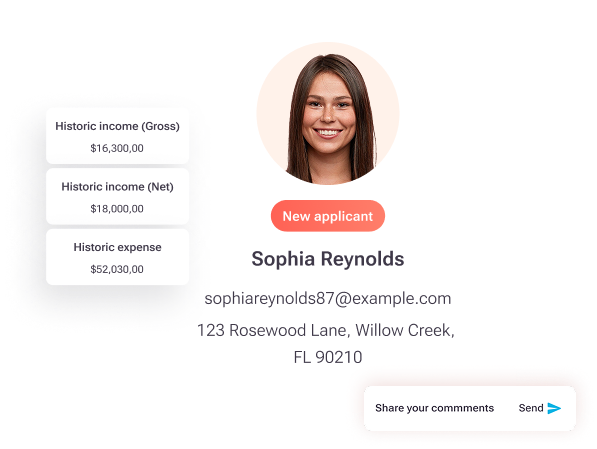
See real-time risk scoring in action for Florida HOAs with a live demo.
Fraud Patterns Behavioral Signals Catch in Rental Applications
The National Multifamily Housing Council found that rental application fraud increased approximately 40% between 2023 and 2024, and Snappt’s 2026 Multifamily Fraud Report puts the average fraud rate at 5.1% across all submissions. Peak application seasons, typically January through March and June through August in Florida, create volume conditions that favor mass synthetic application campaigns.
Behavioral signals catch two distinct fraud patterns that document forensics often miss:
- Mass synthetic submissions: High volumes of new accounts originating from the same device or IP range in a short window, and the same device fingerprint appearing across multiple recent account creations, are mass application fraud indicators.
- Bot-driven form completion: Fields filled faster than any human can type with no hesitation or correction behavior contrast with legitimate users who exhibit organic hesitation.
How Behavioral Biometrics Complements Document and Facial Checks
Behavioral biometrics works alongside document verification and facial biometrics to cover different fraud vectors. The table below compares the three methods across the fraud types they address, the point in the workflow where they operate, and whether they function in real time.
| Method | Primary Fraud Vector Addressed | Workflow Stage | Real-Time Signal |
|---|---|---|---|
| Document Verification | Forged or altered identity documents | Post-submission review | No, requires document upload and review |
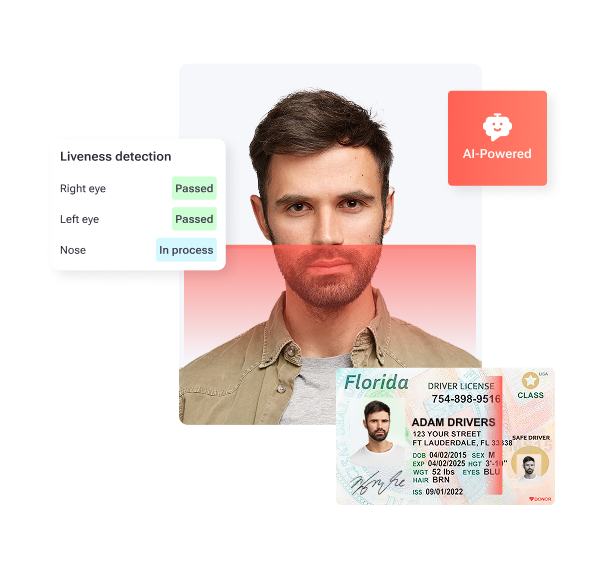
| Facial Biometrics (IDVerify+) | Impersonation and liveness spoofing | Identity confirmation step | Yes, AI liveness detection runs instantly |
| Behavioral Biometrics | Bot submissions, synthetic identities, and account takeover during form completion | Continuous, throughout the session | Yes, risk score updates in real time |
Biometric authentication systems function best when paired with multiple security protocols rather than used in isolation. Document verification catches altered paperwork. Facial biometrics confirms physical presence. Behavioral biometrics detects interaction anomalies that neither of the other two layers can observe.
How Behavioral Biometrics Integrates with TenantEvaluation
Behavioral biometrics acts as a complementary signal layer inside TenantEvaluation, not a replacement for FCRA-compliant background checks or biometric identity verification. TenantEvaluation is built specifically for community associations and management companies, with FCRA compliance as the foundation. Its IDVerify+ layer already combines government ID validation, AI-powered liveness detection, and biometric selfie-to-ID comparison inside the platform. Behavioral signals sit on that foundation and add session-level risk scoring that strengthens permissible-purpose validation and reinforces audit defensibility without redirecting applicants to external portals or adding manual review steps for CAMs.

TenantEvaluation is a legitimate reseller of TransUnion and Equifax data, accessed under strict bureau rules with regular compliance reviews and no gray-market data sources. Behavioral risk scores surface alongside credit, income, and background data in one unified screening report.
Implementation Guidance for Florida Community Associations
Florida CAMs and HOA boards configuring behavioral biometrics within TenantEvaluation should focus on two operational areas.
- Risk threshold configuration per portfolio: Organizations should initially apply conservative risk score thresholds during calibration to capture only high-confidence anomalies and limit false-positive volume before expanding behavioral biometrics weighting. A luxury high-rise in Miami may warrant a lower step-up threshold than a mid-market community in Tampa.
- Audit trail maintenance: Every flagged application generates a timestamped behavioral risk record inside TenantEvaluation’s audit-ready workflow, supporting FCRA adverse action documentation and board-level compliance review. This audit trail becomes especially valuable when combined with TenantEvaluation’s IDVerify+ layer, which strengthens permissible-purpose validation by ensuring identity confirmation occurs prior to screening authorization and documenting that the verified applicant triggered the behavioral signals before any credit or background data was accessed.
Frequently Asked Questions About Behavioral Biometrics for HOAs
What is behavioral biometrics in rental screening?
Behavioral biometrics in rental screening refers to the real-time analysis of how an applicant physically interacts with an online application form, including typing speed and rhythm, mouse or touch movement patterns, copy-paste behavior, navigation sequences, and device consistency. Unlike document verification, which examines what an applicant submits, behavioral biometrics examines how they submit it. These interaction patterns are difficult to replicate at scale, which makes them effective at detecting bots, synthetic identities, and impersonation attempts that bypass document-only screening. In community association workflows, behavioral signals are aggregated into a risk score that surfaces to CAMs and boards before manual review begins, enabling faster and more informed decisions without adding administrative burden.
How quickly does real-time risk scoring flag suspicious applications?
Risk scoring in behavioral biometrics systems operates continuously throughout the application session, not just at submission. Signals are analyzed as the applicant types, navigates, and interacts with each field. By the time an applicant clicks submit, a risk score has already been generated and mapped to an outcome of allow, step-up, or block. Leading AI risk decisioning platforms achieve decision latency measured in milliseconds, so the score is available on the CAM’s dashboard before the application file is opened. For Florida HOA boards using TenantEvaluation’s QuickApprove workflow, flagged applications appear in the board-ready review panel with risk context already attached, which removes the need for separate triage steps.
Who is responsible for reviewing behavioral alerts in an HOA?
In a TenantEvaluation workflow, behavioral risk alerts surface to the Community Association Manager as part of the unified screening report. The CAM is the first point of review and decides whether a step-up verification request is warranted or whether the application should be escalated to the board. Board members access flagged applications through TenantEvaluation’s dedicated board review and voting dashboard, where behavioral risk context appears alongside credit, income, and identity verification results. The decision to approve, deny, or request additional information remains with the board, and behavioral signals inform that decision without replacing it. This separation between data provision and decision-making aligns with TenantEvaluation’s FCRA-first design and maintains clear audit accountability.
How do behavioral signals differ across condo versus single-family HOA applications?
The core behavioral signals, including keystroke dynamics, mouse movement, copy-paste behavior, and device fingerprinting, apply to both condo and single-family HOA applications because they measure how an applicant interacts with a digital form, not the property type. Risk threshold configuration may differ by community profile. High-density condo communities in Miami or Fort Lauderdale that process large application volumes during peak seasons may benefit from tighter step-up thresholds to catch mass synthetic application campaigns earlier. Single-family HOA communities with lower application volumes may configure more conservative thresholds to minimize false positives. TenantEvaluation’s IDVerify+ and behavioral signal layers can be enabled per community and configured per property portfolio, supporting different risk profiles without a one-size-fits-all approach across a management company’s portfolio.
Conclusion: Why Florida Communities Need Behavioral Biometrics
Document verification and facial biometrics address specific fraud vectors but leave session-level behavior unmonitored. Behavioral biometrics closes that gap by analyzing how applicants interact with forms in real time and detecting the session-level anomalies that document verification misses. With the 40% surge in rental application fraud documented earlier and fraud detection rates improving to 88–92% with AI models, Florida community associations benefit from a layered approach that combines document verification, biometric identity confirmation, and behavioral signal analysis in one FCRA-compliant workflow.
TenantEvaluation is the only all-in-one resident screening and onboarding platform built specifically for Florida condos and HOAs that layers behavioral signals onto its existing IDVerify+ biometric verification with FCRA compliance as the foundation. With 50,000 communities and over one million applications processed, TenantEvaluation delivers fraud prevention depth that generic tenant screening tools cannot match.
