Written by: Luis Teran, Co-founder, CEO, TenantEvaluation | Last updated: July 2, 2026
Key Takeaways for Association Leaders
- FCRA compliance for community associations requires a clear permissible purpose, timely adverse action notices, and complete audit trails for every screening decision.
- Direct bureau reseller relationships with TransUnion and Equifax create cleaner data lineage and stronger regulatory defensibility than third-party aggregators.
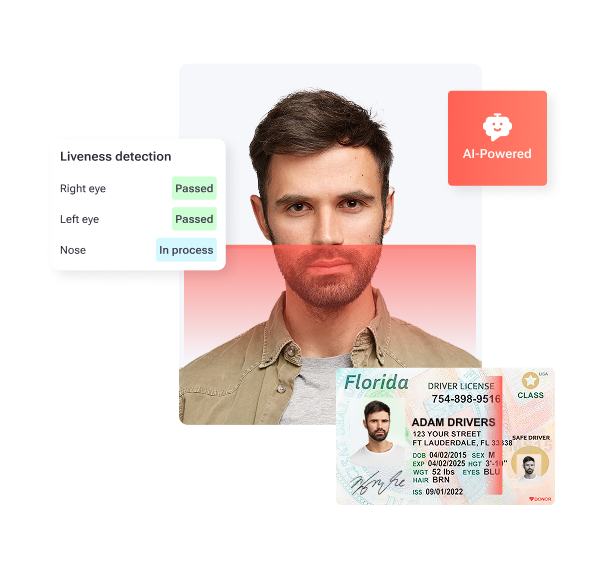
- Biometric liveness detection and facial matching block synthetic identity fraud that traditional document-upload screening cannot detect.
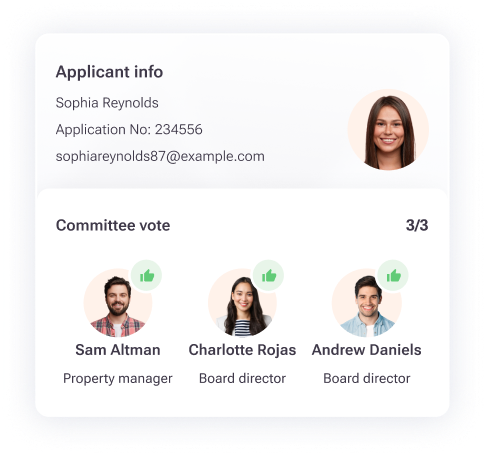
- Board-dedicated dashboards with summarized, redacted data and structured voting workflows create the documentation needed for consistent, defensible decisions.
- Lease Tracking connects screening, approvals, and occupancy records in one centralized system, which you can explore at TenantEvaluation.
Core Terminology and Association Governance Roles
Clear terminology helps boards understand where their responsibilities begin and end during screening.
- Permissible purpose: The legally recognized reason for accessing a consumer report, such as evaluating a rental or purchase application.
- Adverse action notice: A required written disclosure sent to applicants when a consumer report contributes to a denial or conditional approval.
- Consumer reporting agency (CRA): An entity that assembles consumer information for third-party use. Platforms with direct bureau reseller status operate as CRAs under FCRA.
- Audit trail: A timestamped, tamper-resistant record of every action taken on an application, from submission through decision.
- Data redaction: Automated removal of sensitive personally identifiable information (PII) from documents to limit exposure after screening is complete.
These definitions tie directly to association governance. Boards act as decision-makers, not data processors. The screening platform holds responsibility for data integrity and compliant delivery. The board holds responsibility for applying community criteria consistently and documenting its rationale. Platforms that blur this separation increase liability for both parties. Understanding these governance boundaries becomes especially critical as the threat landscape evolves.
2026 Industry Landscape for Florida Associations
Identity fraud is accelerating across Florida’s condominium and HOA communities. Synthetic identities, built from real and fabricated data, now appear more often in applications. Impersonation attempts using stolen government IDs also target communities that rely on document-only review. Traditional document-upload screening cannot reliably detect these threats because it validates paper, not physical presence.
Regulatory scrutiny of association screening practices has intensified at the same time. Florida’s dense concentration of age-restricted communities adds documentation complexity under the Housing for Older Persons Act (HOPA). These communities must maintain consistent age-verification records, which manual processes struggle to produce at scale. The industry is shifting from document-based review toward biometric verification as the baseline standard for identity confirmation before approval.
How Screening Connects to Daily Association Operations
A compliant screening workflow follows a defined sequence that reduces risk and manual effort. This sequence also creates a clear record of how each application moved from intake to decision.
- Application intake: Applicants submit personal, financial, and occupancy information through a structured digital form that enforces completeness before submission.
- Document collection: Executed leases, government-issued IDs, income documentation, and community-specific forms are collected and validated automatically.
- Identity verification: The platform confirms applicant identity against submitted documents before consumer reports are accessed, which establishes permissible purpose.
- Background and credit screening: Reports are pulled through a direct bureau reseller relationship, which supports data integrity and FCRA-aligned access controls.
- Board review: Summarized application data appears in a dedicated dashboard where board members review and vote.
- Adverse action: If an application is denied or conditioned, automated notices generate and deliver the required disclosures.
- Lease lifecycle tracking: Approved applications connect directly to lease records, occupancy status, and unit data for ongoing visibility.
Compliance, Risk, and Governance Considerations
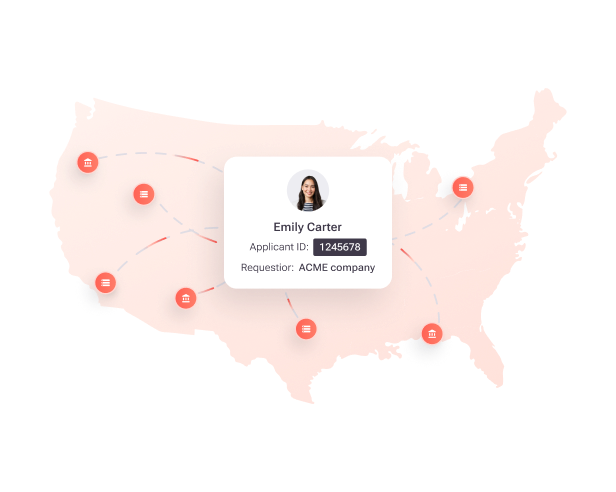
Permissible-purpose controls must be enforced at the platform level, not through manual oversight. This platform-level enforcement depends on comprehensive logging. Every consumer report access event should be logged with the identity of the requestor, the application it is tied to, and the timestamp of access. These logs form the audit trail, which must be complete enough to reconstruct any decision in the event of a regulatory inquiry or legal challenge.
Data redaction functions as a structural requirement, not a nice-to-have feature. Associations that retain unredacted SSNs, bank account numbers, or other PII in email chains or shared folders face breach exposure that automated redaction eliminates. Board members should receive summarized, redacted application data, not raw consumer reports. This approach maintains the separation between data provision and decision-making that FCRA expects.
Common Screening and Lease Management Challenges
- Manual bottlenecks: Applications routed through email chains and spreadsheets create delays, lost documents, and inconsistent follow-up.
- Incomplete applications: Without intelligent form logic, applicants submit partial packages that require multiple rounds of manual correction.
- Fragmented lease records: Lease copies stored across folders, inboxes, and spreadsheets produce occupancy blind spots and audit vulnerabilities.
- Non-compliant data handling: Manual storage of PII without encryption or redaction creates liability that associations often discover only after a breach or dispute.
- Identity fraud exposure: Document-only screening cannot detect synthetic identities or impersonation, which leaves communities vulnerable to fraudulent occupants.
- 55+ documentation gaps: Age-restricted communities relying on manual processes produce inconsistent records that create risk exposure in audits or disputes.
Best Practices and Emerging Screening Standards
The following best practices and emerging standards directly address these operational and compliance gaps.
- Direct bureau reseller relationships: Platforms that access TransUnion and Equifax data as legitimate resellers, not through third-party aggregators, provide cleaner data lineage and stronger FCRA defensibility.
- Automated adverse action notices: Manual adverse action processes introduce timing errors and omissions. Automation reduces these errors and keeps notices consistent.
- Biometric liveness checks: AI-powered liveness detection combined with facial biometric matching addresses the document-validation gap mentioned earlier. This approach confirms physical presence through biometric verification.
- Centralized digital lease visibility: Real-time lease status tracking connected to the onboarding workflow removes the operational blind spots created by disconnected records.
- Board-dedicated dashboards: Boards need structured access to summarized, redacted application data, not raw reports or email attachments, to make consistent, auditable decisions.
Evaluation Framework for Screening Platforms
Community associations evaluating screening platforms should assess candidates across six dimensions. The table below shows how generic landlord tools typically fall short on these criteria compared to purpose-built association platforms, which highlights the compliance and operational gaps that create liability exposure.
| Criterion | What to Look For | Generic Tools | TenantEvaluation |
|---|---|---|---|
| Compliance Readiness | Direct bureau reseller status, automated adverse action, audit trails | Often absent or manual | Built-in, FCRA-first design |
| Operational Efficiency | End-to-end automation from intake to decision | Partial, screening only | A–Z onboarding automation |
| Board Transparency | Dedicated board dashboard with voting and audit log | Not available | QuickApprove board panel |
| Identity Fraud Prevention | Biometric liveness detection and facial matching | Document upload only | IDVerify+ biometric layer |
| Florida-Specific Capabilities | 55+ verification, Florida regulatory configuration | Not available | 55+ Communities Verification |
| Lease Lifecycle Visibility | Centralized, real-time lease tracking from onboarding to occupancy | Not available | Lease Tracking module |
Auditability and scalability should also be evaluated. A platform serving a single 50-unit community and one serving a portfolio of 5,000 or more communities must both produce complete, searchable audit records without adding headcount. Revenue model matters as well. Pay-per-application structures with no upfront fees align platform incentives with association success more closely than fixed monthly subscriptions.
How TenantEvaluation Meets Association Requirements
TenantEvaluation focuses on community associations and management companies, with FCRA compliance as the foundation, not an add-on feature. Founded in 2007 and serving more than 5,000 communities with approximately 100,000 applications processed annually, TenantEvaluation closes the gaps that generic landlord tools leave open.
As a legitimate reseller of TransUnion and Equifax data, TenantEvaluation accesses bureau data under strict bureau rules with regular compliance reviews. The platform does not rely on gray-market or offshore sources. This reseller status helps protect community associations from the liability exposure that third-party data aggregation creates. SafeCheck+ provides the audit infrastructure through timestamped, tamper-resistant records of every application action that support regulatory defensibility.
QuickApprove accelerates resident approvals inside one connected platform. It replaces email chains and spreadsheets with real-time application tracking, automated communication support, customized approval letters, and a board-ready approval process. Boards access a dedicated panel with summarized applicant reports and a structured voting workflow, which reduces the back-and-forth that delays decisions during peak application seasons.

IDVerify+ adds biometric identity verification directly inside the TenantEvaluation workflow. Government ID validation, AI-powered liveness detection, and biometric selfie-to-ID comparison run natively, with no external portals and no workflow disruption. This approach moves communities from document-based review to biometric-confirmed identity verification. It also strengthens permissible-purpose validation and audit defensibility before screening authorization occurs.
55+ Communities Verification standardizes how age-restricted application requirements are handled across Florida condos and HOAs. This standardization reduces manual work, improves documentation consistency, and strengthens internal processes for CAMs and boards managing age-restricted communities.

Lease Tracking connects resident onboarding, unit data, approvals, and lease documentation in one centralized, real-time workflow. It delivers real-time lease status visibility, including active, pending, expired, or missing leases. It also supports automated lease document collection during onboarding, unit-level tracking, and audit-ready digital lease records that replace spreadsheets and scattered email chains from application to occupancy.
TenantEvaluation’s revenue-sharing model removes upfront costs. The platform deducts its service fee from collected application fees and rebates the remainder to the association. This structure turns application processing into a compliant, controlled income stream. A Florida-based management company that switched to TenantEvaluation freed up 50 hours of staff time per day and achieved $240,000 in annual savings.
Frequently Asked Questions
What FCRA requirements apply to community associations?
Community associations that access consumer reports, including credit, criminal background, and eviction history, as part of their resident screening process are subject to the Fair Credit Reporting Act. Key obligations include establishing a permissible purpose before pulling any report, providing pre-adverse and adverse action notices to applicants when a report contributes to a denial or conditional approval, maintaining applicant consent documentation, and retaining records sufficient to reconstruct any screening decision. Associations must also ensure that consumer report data is used only for the purpose for which it was obtained and is not shared with parties who lack permissible purpose. Platforms with direct credit bureau reseller status and built-in adverse action workflows reduce the manual burden of meeting these obligations and create a more defensible compliance posture.
Do boards need dedicated dashboards for screening decisions?
Boards benefit significantly from dedicated dashboards because these tools separate the data-review function from the decision-making function in a structured, auditable way. When board members receive raw consumer reports through email, there is no reliable record of who reviewed what, when, and on what basis a decision was made. A dedicated board dashboard, such as the one included in TenantEvaluation’s QuickApprove workflow, provides summarized, redacted application data, a structured voting panel, and a timestamped audit log of every board action. This setup creates the documentation trail that supports consistent decision-making, reduces discrimination liability, and gives associations a clear record to reference in the event of an applicant dispute or regulatory inquiry.
How does biometric verification improve FCRA workflows?
Biometric verification strengthens FCRA workflows by confirming that the person submitting an application is the same person whose identity documents and consumer reports are being reviewed. Traditional document-upload screening cannot detect synthetic identities or impersonation because it validates paper, not physical presence. When biometric liveness detection and facial matching are embedded directly into the screening workflow, as they are in TenantEvaluation’s IDVerify+, identity confirmation occurs before consumer reports are accessed. This sequencing reinforces permissible-purpose validation. The association can demonstrate that it confirmed applicant identity prior to authorizing a credit or background pull, which strengthens the audit defensibility of the entire screening record. It also reduces fraud exposure by catching impersonation attempts before they reach the board review stage.
What lease tracking capabilities support compliance readiness?
Lease tracking capabilities that support compliance readiness include centralized digital storage of all lease agreements connected to the onboarding record, real-time lease status visibility showing whether each unit’s lease is active, pending, expired, or missing, automated lease document collection during the application process, and a searchable audit-ready history of lease records and resident activity. When lease data is fragmented across spreadsheets, email inboxes, and shared folders, associations face occupancy blind spots and incomplete records that create risk in audits and resident disputes. A centralized lease tracking system built into the same platform as screening and approvals, as TenantEvaluation’s Lease Tracking module provides, keeps every lease connected, searchable, and audit-ready from application submission through occupancy without requiring additional administrative headcount.
Conclusion: Selecting a Compliant Screening Platform
The structural requirements for FCRA-compliant community association screening in 2026, including direct bureau reseller status, automated adverse action, biometric identity verification, board-dedicated dashboards, 55+ documentation handling, and centralized lease lifecycle visibility, are rarely met by generic landlord tools. These capabilities require a platform designed for the workflows, governance structures, and regulatory environment of Florida HOAs and condominiums.
Associations evaluating screening vendors should measure each candidate against the six-dimension framework above and determine whether the platform treats compliance as a foundation or as a late-stage feature. The operational and financial stakes, including liability exposure, staff hours, board decision quality, and revenue from application fees, make this a governance decision rather than a simple technology purchase.
