Written by: Luis Teran, Co-founder, CEO, TenantEvaluation | Last updated: July 23, 2026
Key Takeaways for Florida Associations Using Equifax Data
- Florida HOAs and condo boards can access Equifax tenant screening data through a legitimate reseller that manages compliance and workflow integration, without holding a direct Equifax contract.
- CS/HB 1293, effective October 1, 2026, creates new felony penalties for rental application fraud, so biometric identity verification and FCRA-compliant screening now play a central role for Florida associations.
- Direct Equifax contracts require volume commitments and compliance infrastructure that most Florida associations cannot justify, so reseller access is usually the practical path.
- TenantEvaluation embeds Equifax data inside an all-in-one platform that automates FCRA compliance, adverse action notices, board voting, and lease tracking with no upfront fees.
- See how TenantEvaluation replaces manual screening bottlenecks with compliant, board-ready Equifax workflows for Florida associations.
5-Step FCRA Compliance Checklist for Equifax Tenant Screening
Every Florida association pulling Equifax data must follow these five requirements before, during, and after each screening decision.
- Written Authorization: Obtain the applicant’s clear, conspicuous, written authorization on a standalone consent form, separate from the rental application, that names the consumer reporting agency. Each adult occupant, cosigner, and guarantor signs their own form.
- Permissible Purpose: Under 15 U.S.C. § 1681b, a landlord has permissible purpose only when evaluating a specific, active rental application. Associations cannot pull reports for former tenants, curiosity, or unrelated reasons.
- Adverse Action Notice: If any adverse action, such as denial, higher deposit, required cosigner, or less favorable terms, is based in whole or in part on a consumer report, the association must send a written adverse action notice that includes the agency’s name, address, and phone number, a statement that the agency did not make the decision, and notice of the right to a free copy within 60 days and the right to dispute inaccuracies (15 U.S.C. § 1681m).
- Record Retention: Florida landlords must maintain credit reports used in screening for at least two years and applicant notifications for at least one year. Signed applicant authorizations must be kept for at least three years from the application date as proof of permissible purpose.
- Audit Trail: Document every decision, approvals and denials, with objective reasons recorded in writing, because one inconsistency in how screening criteria are applied can support a plaintiff’s claim. Record the date, applicant ID, pass, conditional, or deny outcome, reason category, and supporting documents received.
TenantEvaluation is built specifically for community associations and management companies, with FCRA compliance as the foundation, not an afterthought. Because compliance is embedded at the platform level, every step above, from authorization collection through adverse action notices, runs inside one automated workflow that removes manual handoffs. See how TenantEvaluation handles each FCRA step automatically for Florida associations.
The Daily Pain of Incomplete Applications and Board Delays
Florida CAMs managing more than a handful of communities recognize the same pattern. An application arrives without the executed lease, the co-occupant’s signed authorization, or the income documentation. A follow-up email goes out, the realtor responds three days later, the board meeting is Thursday, and the application still is not complete by Wednesday night. The unit then sits vacant for another week.
According to Snappt’s 2024 Fraud Trends Report, one in eight rental applications contains some form of fraud, with 73% of that fraud remaining undetected until after the tenant has moved in, resulting in $7,500–$15,000 in eviction costs, lost rent, and property damage per incident. Manual workflows create delays and also create liability exposure at every handoff point.
Housing discrimination complaints often originate from the tenant screening process, and first-time Fair Housing violations can carry civil penalties of up to $26,262 (inflation-adjusted), assessed at the ALJ’s discretion and separate from any compensatory damages. Fragmented, manual screening is a documented source of legal and financial risk for Florida associations, not just a minor operational nuisance.
Equifax Tenant Screening Pricing for Florida in 2026
Direct Equifax access requires a commercial agreement, volume commitments, and ongoing compliance infrastructure. Equifax does not publish public pricing for its tenant screening products, which indicates that access and pricing are available only via quote or direct inquiry.
The table below compares the three primary access paths available to Florida associations in 2026. Items that do not fit a shared metric appear in the explanation that follows the table.
| Access Path | Estimated Per-Report Cost | Upfront / Monthly Fees |
|---|---|---|
| Equifax Direct Contract | Quote-based (pricing not publicly listed) | Volume commitments required, with additional compliance infrastructure costs |
| Generic Reseller (non-Florida-specific) | Varies, typically $15–$40 per report depending on bundle | Monthly subscription or per-seat fees are common |
| TenantEvaluation (Florida Reseller) | Covered within the application fee, with a revenue-share model that returns the remainder to the association | No upfront fees, pay-per-application model |
Workflow integration varies significantly across these access paths. Direct Equifax contracts provide raw data with no HOA or condo-specific workflow, so associations must build their own board voting, adverse action automation, and document collection processes. Generic resellers offer standard rental workflows but usually lack Florida-specific features such as board voting dashboards, 55+ verification, or lease tracking integration. TenantEvaluation embeds Equifax data inside QuickApprove, IDVerify, 55+ Communities Verification, and Lease Tracking, which are purpose-built workflows for Florida community associations.
The revenue-share model is a structural distinction that does not reduce cleanly to a per-report number. TenantEvaluation deducts its service fee from the collected application fee and rebates the remainder to the association or management company, which turns the screening process into a compliant income stream rather than a cost center.
FCRA Adverse Action Letter Requirements in Florida
Florida-specific context adds two important layers for HOA and condo boards.
- Florida does not impose additional state-level requirements beyond federal FCRA standards for adverse action notice content or timing, and the FCRA’s “reasonable time” standard is generally interpreted as same-day to seven days after the decision.
- Under FCRA § 605 (15 U.S.C. § 1681c), most negative credit items are limited to seven years on consumer reports, while bankruptcy information is limited to ten years. However, Florida law imposes no lookback time limit on eviction history because eviction judgments are permanent public court records, so a Florida association may consider a ten-year-old eviction judgment if it applies the criteria consistently to all applicants.
A willful FCRA violation exposes landlords to statutory damages of $100 to $1,000 per violation, plus possible punitive damages and attorney fees, with no proof of actual harm required. TenantEvaluation’s automated adverse action workflows remove the manual steps where these violations most commonly occur. Request a walkthrough of TenantEvaluation’s automated adverse action workflow for Florida HOAs and condos.
Equifax Smart Screen Plus Inside HOA Workflows
Equifax Smart Screen™ Plus, Tenant Check Government delivers an instant result by querying a proprietary incarceration data network along with a sex offender registry network. The product accepts SSN input to streamline searches and serves as a first-pass criminal background screening step within broader tenant screening processes.
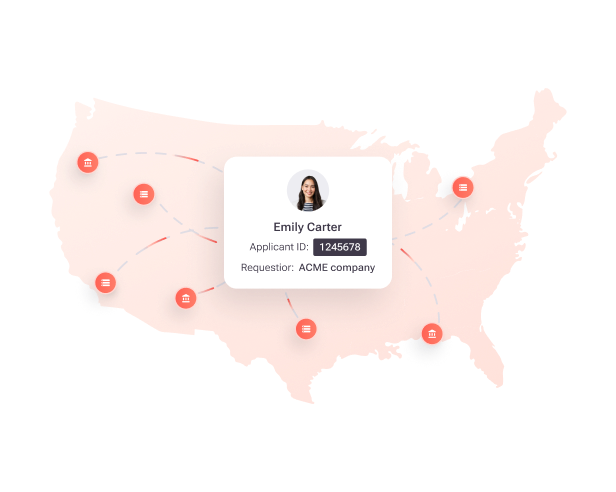
For Florida HOA and condo boards, Smart Screen Plus data delivers the most value when it sits inside a workflow that also handles credit evaluation, identity verification, document collection, and board voting. A standalone API result that a CAM must manually route to the board adds work and risk. TenantEvaluation integrates Equifax data, including Smart Screen Plus outputs, directly inside its association-specific workflows.
The result is a single screening report that combines Equifax credit and background data with biometric identity confirmation from IDVerify, board-ready summaries inside QuickApprove, and audit-ready records inside Lease Tracking, all without requiring the association to hold a direct Equifax contract. Book a 15-minute platform tour to see Equifax Smart Screen Plus data inside a board-ready workflow.
Minimum Credit Score Standards for Florida Rental Applicants
When reviewing a credit report, landlords and associations typically look for a VantageScore 3.0 above 650, consistent on-time payments over the past seven years, low outstanding debt, and manageable credit utilization. In practice, Florida associations vary widely. Luxury high-rises in Miami and Palm Beach may require scores of 700 or above, while workforce-housing communities may set thresholds at 600 or use conditional approval with a higher deposit for scores between 580 and 650.
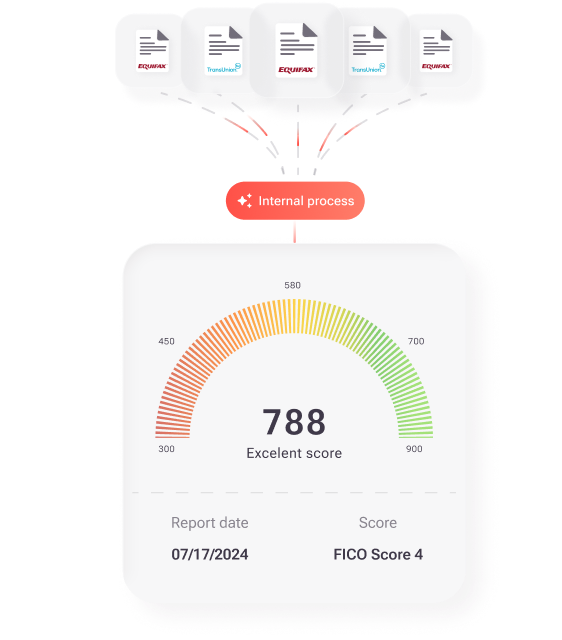
No Florida statute mandates a minimum credit score for rental approval. A Florida screening process should use a written screening policy that specifies criteria in advance, including credit score standards if used, because this policy serves as both a compliance tool and legal defense.
TenantEvaluation allows boards to configure custom credit score thresholds, income-to-rent ratios, and conditional approval rules directly inside the platform. The system applies criteria consistently to every applicant, which reduces the inconsistency risk that triggers Fair Housing complaints. Configure your community’s credit score criteria inside TenantEvaluation and see consistent application in action.
Direct Equifax Contracts vs Reseller Access: Decision Guide
Florida associations evaluating Equifax access usually fall into one of three scenarios, and that scenario shapes whether a direct contract or reseller relationship makes sense.
- Large property management company with 500+ annual applications and dedicated compliance staff: A direct Equifax contract may be viable but still requires integration work, adverse action automation, and bureau audit readiness. Many companies in this category still use a reseller for workflow automation.
- Mid-size association or management company with 50–500 annual applications: Direct bureau contracts are generally impractical. Volume requirements, upfront costs, and compliance infrastructure make a reseller the standard path, and the key question becomes which reseller offers Florida HOA and condo-specific workflows.
- Self-managed HOA or condo board with fewer than 50 annual applications: A direct Equifax contract is not realistic. A reseller with no upfront fees and a pay-per-application model is usually the only cost-effective path.
In all three scenarios, TenantEvaluation’s reseller model delivers Equifax data inside a platform built exclusively for Florida community associations, with no upfront fees, no volume commitments, automated FCRA compliance, and a revenue-share model that generates income for the association. Generic resellers deliver a report, while TenantEvaluation delivers a complete, board-ready workflow. Talk with the TenantEvaluation team to determine the right Equifax access path for your Florida association.
How TenantEvaluation Uses Equifax Inside QuickApprove, IDVerify, 55+ Communities Verification, and Lease Tracking
TenantEvaluation is a legitimate reseller of TransUnion and Equifax data, with data accessed under strict bureau rules, regular compliance reviews, and no gray-market or offshore data sources. That reseller relationship forms the foundation, and the differentiation comes from what happens to the data once it enters the platform.
Equifax credit and background data flows into four connected workflows.
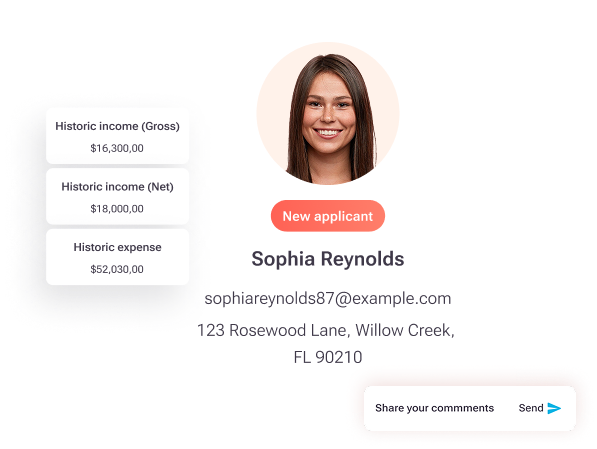
- QuickApprove: Speeds up resident approvals inside one connected platform. Equifax report results appear directly inside board-ready application summaries, with a dedicated voting panel for board members, real-time application tracking, automated communication support, customized approval letters, and a personalized welcome package. Communities keep control, compliance, and visibility, even during high-volume seasons and complex onboarding.
- IDVerify: Adds a biometric identity verification layer that includes government ID validation, AI-powered liveness detection, and facial biometric comparison, all running natively inside TenantEvaluation before the Equifax report is pulled. This sequence reinforces permissible-purpose validation and audit defensibility. Standard background checks and credit screening alone will not detect synthetic identities or digitally forged documents, and IDVerify addresses that gap directly.
- 55+ Communities Verification: Reduces manual work and standardizes application handling for age-restricted Florida condos and HOAs. Built for Community Association Managers, it improves documentation consistency, strengthens internal processes, and supports operational efficiency, while still leaving room for legal guidance.
- Lease Tracking: Provides centralized, real-time lease visibility and lifecycle control from application to occupancy. The workflow connects resident onboarding, unit data, approvals, and lease documentation inside one platform. Real-time lease status, automated lease document collection during onboarding, unit-level tracking, and audit-ready digital lease records replace spreadsheets and scattered email chains.
Across 5,000+ communities and approximately 100,000 applications processed annually, TenantEvaluation has generated $150M for Florida associations. The platform turns screening into a compliant, controlled income stream while reducing approval times by up to 70 percent and freeing as much as 50 hours of staff time per day.
Frequently Asked Questions
Can a Florida HOA or condo board access Equifax tenant screening reports without a direct Equifax contract?
Yes. Florida associations access Equifax data through legitimate resellers, which are companies that hold direct bureau agreements and deliver Equifax reports inside their screening platforms. TenantEvaluation is a direct reseller of Equifax and TransUnion data, so associations receive bureau-grade data without needing their own Equifax contract, volume commitments, or compliance infrastructure. The association remains the decision-maker, and TenantEvaluation provides the data and the workflow.
Who is responsible for sending the FCRA adverse action notice, the association, the management company, or TenantEvaluation?
The entity that takes the adverse action, typically the association or management company, is responsible for sending the FCRA adverse action notice. TenantEvaluation automates the generation of adverse action notices inside the platform, but the association or CAM remains the decision-maker and the party legally responsible for the notice. TenantEvaluation’s role is to provide the data and the automated workflow, and this clear separation between data provision and decision-making is a core compliance design principle of the platform.
What credit score can a Florida HOA or condo association require for rental applicants?
Florida law does not mandate a minimum credit score for rental approval. Each association sets its own threshold based on its governing documents and written screening policy. Industry practice commonly uses a VantageScore 3.0 threshold of 650 or above as a baseline, with conditional approval pathways for scores between 580 and 650. TenantEvaluation allows boards to configure custom credit score thresholds directly inside the platform, and the system applies criteria consistently to every applicant to reduce Fair Housing liability.
How does Florida’s new rental fraud law, CS/HB 1293, effective October 1, 2026, affect HOA and condo screening workflows?
CS/HB 1293 creates a third-degree felony for obtaining a rental unit through materially false identity statements or forged documents and classifies fraudulent rental applications as a non-curable lease violation. For HOA and condo boards, this means standard credit and background checks no longer provide enough protection on their own, and digital identity authentication becomes a practical necessity. TenantEvaluation’s IDVerify+ addresses this directly by adding biometric identity verification, including government ID validation, AI-powered liveness detection, and facial biometric comparison, inside the screening workflow before approval decisions are made.

What is the difference between how TenantEvaluation handles screening for a 55+ age-restricted community and a standard Florida condo?
For standard Florida condos and HOAs, TenantEvaluation runs the full screening workflow, including application intake, document collection, Equifax credit and background data, IDVerify+ biometric verification, board voting via QuickApprove, and Lease Tracking. For 55+ age-restricted communities, TenantEvaluation also activates 55+ Communities Verification, a built-in capability that standardizes how age-restricted application requirements are handled across applications, reduces manual work, improves documentation consistency, and strengthens internal operational control. This feature standardizes documentation and workflow but does not replace legal guidance on HOPA compliance.

Conclusion: Moving from Manual Screening to Board-Ready Equifax Workflows
Florida CAMs and HOA or condo boards in 2026 face a convergence of pressures, including a new rental fraud felony law effective October 1, rising application fraud rates, FCRA adverse action liability, and the operational burden of manual screening workflows. Equifax tenant screening data forms a necessary part of a defensible screening process, yet direct contracts are impractical for most Florida associations, and generic resellers leave board workflows, adverse action automation, and lease tracking unresolved.
TenantEvaluation embeds Equifax data inside a complete Florida association workflow that connects QuickApprove, IDVerify+, 55+ Communities Verification, and Lease Tracking into one audit-ready, FCRA-compliant platform with no upfront fees and a revenue-share model that generates income for the association. The platform is built specifically for community associations and management companies, with FCRA compliance as the foundation, not an afterthought.
