Written by: Luis Teran, Co-founder, CEO, TenantEvaluation | Last updated: June 16, 2026
Key Takeaways for Florida Condo Boards
- Florida condo associations must follow a clear seven-step FCRA-compliant workflow to avoid liability under Chapter 718 and federal credit reporting laws.
- Boards need documented, objective screening criteria adopted in advance and applied the same way to every rental applicant.
- Written FCRA consent, bureau-sourced background checks, and individualized criminal assessments are mandatory to maintain compliance and reduce Fair Housing risk.
- Biometric identity verification and timestamped board voting strengthen fraud protection and create defensible audit trails for every decision.
- TenantEvaluation centralizes the entire process, from application through lease tracking, helping associations stay compliant and organized; explore the platform’s compliance features.
Step 1: Confirm Bylaw Authority and Adopt Written Screening Criteria
The association must confirm it has legal authority to screen tenants and that its screening criteria are documented in writing before accepting any application. Florida Statute 718.110(13) governs amendments that prohibit rentals, alter rental duration, or limit the number of times a unit owner may rent during a specified period. A condo association may adopt an amendment requiring board approval of all leases and enforce that requirement against all owners regardless of when they purchased. Amendments that restrict rental frequency or set minimum post-purchase holding periods apply only to consenting owners and those who acquire title after the amendment’s effective date.
Once authority is confirmed, the board adopts written, objective screening criteria before advertising or accepting applications. Written criteria must be defined before advertising a property and applied uniformly to every applicant. A compliant criteria document should include minimum gross monthly income, commonly 2.5 to 3 times monthly rent, minimum credit score threshold, rental history standards such as no evictions within five years, employment verification requirements, and criminal background parameters subject to individualized assessment. Screening criteria must be based solely on objective factors such as financial qualifications, rental history, and ability to follow lease terms, and must apply equally to all applicants regardless of personal background.
The challenge is applying these criteria the same way to every applicant without subjective variation. TenantEvaluation lets associations load board-approved criteria directly into the platform so each application is measured against an identical, documented standard. This consistency strengthens audit defensibility from the first submission.
Step 2: Use FCRA-Compliant Written Consent for Every Applicant
Under the FCRA, a housing provider must obtain the applicant’s written consent before obtaining a credit or other consumer report for tenant screening; consent forms should clearly outline what reports will be reviewed and how the information will be used. This requirement is non-negotiable. Screening any applicant without prior written authorization creates direct FCRA liability for the association.
A compliant consent form identifies the types of reports to be obtained, such as credit, criminal, and eviction, names the screening provider, states the permissible purpose, and includes a clear applicant signature line. FCRA-compliant tenant screening requires housing providers to use a compliant screening company, obtain written consent for checks, and provide adverse action notices when denying an application based on the results.
TenantEvaluation embeds FCRA-compliant consent language directly into the online application workflow. Applicants authorize screening at the point of submission, which removes paper forms, reduces incomplete authorizations, and ensures every consumer report is properly authorized before TenantEvaluation’s SafeCheck+ initiates any data retrieval.
Step 3: Run Background Checks Through an FCRA-Compliant Provider
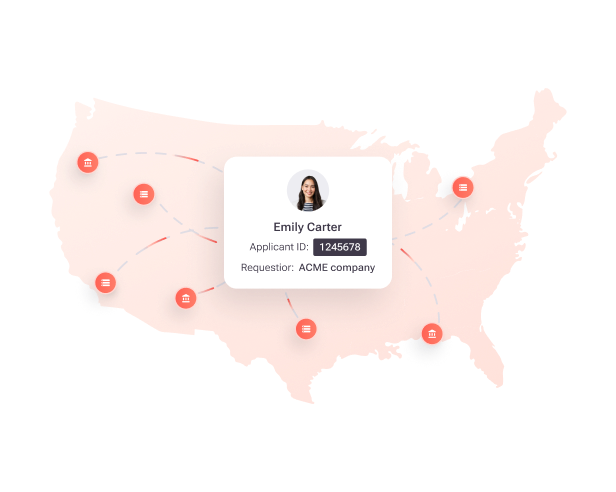
After consent is secured, the association obtains screening reports through a provider that qualifies as a Consumer Reporting Agency under the FCRA. Tenant screening reports commonly include TransUnion credit data with VantageScore 3.0, felony and misdemeanor criminal records from state and local jurisdictions plus sex offender registries and federal watch lists, and eviction judgments for possession or monetary claims. Using a provider without direct bureau relationships, or one that aggregates data from gray-market sources, transfers significant compliance risk to the association.
An NMHC survey found that 93.3% of respondents experienced rental application fraud in the prior twelve months, with 84.3% reporting falsified pay stubs, employment references, or income documentation. This level of fraud underscores the need for verified, bureau-sourced data rather than relying on applicant-supplied documents alone.
TenantEvaluation is a legitimate reseller of TransUnion and Equifax data, with direct bureau relationships, strict permissible purpose controls, and regular compliance audits. SafeCheck+ delivers credit, criminal, eviction, and reference reports inside one connected workflow with built-in audit trails. This structure protects the association from liability tied to unverified data sources.
Step 4: Apply Individualized Criminal-Record Assessments
Boards must avoid blanket criminal record bans and instead follow Fair Housing Act guidance on individualized assessments. Blanket bans on applicants with criminal records are prohibited under Fair Housing Act guidance; criminal screening must be limited to records that demonstrably affect the property or other residents, with landlords advised to consult the April 2016 HUD guidelines on individualized assessments.
An individualized assessment requires the board or CAM to evaluate the nature and severity of the offense, the time elapsed since conviction or release, evidence of rehabilitation, the applicant’s age at the time of the offense, and the direct nexus between the offense and tenancy risk. When conducting individualized assessments, housing providers should consider mitigating factors such as completion of education programs, participation in rehabilitation, history of trauma, reentry reports, age and maturity at time of offense, and the impact of denial on other family members. Housing providers should only screen for felony convictions that occurred within the last three years, with the lookback period beginning at either the point of conviction or the point of release from incarceration, which serves as a recognized best practice benchmark.
Because Fair Housing complaints can arise months or years after a denial, all assessment questions asked, evidence reviewed, and the reasoning behind the final decision must be documented in writing. Landlords should retain all tenant screening applications, reports, correspondence, and decision records for at least three years, as Fair Housing complaints are complaint-driven and may arise months or years after a denial.
TenantEvaluation surfaces criminal records with contextual detail so boards can perform and document individualized assessments quickly. Every action is timestamped inside the platform’s audit trail, which supports a defensible record.
Step 5: Use a Centralized Dashboard for Board Review and Voting
Board voting on tenant applications must be transparent, consistent, and documented. Email chains and informal text approvals create gaps in the audit record and expose the association to claims of inconsistent treatment. These gaps are particularly problematic because the approval workflow is one of the highest-friction points in the screening process, where delays and inconsistency compound most visibly.
A compliant board review process requires each member to evaluate the same summarized application data, cast a documented vote, and have that vote timestamped in a retrievable record. Decisions must be traceable to specific criteria, not general impressions.
TenantEvaluation’s QuickApprove workflow gives boards a real-time dashboard with AI-generated application summaries and a dedicated voting panel, which accelerates resident approvals inside one connected platform. It reduces manual follow-ups, supports automated communication, and delivers customized approval letters, while preserving control, compliance, and visibility. This structure replaces email chains with a board-ready approval process designed for high-volume seasons and communities with complex onboarding requirements.

Step 6: Strengthen Fraud Prevention with Biometric Identity Checks
The fraud risks identified earlier, including the 93.3% incidence rate documented by NMHC, often manifest as eviction filings and significant write-offs when undetected during screening. Traditional document-upload screening cannot reliably detect synthetic identities, impersonation attempts, or stolen credentials, which are increasing across Florida condo communities.
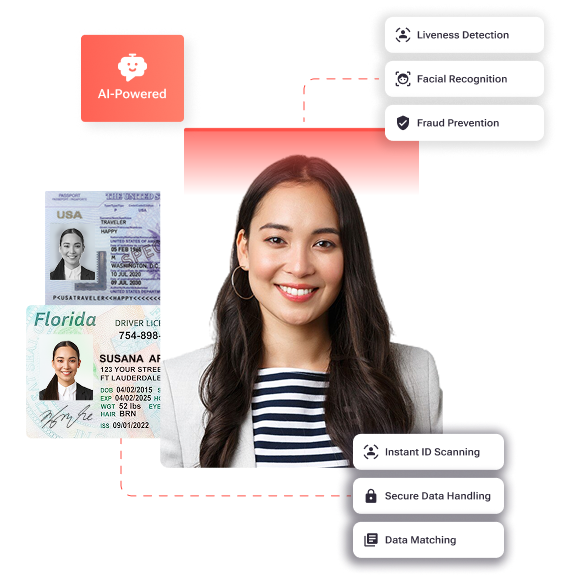
Biometric identity verification closes this gap by confirming that the person submitting the application is physically present and matches the government-issued ID provided. The verification layer should include government ID authentication, AI-powered liveness detection, and facial biometric comparison, all executed inside the screening workflow rather than through a separate external portal.
TenantEvaluation’s IDVerify performs all three verification steps, including government ID validation, liveness detection, and biometric selfie-to-ID matching, natively inside the application. CAMs receive embedded verification results, including ID authenticity confirmation, liveness status, and biometric match result alongside the screening report. IDVerify can be configured per community risk profile, which strengthens approval confidence and reduces liability exposure before any resident enters the property.
Step 7: Track Leases Centrally from Approval Through Occupancy
Approval marks the beginning of the occupancy record, not the end of the workflow. Missing lease copies, manual expiration tracking, and disconnected spreadsheets create operational blind spots that compound over time. Deloitte recommends that rental owners implement resident analytics platforms and tenancy life-cycle tracking to monitor tenant satisfaction, renewal rates, and turnover, reflecting a broader industry shift toward connected lease lifecycle management.
A national survey found that 60% of property managers encounter financial discrepancies monthly and 40% report quarterly mismatches. Centralized lease records directly reduce these problems by connecting approvals, unit data, and documentation in one searchable system.
TenantEvaluation’s Lease Tracking connects every approved application to unit-level lease records with real-time status visibility, including active, pending, expired, or missing. It delivers automated lease document collection during onboarding, unit-level tracking tied to occupancy records, and a searchable digital history that is audit-ready from day one. Boards gain a clearer operational picture of occupancy across communities, and CAMs eliminate spreadsheets and scattered email chains so every lease stays connected, searchable, trackable, and audit-ready from application to occupancy.
Frequently Asked Questions
How long does a compliant tenant screening process typically take in Florida condo associations?
The timeline varies based on how the association manages each step. Manual processes, including paper applications, email-based board voting, and phone-based reference checks, commonly extend the process to five to ten business days or longer, particularly during peak seasons. A digitized, automated workflow compresses that timeline significantly. TenantEvaluation’s platform, including QuickApprove, reduces approval cycles by up to 70% by automating document collection, background check retrieval, board notification, and communication. Applications move from submission to decision in hours rather than days while preserving board oversight and compliance controls.
Who is responsible for issuing adverse action notices under FCRA when a condo association denies an application?
The condo association, as the entity making the housing decision, is responsible for issuing the adverse action notice. The FCRA requires that when a denial is based in whole or in part on information from a consumer report, the applicant must receive a notice that includes the name, address, and phone number of the screening company used, a statement that the screening company did not make the decision, the applicant’s right to dispute the accuracy of the report, and the applicant’s right to obtain a free copy of the report within 60 days. TenantEvaluation includes automated adverse action workflows that generate compliant notices, maintaining a clear separation between TenantEvaluation’s role as data provider and the association’s role as decision-maker, which protects both parties from liability.
What documentation must Florida condo associations retain for tenant screening decisions?
Best practice and Fair Housing defense standards require retaining all applications received, the written screening criteria applied, credit and background reports, landlord verification notes, decision documentation, and adverse action notices for the three-year minimum discussed in Step 4. Florida associations operating under Chapter 718 should also retain records of board votes, timestamped approval or denial communications, and any individualized criminal assessment documentation. TenantEvaluation’s built-in audit trails automatically preserve all of these records in a searchable, digital format, which removes the risk of lost files and reduces the administrative burden of manual record retention.
Can a condo association use biometric identity verification during the screening process?
Yes. Biometric identity verification is a permissible and increasingly recommended layer of the screening process for Florida condo associations. It does not replace FCRA-required background checks or board approval; it strengthens the identity confirmation step that precedes those checks. By validating that the applicant is physically present and matches their government-issued ID before the application proceeds to review, associations reduce exposure to synthetic identity fraud, impersonation, and misrepresented applications. TenantEvaluation’s IDVerify integrates government ID validation, AI-powered liveness detection, and biometric facial matching natively inside the application workflow, with results embedded directly in the screening report for CAM and board review. It can be configured per community based on individual risk profiles.
Conclusion
A defensible, repeatable tenant screening process for a Florida condo association relies on seven connected steps. These include confirmed bylaw authority with documented objective criteria, FCRA-compliant written consent, bureau-sourced background checks, individualized criminal assessment, timestamped board voting, biometric identity verification, and centralized lease tracking from approval through occupancy. Each step builds on the last, and a gap in any one of them creates compliance exposure or operational friction that compounds across every application cycle.
TenantEvaluation is the only platform purpose-built for Florida condo associations that delivers all seven steps inside one connected system, with QuickApprove board dashboards, IDVerify biometric verification, and real-time Lease Tracking built on an FCRA-first foundation. With 5,000+ communities, 100,000+ applications processed annually, and $150M generated for communities, TenantEvaluation turns a manual, liability-prone process into a streamlined, audit-ready, revenue-generating workflow.
Ready to replace scattered emails and spreadsheets with a board-ready, FCRA-compliant screening system? Schedule your demo today.
