Written by: Luis Teran, Co-founder, CEO, TenantEvaluation | Last updated: June 15, 2026
Key Takeaways for Florida Associations
- Florida associations face heightened compliance demands in 2026 from HB 1203, HB 1021, and new website mandates under Statute 718.111(12)(g) that require audit-ready records.
- Integrated HOA screening platforms consolidate the full resident lifecycle, including application, biometric verification, FCRA-compliant screening, board approval, and lease tracking, inside one connected workflow.
- Manual tools like spreadsheets and email chains create legal exposure because they fail to maintain consistent, documented enforcement trails required under Florida Statutes.
- TenantEvaluation delivers FCRA-first architecture with direct credit-bureau access, native biometric IDVerify, QuickApprove board dashboards, and centralized lease tracking trusted by major Florida management companies.
- Associations that want to reduce compliance risk and operational workload can schedule a demo at TenantEvaluation and evaluate an end-to-end platform built for Florida HOAs and condos.
What an Integrated HOA Screening Platform Includes
An integrated HOA screening and compliance management platform is a single system that handles the full resident lifecycle. It covers application intake, document collection, biometric identity verification, FCRA-compliant background screening, board review and voting, lease tracking, and audit trail generation. Every step occurs inside one connected workflow, not across multiple vendors, spreadsheets, and email threads.
The distinction matters because Florida associations cannot enforce restrictions that are not in the governing documents and cannot adopt rules that conflict with Florida law. Inconsistent or undocumented screening decisions create direct legal exposure. A platform built on FCRA compliance as the foundation, not as an afterthought, closes that gap by embedding permissible purpose controls, adverse action workflows, and audit trails into every transaction.
Florida Market Trends and Technology Gaps
In 2026, the gap between communities using integrated platforms and those relying on spreadsheets and email threads is large enough to materially affect operations, with most associations managing 50 or more units now using dedicated software. The consolidation trend brings accounting, assessment collection, work orders, resident communication, violation tracking, and board document storage into one system. Technology adoption reached a tipping point in 2025, and the focus now sits on integrated systems that connect financial operations, communication, reporting, and document access.
The gap that persists is FCRA-first design and Florida-specific workflows. Generic property management platforms and broad background screening vendors were not built for the Chapter 718 and Chapter 720 environment. They lack direct credit bureau reseller status, biometric identity verification native to the screening workflow, board-ready voting dashboards, age-restricted community documentation workflows, and centralized lease lifecycle visibility. That gap defines the category TenantEvaluation occupies.
How TenantEvaluation Handles the Resident Journey
TenantEvaluation addresses this gap through an integrated workflow that consolidates every step of the resident lifecycle. The resident journey begins when an applicant receives a Property Code from the association and creates an account. The application is completed entirely online, including personal, financial, and contact details, document uploads, and secure payment. The process then moves to IDVerify, TenantEvaluation's biometric identity verification layer.
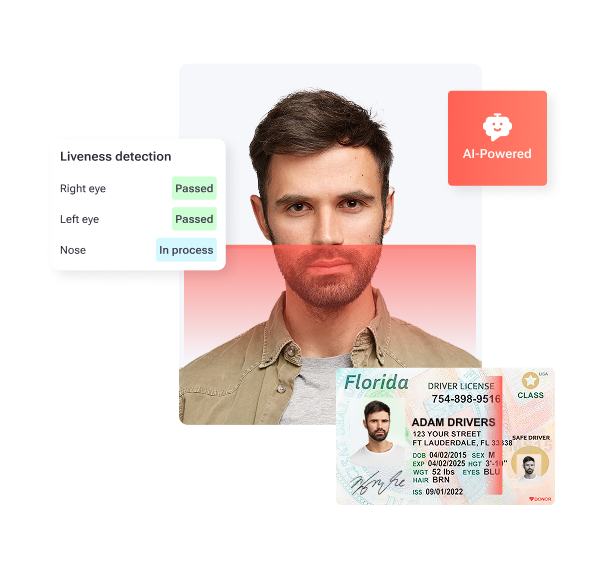
Government-issued ID validation, AI-powered liveness detection, and biometric selfie-to-ID comparison run natively inside the platform. The CAM sees verification results, including ID authenticity confirmation, liveness status, biometric match result, and a redacted ID copy, embedded directly in the screening report.

From there, QuickApprove moves the application to the board-ready review and voting dashboard. Board members access summarized applicant reports and cast votes inside TenantEvaluation. Email chains and spreadsheets disappear from the approval process. Approved applications connect directly to Lease Tracking, where lease status, unit-level occupancy records, and searchable digital history are maintained in real time from application through occupancy.

This connected workflow is trusted by RealManage, Castle Group, Vesta, FirstService Residential, Campbell Property Management, and Associa, all enterprise-level management companies operating across Florida's most demanding markets.
See how Florida's leading management companies run their resident workflows and request a platform walkthrough.
Compliance Risk and Governance in Florida Communities
Under the FCRA, willful noncompliance can result in liability for actual damages or statutory damages of $100 to $1,000. For employment decisions based on a consumer report, a pre-adverse action notice, including the report and FCRA Summary of Rights, followed by a reasonable waiting period is required before a final adverse action notice. For housing or credit decisions, only the final notice is required.
TenantEvaluation is a legitimate reseller of TransUnion and Equifax data, accessed under strict bureau rules with regular compliance reviews and no gray-market or offshore data sources. Permissible purpose controls, automated adverse action workflows, and a clear separation between data provision by TenantEvaluation and decision-making by the association are built into every transaction. No feature in any platform guarantees legal compliance. Associations should work with qualified legal counsel on their specific governing documents and Florida statutes. TenantEvaluation's architecture is designed to support defensible, consistent, audit-ready processes.
Florida condominium associations cannot charge screening or transfer approval fees exceeding $150 per applicant unless the authority and fee are explicitly provided in the declaration, articles, or bylaws. TenantEvaluation's revenue-sharing model operates within this framework and turns application processing into a compliant, controlled income stream rather than an operational cost.
Operational Failure Points in HOA Screening
Boards must follow procedures required by Florida law and governing documents before taking enforcement action, which creates failure points when teams rely on informal or ad hoc workflows instead of structured processes. The most common operational breakdowns in Florida HOA screening and compliance include:
- Missing or outdated lease copies stored across folders, inboxes, and disconnected spreadsheets with no centralized visibility or occupancy confirmation.
- Identity fraud exposure from document-only review, including stolen IDs, synthetic identities, and impersonation attempts that traditional screening cannot detect without biometric confirmation.
- Inconsistent 55+ documentation handled through fragmented manual processes, which creates incomplete records that surface as risk in audits or disputes.
- Audit exposure from incomplete enforcement trails. Florida law under Section 720.311 requires pre-suit mediation only for specific HOA disputes such as covenant enforcement and property-use changes before a lawsuit can be filed, making weak documentation and unclear decision trails likely to increase the time and cost of resolution.
- Lengthy board approval cycles caused by email chains, manual follow-ups, and no real-time application visibility for board members.
Best Practices and 2026 Operational Standards
As digital reliance grows in HOA operations, cybersecurity, data privacy, and role-based access controls are becoming more critical, especially where money, approvals, and compliance intersect. The 2026 operational standard for Florida associations includes four converging practices.
Biometric identity verification. Communities managing fraud exposure now move from document-based review to biometric-confirmed identity. Government ID validation, liveness detection, and facial biometric comparison form the emerging baseline. IDVerify delivers this natively inside TenantEvaluation with no external portals or workflow disruption.
Centralized lease lifecycle visibility. Real-time lease status tracking, automated document collection during onboarding, unit-level tracking, and searchable digital history replace the spreadsheet-and-email model that creates operational blind spots.
Board-ready dashboards. Boards are increasingly evaluating management partners on measurable outcomes including compliance execution, which makes transparent approval workflows a competitive differentiator for CAMs. QuickApprove addresses this expectation by giving board members direct, real-time access to application status, summarized reports, and a voting panel. It replaces email chains with a connected approval process that maintains full control, compliance, and visibility.
Revenue-sharing models. Platforms that turn application processing into a compliant income stream, rather than a cost center, align vendor incentives with association outcomes. TenantEvaluation has generated $150M for communities across 5,000+ associations.
Evaluation Criteria and Decision Framework for CAMs
The table below compares TenantEvaluation against the generic platform category on criteria that directly affect Florida CAMs and boards in 2026. Every data point is drawn from TenantEvaluation's documented platform capabilities and publicly available competitive positioning.
| Criterion | TenantEvaluation | Generic PMS Platforms (e.g., AppFolio, RealPage) | Background-Only Vendors (e.g., ApplyCheck, Verify Screening Solutions) |
|---|---|---|---|
| FCRA-first design | Foundation of platform architecture, direct TransUnion and Equifax reseller, automated adverse action workflows, permissible purpose controls built in | FCRA addressed as a feature layer, not the architectural foundation, typically third-party screening integrations | FCRA addressed at the report level, no end-to-end workflow enforcement, TazWorks-based platforms lack native applicant interaction |
| Biometric identity verification | IDVerify: government ID validation, AI liveness detection, facial biometric matching, native to screening workflow, no external portal | Not available natively, relies on third-party integrations if offered at all | Not available, document-upload-only identity review |
| Board approval dashboard | QuickApprove: dedicated board voting panel, real-time application tracking, automated communication support, customized approval letters, personalized welcome package, inside one connected platform | Board access limited to document storage or general portals, no dedicated voting workflow | No board workflow, report delivery only |
| 55+ community documentation | 55+ Communities Verification: standardizes age-restricted application handling, reduces manual work, improves documentation consistency, built for Florida Condos and HOAs | No Florida-specific 55+ workflow, manual handling required | Not applicable |
| Lease tracking | Centralized, real-time lease visibility and lifecycle control from application to occupancy, real-time status, audit-ready digital records, unit-level tracking | Lease storage available but disconnected from screening and onboarding workflow | Not applicable |
| Quantified outcomes | Up to 70% faster approvals, up to 50 hours of staff time saved daily, $150M generated for communities, 100,000+ applications processed annually, 4.8/5 Google rating | Outcomes vary, no published community-association-specific benchmarks comparable on the same metrics | Outcomes limited to report turnaround time, no onboarding or approval cycle data |
Compare your current stack against the criteria above and request a live platform comparison.
Frequently Asked Questions
How HB 1203 Increases Compliance Pressure in 2026
HB 1203 and companion legislation HB 1021, effective 2024, introduced significant changes to Florida HOA law. For condominium associations, post-Surfside structural inspection and reserve-funding requirements fundamentally altered what adequate reserve funding means in practice, with some communities facing special assessments of $40,000 to $60,000 per unit. For HOAs broadly, new fine structures, notice requirements, and enforcement limitations increase the operational burden on managers and boards.
Separately, Florida's 2026 website mandates under Statute 718.111(12)(g) and for homeowner associations require associations to maintain accessible, organized records, including governing documents, budgets, meeting minutes, and contracts, on official websites or secure portals. Together, these changes make audit-ready, centralized record-keeping a non-negotiable operational requirement rather than a best practice.
Time Savings from Moving to TenantEvaluation
A Florida-based management company that switched to TenantEvaluation freed up 50 hours per day for their team, cut processing time by 50%, and achieved $240,000 in annual savings, calculated at $10 savings per hour per property. TenantEvaluation's automated workflows handle document collection, ID verification, background screening, board communication, approval letters, and lease tracking inside one platform. This consolidation eliminates the manual follow-ups, incomplete submissions, and cross-vendor coordination that consume staff time in fragmented setups.
The platform processes 100,000+ applications annually across 5,000+ communities, so the efficiency gains are documented at scale, not just in isolated cases.
Direct Credit Bureau Reseller Status and FCRA Compliance
TenantEvaluation is a legitimate reseller of TransUnion and Equifax data, accessed under strict bureau rules with regular compliance reviews and no gray-market or offshore data sources. This status matters because many screening vendors access credit data through intermediaries or aggregators, which introduces additional layers of data handling, potential accuracy gaps, and liability exposure for the association.
As a direct reseller, TenantEvaluation operates under bureau-level compliance standards, with permissible purpose controls, automated adverse action workflows, and a clear separation between data provision and decision-making built into every transaction. Community associations using TenantEvaluation stay protected from the liability exposure that comes with gray-market data sourcing.
Support for 55+ Age-Restricted Communities
55+ Communities Verification is a built-in capability within TenantEvaluation that standardizes how age-restricted application requirements are handled across applications. It reduces manual work, improves documentation consistency, and strengthens internal operational control for Florida Condos and HOAs managing age-restricted communities.

Before this capability, age-restricted application handling typically relied on fragmented manual processes, heavy email communication, PDFs, and follow-ups. Those approaches resulted in inconsistent documentation and growing risk exposure in audits or disputes. TenantEvaluation's 55+ Communities Verification creates a more structured, scalable process for CAMs and boards without replacing legal guidance. It is a documentation-first workflow standardization tool designed specifically for the real operational environment of Florida associations.
TenantEvaluation vs Generic Property Management Platforms
Generic property management platforms and background-only screening vendors were not built for the Chapter 718 and Chapter 720 environment. They address FCRA as a feature layer rather than an architectural foundation, lack direct credit bureau reseller status, do not offer biometric identity verification native to the screening workflow, have no dedicated board voting dashboard, and provide no Florida-specific workflows for 55+ communities or centralized lease lifecycle visibility.
TenantEvaluation was built exclusively for community associations and management companies. It combines FCRA-focused design, a direct bureau reseller relationship, the biometric verification and board approval capabilities described earlier, and centralized lease tracking inside one connected platform purpose-built for Florida condos and HOAs.
Conclusion: Next Steps for Florida CAMs and Boards
Florida's 2026 regulatory environment, including HB 1203, Chapters 718 and 720, and the new website mandates, has turned the gap between integrated platforms and fragmented manual processes into a direct compliance and financial risk. Spreadsheets and email chains cannot produce the audit-ready records, consistent enforcement documentation, or real-time lease visibility that Florida associations now need to operate defensibly.
TenantEvaluation consolidates this FCRA-first architecture into an end-to-end platform purpose-built for Florida associations and management companies. With direct credit bureau reseller status, IDVerify biometric verification, QuickApprove board-ready approvals, 55+ Communities Verification, and centralized Lease Tracking, it delivers up to 70% faster approvals and up to 50 hours of staff time saved daily, outcomes documented across the 5,000+ associations using the platform.
CAMs and boards evaluating their current processes against the 2026 compliance standard have a clear next step. See the platform in action and evaluate it against your current workflow.
