Written by: Luis Teran, Co-founder, CEO, TenantEvaluation | Last updated: June 24, 2026
Key Takeaways
- Florida CAMs and boards that rely on manual processes face daily delays, compliance gaps, and higher fraud risk from disconnected tools and unsecured data handling.
- HOA screening requires more than generic background checks. It demands FCRA-first design, biometric identity verification, and board voting workflows tailored to Florida governing documents.
- Manual workflows create audit exposure, missing adverse action notices, and disconnected lease records that cannot be reliably tracked or retrieved.
- A purpose-built platform must deliver five non-negotiable features: FCRA compliance, native biometrics, dedicated board dashboards, automated lease tracking, and 55+ workflow support.
- TenantEvaluation is the only platform meeting every criterion for Florida communities. See the complete solution in action and evaluate it against your current process.
The Daily Burdens of Fragmented HOA Screening Processes
Most Florida community associations still manage resident applications through a patchwork of tools. Email threads handle document collection, PDF forms arrive by fax or scan, spreadsheets track approval status, and generic background check vendors return data without context or workflow integration. Each handoff between these systems introduces delay, error, and compliance exposure.
CAMs spend significant portions of their day chasing incomplete submissions, re-requesting documents, and manually routing applications to board members who may not respond for days. Sensitive applicant data, including Social Security numbers, financial records, and government IDs, passes through unsecured inboxes and shared drives. Lease records sit in folders disconnected from the onboarding workflow. Communities lose a single source of truth, a reliable audit trail, and a clear mechanism to confirm that every required step was completed correctly.
TenantEvaluation’s platform serves 5,000+ communities and processes approximately 100,000 applications per year. Communities that have migrated from manual workflows to TenantEvaluation report up to 70% reduction in processing time and up to 50 hours of staff time freed per day.
HOA Screening Defined for Florida Communities
HOA screening is the process a community association uses to evaluate prospective residents before granting approval to occupy a unit. It typically includes identity verification, background checks such as criminal history, eviction records, and sex offender registry searches, credit evaluation, income verification, and document collection such as executed leases and government-issued IDs.
Generic tenant screening tools built for individual landlords or multifamily operators lack the structural features community associations require. They do not support board voting workflows, do not accommodate Florida-specific governing document rules, do not provide biometric identity verification, and do not connect screening outcomes to lease records or occupancy tracking. HOA screening functions as a distinct operational category and requires a platform built specifically for that reality.
Compliance Pressures and the Risks of Manual HOA Workflows
Florida condos and HOAs operate under governing documents such as declarations, bylaws, and rules that define specific screening criteria. These criteria include minimum credit scores, income thresholds, required documentation, approval timelines, and board voting procedures. Compliance with these internal requirements, alongside external obligations under the Fair Credit Reporting Act, creates a layered compliance environment that manual workflows cannot reliably support.
Manual processes introduce several categories of risk. Incomplete document submissions that are not caught at intake create audit gaps. Adverse action notices required under FCRA may be delayed or omitted when approvals and denials are tracked informally. Sensitive applicant data handled outside a secure, encrypted system exposes associations to data breach liability. Lease records that are not connected to the application workflow become impossible to audit retroactively.
TenantEvaluation addresses these risks through FCRA-first design. Compliance functions as the foundation, not an afterthought. The platform includes automated adverse action workflows, built-in audit trails for every application, strict permissible purpose controls, and direct reseller relationships with TransUnion and Equifax. Data is accessed under strict bureau rules with no gray-market or offshore sources, which keeps community associations protected from liability exposure.
Board Voting Dashboards and the Limits of Spreadsheets
Board members in Florida community associations are volunteers with limited time and no obligation to monitor a shared spreadsheet for pending applications. When approval workflows depend on email chains and manual follow-ups, applications stall. CAMs spend hours on status calls. Applicants and their realtors experience uncertainty that damages the community’s reputation and delays move-in timelines.
A dedicated board voting dashboard for resident applications replaces this friction with a structured, real-time decision environment. Board members log in to a single panel, review AI-generated applicant summaries, cast votes, and receive automated notifications, all within a timestamped, auditable workflow. Communities gain faster decisions, clearer accountability, and a complete record of every board action.
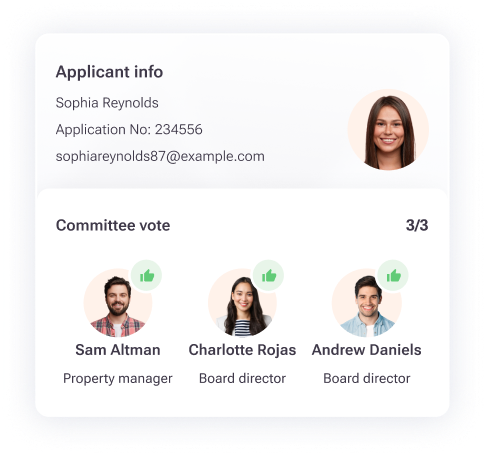
QuickApprove, TenantEvaluation’s accelerated approval workflow, delivers this capability in practice. It serves CAMs, Boards, and property management teams inside one connected platform. It provides real-time application tracking, automated communication support, customized approval letters, and a personalized welcome package. Communities handle high-volume seasons and complex onboarding requirements without losing control, compliance, or visibility.
Five Non-Negotiable Capabilities for a Florida HOA Screening Platform
A platform built for Florida community associations must satisfy five non-negotiable criteria that work together as a complete system.
FCRA-first design. Compliance must be embedded in every workflow, including adverse action automation, permissible purpose controls, and audit trails, not added as a checkbox after the fact. This foundation supports every other capability.
Native biometric identity verification. FCRA compliance depends on confirming the applicant’s true identity. Document uploads alone cannot prevent impersonation, synthetic identity fraud, or stolen ID use. The platform must confirm physical presence and biometric match before approval decisions are made, without redirecting applicants to external portals.
Dedicated board voting dashboard. Board members need a structured, real-time review and voting environment connected directly to the screening workflow, not a forwarded email with a PDF attachment. This structure keeps decisions timely and auditable.
Automated lease tracking. Lease records must connect to the onboarding workflow from application submission through occupancy. Real-time status visibility and audit-ready digital records give CAMs reliable control over occupancy and renewals.
Florida-specific 55+ workflow support. Age-restricted communities face documentation and operational requirements that generic platforms cannot accommodate. The platform must standardize how these requirements are handled across applications and communities.
How TenantEvaluation Delivers a Connected HOA Screening System
TenantEvaluation is the only platform meeting every criterion listed above. Founded in 2007 and built by property managers, board members, and software engineers with over 50 years of combined experience, it is purpose-built for Florida community associations, not adapted from a generic rental tool.
FCRA compliance as the foundation. TenantEvaluation meets the FCRA-first requirement through direct reseller relationships with TransUnion and Equifax, subject to regular compliance reviews and audits. This structural position supports automated adverse action workflows, strict permissible purpose controls, and built-in audit trails that generic platforms cannot easily match.
PCI Level 1 compliance and end-to-end encryption. Sensitive applicant data is automatically redacted, encrypted, and stored under the highest payment card industry security standard. Associations reduce data breach liability and demonstrate responsible data stewardship.
IDVerify. TenantEvaluation’s biometric identity verification layer runs natively inside the platform. It combines government-issued ID validation, AI-powered liveness detection, and biometric selfie-to-ID facial comparison. CAMs see verification results, including ID authenticity, liveness status, and biometric match, embedded directly in the screening report. Communities move from document-based review to biometric-confirmed identity verification without workflow disruption.

QuickApprove. The accelerated approval workflow gives boards a dedicated review and voting dashboard, gives CAMs real-time application tracking and automated communication support, and gives applicants clearer status visibility. All stakeholders work inside one connected platform.
55+ Communities Verification. This built-in capability reduces manual work, standardizes application handling, supports documentation consistency, and improves operational efficiency for Florida condos and HOAs managing age-restricted communities. It is designed for Community Association Managers and strengthens internal processes while legal counsel maintains oversight.

Lease Tracking. Centralized, real-time lease visibility and lifecycle control connect resident onboarding, unit data, approvals, and lease documentation inside one connected platform. Real-time lease status, automated lease document collection during onboarding, unit-level tracking, and audit-ready digital lease records replace spreadsheets and scattered email chains from application to occupancy.
TenantEvaluation has generated $150M for communities and holds a 4.8/5 Google rating. Enterprise-level management companies including FirstService Residential, Campbell Property Management, and Associa rely on the platform.
Step-by-Step Workflow From Intake to Lease Record
Step 1: Intake. The applicant receives a community Property Code and completes a 100% online application via web or mobile. Intelligent form logic adjusts required fields based on applicant type and community rules.
Step 2: Identity Verification. IDVerify runs biometric validation, including government ID authentication, AI liveness detection, and facial biometric comparison, natively within the workflow before the application proceeds to review.
Step 3: Document Collection. Smart application logic checks for executed leases, valid IDs, and all required community-specific documents. The system rejects incomplete submissions automatically and prompts applicants to correct them.
Step 4: Board Review. QuickApprove routes the application to the board voting dashboard. Board members review AI-generated summaries and cast timestamped votes inside the platform.

Step 5: Approval. Automated communication support triggers customized approval letters and a personalized welcome package. Adverse action notices generate automatically for denials, keeping FCRA requirements intact.
Step 6: Lease Record Creation. Lease Tracking connects the approved application to a centralized lease record with real-time status visibility, unit-level tracking, and a searchable digital history. Communities gain audit-ready records from day one.
Evaluation Criteria for Selecting an HOA Screening Platform
Florida CAMs and Board members should assess eight dimensions that build a complete compliance and operational picture. Start with compliance requirements. Determine whether the platform treats FCRA as a foundation or a feature. This decision influences data handling, including whether sensitive applicant data is encrypted, auto-redacted, and stored under PCI Level 1 standards.
Proper data handling then enables auditability. Every application action should generate a timestamped, retrievable audit trail. Next, examine stakeholder access. Boards need a dedicated, real-time review environment that remains distinct from the CAM workflow.
Evaluate fraud prevention by confirming that the platform moves beyond document uploads to biometric-confirmed identity. Review turnaround time expectations and confirm that the platform can reduce approval cycles by up to 70% compared to manual processes. Assess configurability to ensure support for Florida-specific governing document rules, 55+ age-restriction workflows, and community-level screening criteria. Finally, confirm that user experience includes 24/7 access in multiple languages with AI-powered support.
Generic platforms such as AppFolio, RealPage, and RentSpree address some of these dimensions for broad property management use cases. None were designed for the compliance depth, board governance structure, biometric fraud prevention, or Florida-specific workflow requirements that community associations require. The difference between a fragmented multi-vendor approach and a centralized purpose-built platform appears in hours saved, errors avoided, and liability reduced.
Frequently Asked Questions
What is HOA screening?
HOA screening is the process a community association uses to evaluate prospective residents before approving occupancy. It encompasses identity verification, criminal and eviction background checks, credit evaluation, income verification, and collection of community-required documents such as executed leases and government-issued IDs. Unlike generic tenant screening, HOA screening must align with the association’s governing documents, accommodate board voting procedures, and comply with FCRA requirements specific to community association operations. A purpose-built platform automates each of these steps within a single connected workflow rather than distributing them across multiple vendors and manual processes.
What are HOA compliance inspection requirements?
HOA compliance inspection requirements refer to the internal standards defined in a community’s declaration, bylaws, and rules. These standards cover screening criteria such as minimum credit scores, income thresholds, required documentation, and board approval timelines, as well as external legal obligations under the Fair Credit Reporting Act. For Florida communities, these requirements also include proper adverse action notice procedures when applications are denied, permissible purpose controls governing when and how credit data may be accessed, and audit trail maintenance demonstrating that every step of the screening process was completed correctly. Manual workflows create gaps in all of these areas. A platform with FCRA-first design and built-in audit trails addresses them systematically.
How does a board voting dashboard improve resident application decisions?
A dedicated board voting dashboard gives board members direct, real-time access to application status and AI-generated applicant summaries inside a structured review environment. Instead of receiving forwarded emails with PDF attachments and responding informally, board members log in to a single panel, review organized applicant data, and cast timestamped votes that become part of the application’s permanent audit record. This structure eliminates approval bottlenecks caused by email chains and manual follow-ups, reduces the time boards spend on administrative coordination, and creates a clear, defensible record of every decision. CAMs handle fewer status calls and move applications faster. Applicants experience shorter wait times and clearer communication.
How does centralized lease tracking reduce compliance risk?
Centralized lease tracking reduces compliance risk by connecting lease documentation directly to the resident onboarding workflow. This connection eliminates the gap between application records and active lease records that creates audit exposure. When lease status, including active, pending, expired, or missing, is visible in real time and tied to unit-level occupancy data, CAMs can confirm occupancy accurately, identify expired or missing leases before they become disputes, and produce audit-ready digital records on demand. Automated lease document collection during onboarding ensures that records are captured at the point of approval rather than assembled retroactively. Communities see fewer incomplete records, fewer manual follow-ups, and a stronger compliance posture across the entire portfolio.
Conclusion: A Purpose-Built Platform for Florida Community Associations
Fragmented manual screening processes cost Florida communities time, revenue, and compliance standing. Email chains, spreadsheets, and generic tools were not designed for the governance structure, FCRA obligations, fraud exposure, or operational complexity of Florida condos and HOAs. The secure integrated HOA compliance and resident application screening platform that solves these problems must deliver FCRA compliance as the foundation, biometric identity verification, a dedicated board voting dashboard, automated lease tracking, and Florida-specific 55+ workflow support in a single connected system.
TenantEvaluation is that platform. With the scale and track record established earlier, serving thousands of communities and processing hundreds of thousands of applications annually, it is the only purpose-built solution meeting every criterion Florida CAMs and Board members require.
