Written by: Luis Teran, Co-founder, CEO, TenantEvaluation | Last updated: June 22, 2026
Key Takeaways for Florida Condo Resident Screening
- Florida condo associations need a written, board-approved screening policy grounded in governing documents to keep decisions consistent and Fair Housing compliant.
- Digital intake platforms cut incomplete applications and approval delays by enforcing document completeness at submission with smart form logic.
- FCRA-compliant background, credit, and eviction checks sourced directly from TransUnion and Equifax protect associations from liability and automate adverse action notices.
- Biometric identity verification, income confirmation, and board-ready dashboards create transparent, auditable workflows that reduce fraud and approval bottlenecks.
- Lease tracking from approval through occupancy closes the compliance loop; explore the full workflow at TenantEvaluation.
Stage 1: Turn Governing Documents into a Written Screening Policy
Compliance anchor: Ground every approval criterion in the association’s declaration, bylaws, or rules. The board should confirm that its screening policy is authorized by governing documents and captured in a clear written format before accepting any applications.
To complete this stage, the board and association legal counsel gather the current declaration of condominium, bylaws, and any recorded rules and regulations. These documents provide the legal foundation for screening criteria and decision authority. Once the policy is drafted and approved, it should be dated, signed by the board, and stored in the official association records to create an auditable compliance anchor.
Sample disqualifying factors that may appear in a written policy, subject to legal review, include felony convictions within a defined lookback period and credit scores below a board-set threshold. Policies may also address prior evictions within a specified timeframe and failure to provide complete documentation within the application window. Every factor must be applied uniformly to reduce Fair Housing exposure.
See how TenantEvaluation embeds your governing-document criteria directly into the platform — request a walkthrough.
Stage 2: Standardize Application Intake and Document Collection
Once the screening policy is documented and board-approved, the next priority is making sure every application arrives complete and ready for review. Manual intake with paper forms, email attachments, and phone follow-ups often produces incomplete applications and approval delays in Florida community associations. A digital platform with intelligent form logic removes this bottleneck by adjusting required fields based on applicant type, then blocking submissions that lack executed leases, valid government-issued IDs, or other required documents.
TenantEvaluation’s 100% online application platform, available via web and mobile app, enforces this completeness standard at submission. Applicants upload documents directly from their phones, and the system sends automated notifications for any missing items, so every application that reaches the manager’s queue is ready for review. Standard Brickell condo applications, for example, require a completed form, government-issued ID, proof of funds or mortgage pre-approval, bank reference letter, personal reference letters, and background check authorization, and TenantEvaluation’s intake workflow collects and validates each of these document types automatically.
Ready to eliminate incomplete applications from your workflow? Book a demo to see intelligent intake in action.
Stage 3: Run FCRA-Compliant Background, Credit, and Eviction Checks
Compliance anchor: The Fair Credit Reporting Act (FCRA) governs every consumer report ordered by a Florida association, including criminal background, credit, and eviction checks. Associations must obtain written consent, use a permissible-purpose consumer reporting agency, and follow adverse action procedures for any denial based on report findings.
TenantEvaluation’s SafeCheck+ solution delivers nationwide and global background checks, including criminal records, sex offender registry, and FBI Most Wanted searches. It also provides credit data sourced directly from TransUnion and Equifax as a legitimate bureau reseller. This direct reseller relationship means data is accessed under strict bureau rules with no gray-market or offshore sources, which protects associations from downstream liability. Automated adverse action workflows sit inside the platform, so required notices generate and send without manual intervention.
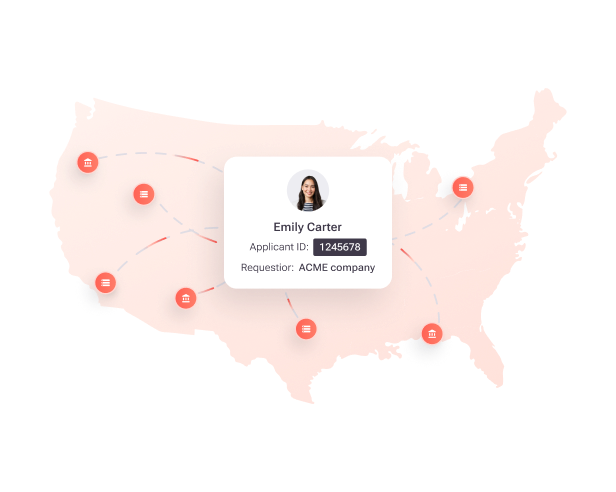
Explore TenantEvaluation’s FCRA-first screening architecture in a live demo — schedule your session.
Stage 4: Add Biometric Identity Verification to Your Screening Flow
Document-only review that accepts an uploaded ID and runs a database check cannot reliably detect impersonation, synthetic identities, or stolen credentials. Florida condo and HOA communities face growing exposure to these fraud risks, and traditional screening methods no longer provide enough protection for modern communities.
IDVerify introduces biometric identity verification directly inside the TenantEvaluation workflow. Applicants complete a guided step that validates their government-issued ID for authenticity and runs AI-powered liveness detection to confirm physical presence. The system then performs facial landmark biometric mapping with a selfie-to-ID comparison. Results such as ID authenticity confirmation, liveness status, and biometric match outcome appear directly in the screening report visible to the CAM, with no external portals or redirects. IDVerify can be enabled per community and configured per portfolio, which supports different risk profiles without a one-size-fits-all approach. This shift moves associations from document-based validation to biometric-confirmed identity verification before any approval decision.

See IDVerify biometric verification in action during a tailored walkthrough — request a demo.
Stage 5: Confirm Income and Capture Any Required Interviews
Income verification should move beyond self-reported figures by contacting employers directly and cross-referencing financial documentation. TenantEvaluation’s IncomeEv report provides this layer and gives boards an objective income-to-rent or income-to-purchase ratio tied to the association’s written threshold instead of an applicant’s unverified claim.

Where governing documents authorize an interview, the CAM should document the date, participants, and questions using a standardized template. Interview questions must stay limited to criteria in the written screening policy and must never address protected class characteristics. The interview record becomes part of the application file and the audit trail.
Stage 6: Use a Board-Ready Dashboard for Transparent Voting
Board review often becomes a bottleneck in Florida condo approvals. Applications circulate through email chains, board members lack a consolidated view of pending items, and approval letters require extra manual work after decisions. QuickApprove addresses this directly as an accelerated approval workflow built for CAMs, boards, and property management teams inside one connected platform. It supports high-volume seasons and communities with complex onboarding requirements while preserving control, compliance, and visibility.
Board members access a dedicated voting panel with AI-generated applicant summaries, real-time application status, and a structured voting workflow. All actions are timestamped and auditable. Automated communication support, customized approval letters, and a personalized welcome package generate within the same workflow, which reduces manual follow-ups and delivers a faster, clearer, more consistent approval experience.

Stage 7: Document Board Decisions and Issue Certificates
After the board completes its vote through QuickApprove or another voting method, the association should formalize and document the decision. Every approval and denial must include the specific criteria applied, the date of the board vote, and the names of voting members. For denials, the FCRA-required adverse action notice must be issued within the statutory timeframe and must reference the consumer report used. TenantEvaluation’s built-in audit trails capture every action, including document uploads, background check orders, board votes, and communication timestamps, which creates a defensible record for any future Fair Housing inquiry or legal challenge. Approval certificates are issued through the platform and stored in the application file.
Stage 8: Track Leases from Approval Through Occupancy
Approval should mark the start of lease oversight, not the end of the workflow. Missing or outdated lease copies, manual expiration tracking, and disconnected spreadsheets create operational blind spots and compliance risk after a resident moves in. TenantEvaluation’s Lease Tracking capability delivers centralized, real-time lease visibility and lifecycle control from application to occupancy in one connected flow. It links resident onboarding, unit data, approvals, and lease documentation into a single streamlined workflow.
The platform provides real-time lease status such as active, pending, expired, or missing, along with automated lease document collection during onboarding. It also supports unit-level tracking and searchable, audit-ready digital records. Spreadsheets and scattered email chains give way to one operational source of truth for CAMs, boards, property management companies, and community operations teams.
See how Lease Tracking provides real-time occupancy visibility and control — schedule a live demo.
Before-and-After Process Maturity Comparison
| Stage | Manual Process | TenantEvaluation Process | Risk Reduction |
|---|---|---|---|
| Application Intake | Paper or email forms, incomplete submissions reach the manager’s queue | Smart form logic rejects incomplete submissions automatically, 100% digital intake via web and mobile | Removes incomplete-application delays and manual follow-up cycles |
| Background & Credit Checks | Third-party vendors with inconsistent permissible-purpose controls, manual adverse action letters | SafeCheck+ via direct TransUnion and Equifax reseller relationship, automated adverse action workflows | Lowers FCRA liability exposure and avoids gray-market data sources |
| Identity Verification | Document upload only, no liveness or biometric confirmation | IDVerify biometric matching, AI liveness detection, and government ID authentication natively in-platform | Shifts communities from document-based review to biometric-confirmed identity and reduces impersonation and synthetic identity fraud |
| Board Review & Voting | Email chains, spreadsheets, no centralized voting record | QuickApprove board voting panel with AI summaries, real-time tracking, and timestamped audit trail | Removes approval bottlenecks and creates a defensible decision record |
| Lease Lifecycle Management | Folders, inboxes, and spreadsheets, no centralized lease visibility or occupancy confirmation | Lease Tracking with real-time status, unit-level records, and audit-ready digital history | Reduces compliance risk from incomplete records and closes operational blind spots |
Conclusion: A Connected Workflow for Florida Condo Screening
The eight-stage workflow above, from governing document review through lease lifecycle tracking, reflects the operational standard for Florida condo and HOA resident vetting in 2026. Each stage addresses a specific liability vector, including Fair Housing consistency, FCRA permissible purpose, identity fraud, approval transparency, and post-approval occupancy control.
TenantEvaluation is built specifically for community associations and management companies, with FCRA compliance as the foundation rather than an afterthought. With 5,000+ communities served, approximately 100,000 applications processed annually, and $150M generated for communities, TenantEvaluation delivers every stage of this workflow inside one connected, audit-ready platform. The system supports CAMs and boards from document intake through lease expiration.
Frequently Asked Questions
How long should the resident vetting process take for a Florida condo association?
The timeline depends on the association’s governing documents, which may specify a maximum review period, commonly 30 days from receipt of a complete application. The most significant delays usually occur at intake with incomplete submissions and at board review with email-based voting and no centralized dashboard. Associations using a digital platform with automated intake validation and a board voting panel can compress the process from weeks to days without skipping any required review steps. The goal is to remove idle time between stages while preserving every control.
Who is responsible for screening decisions, the CAM or the board?
In Florida condo associations, the board of directors typically holds the authority to approve or deny applicants. The Community Association Manager’s role is administrative and operational, which includes collecting documents, ordering background checks, preparing the application file, and presenting it to the board. The board makes the final decision and must document its vote. This separation also supports FCRA compliance because it keeps a clear distinction between the entity providing consumer report data and the entity making the adverse action decision. CAMs should avoid making unilateral approval or denial decisions on behalf of the board.
How should a Florida condo association handle 55+ age-restricted community verification?
Florida communities that qualify as housing for older persons under the federal Housing for Older Persons Act must maintain documentation showing that at least 80% of occupied units have at least one resident aged 55 or older. They must also publish and follow policies that demonstrate intent to operate as age-restricted housing. The documentation burden is ongoing and applies to every application. 55+ Communities Verification within TenantEvaluation standardizes how age-restricted application requirements are handled, reduces manual work, supports documentation consistency, and improves operational efficiency for CAMs and boards managing these communities. It functions as a workflow standardization tool and does not replace legal guidance on HOPA eligibility.

What are the most common Fair Housing pitfalls in Florida condo resident screening?
Common Fair Housing issues in Florida condo screening often stem from inconsistent application of criteria, such as approving one applicant with a 620 credit score while denying another with the same score. Problems also arise when associations require additional documentation from applicants of a particular national origin. A written, board-adopted screening policy with objective, uniformly applied criteria provides the primary defense. Associations should also ensure that interview questions, when interviews occur, stay limited to criteria in the written policy. Any denial based on a consumer report requires FCRA-compliant adverse action procedures, including the required notice and the applicant’s right to dispute the report. Maintaining a complete, timestamped audit trail for every application forms the operational foundation for defending any Fair Housing inquiry.
What is the difference between a background check vendor and an FCRA-compliant credit bureau reseller?
Many background screening vendors aggregate data from secondary sources without a direct relationship with the major credit bureaus, which can introduce data accuracy issues and permissible-purpose gaps. A legitimate credit bureau reseller, such as TenantEvaluation with direct reseller relationships with TransUnion and Equifax, accesses data under strict bureau rules, undergoes regular compliance reviews and audits, and avoids gray-market or offshore data sources. For Florida condo associations, this distinction matters because the association’s liability exposure ties directly to the quality and compliance posture of the consumer reporting agency it uses. A direct reseller relationship provides a cleaner chain of custody for the data and stronger protection if a screening decision faces a challenge.
