Written by: Luis Teran, Co-founder, CEO, TenantEvaluation | Last updated: June 21, 2026
Key Takeaways for Florida CAMs
- Background-check integration now functions as a core compliance and operations layer for Florida CAMs. It directly affects approval speed, fraud detection, and FCRA audit readiness.
- Verify Screening Solutions and other TazWorks-based tools create fragmented workflows, missing lease visibility, and manual adverse-action handling that increase risk for associations.
- TenantEvaluation combines direct TransUnion and Equifax access, automated adverse-action notices, biometric IDVerify, and a board-ready QuickApprove dashboard in one platform.
- Switching from Verify Screening Solutions follows an eight-step migration that covers data import, community configuration, board dashboard setup, and lease-tracking activation.
- Associations using TenantEvaluation report up to 70% faster approvals and 50 hours of daily staff time saved. See how TenantEvaluation can streamline your screening and lease tracking.
Why Integrated Background Checks Now Matter for Florida Condos and HOAs
Identity fraud is rising across condo and HOA communities, and traditional screening methods no longer keep pace. Many processes still rely on document uploads and basic database checks, which leave gaps that sophisticated fraudsters exploit. Biometric verification now sets the standard response. Industry identity verification providers now operate under ISO/IEC 30107-3:2023 liveness detection standards and SOC 2 Type II certification covering biometric and identity data, which shows how much higher the bar for identity confirmation has become.
Background-check integration touches every stage of the resident lifecycle in daily operations. Application intake, document collection, board review, and lease tracking all depend on the same core data. When those stages live across email chains, spreadsheets, and separate portals, CAMs absorb the administrative cost and boards lose visibility. The global property management software market is projected to grow from USD 26.55 billion in 2025 to USD 52.21 billion by 2032 at a CAGR of 10.1%, driven largely by automation that cuts operating costs. Florida associations now feel this shift in day-to-day workloads.
CAMs who want to reduce manual work and tighten compliance can see these workflows inside a single platform. See TenantEvaluation’s workflow automation in action.
FCRA Compliance Requirements for Florida Community Associations
Florida community associations occupy a specific position under the FCRA. They act as end-users of consumer reports obtained for a permissible purpose and carry responsibility for adverse-action compliance when a screening result contributes to a denial. The FCRA requires any person obtaining a consumer report to certify to the consumer reporting agency the specific permissible purpose(s) for the report and that the report will not be used for any other purpose. Vague authorization language does not satisfy this requirement.
Under Section 615(a) of the FCRA, any party that takes an adverse action based in whole or in part on information in a consumer report must provide an adverse action notice to that consumer, deliverable orally, in writing, or electronically. When a joint application is denied based on one applicant’s report, adverse action notices are required for both the primary applicant and any co-applicant adversely affected by the decision.
TenantEvaluation supports these requirements with automated adverse-action workflows and built-in audit trails for every application. The platform enforces strict permissible-purpose controls and accesses TransUnion and Equifax data under direct reseller relationships, with regular compliance reviews and no gray-market or offshore data sources. The association keeps full decision-making authority, while TenantEvaluation supplies the data and compliance infrastructure.
Common Integration Failure Points with TazWorks-Based Tools
Verify Screening Solutions and ApplyCheck both run on the TazWorks platform, which was not designed primarily for tenant or resident screening in community association environments. Four failure points appear consistently in Florida CAM workflows.
Fragmented data: Screening results, application documents, and board decisions sit in separate systems. CAMs manually reconcile information across portals, email, and spreadsheets, which creates audit gaps and slows approvals.
Missing lease visibility: TazWorks-based tools do not connect background check outcomes to lease documentation or occupancy records. Lease expiration tracking, missing lease copies, and occupancy confirmation remain manual tasks.
No board dashboard: Board members receive screening summaries through email or PDF exports instead of a dedicated, real-time review and voting interface. This setup creates bottlenecks during high-volume seasons and limits board transparency.
Manual redaction and adverse-action handling: Without automated redaction of sensitive PII and built-in adverse-action notice generation, associations carry compliance exposure that grows with application volume.
Best-Practice Principles for Resident Screening Integration
Florida CAMs should evaluate any background-check integration against four operational principles. First, centralized records must connect application intake, screening results, approvals, and lease documentation. Fragmented systems create audit gaps and slow decisions.
Second, real-time status visibility for managers, boards, and applicants should replace email-and-spreadsheet updates. Clear status views prevent bottlenecks during busy seasons and reduce follow-up calls.
Third, automated redaction of sensitive PII with end-to-end encryption needs to scale with application volume. Strong data handling reduces compliance exposure as portfolios grow.
Fourth, standardized handling of 55+ age-restricted application requirements should keep documentation consistent across communities. This consistency supports portfolio-level compliance reviews and internal audits.
Platforms that rely on manual steps for any of these principles introduce operational risk and compliance exposure at scale.
Decision Framework: Comparing Background-Check Integration Options
The following comparison applies these principles to three common platform categories. It shows how each option handles compliance, efficiency, board transparency, and fraud controls for Florida community associations.
| Criteria | TenantEvaluation | Verify Screening Solutions (TazWorks) | Generic Employment Screening Tools |
|---|---|---|---|
| Compliance Readiness | Direct TransUnion & Equifax reseller, automated adverse-action notices, built-in audit trails, FCRA-first design | TazWorks intermediary layer, adverse-action handling requires manual steps, not designed for association permissible-purpose workflows | Employment-focused FCRA framework, not configured for community association permissible purpose or board oversight requirements |
| Operational Efficiency | End-to-end automation from application intake to lease tracking, up to 70% reduction in approval time, up to 50 hours of staff time freed per day | Background check delivery only, application intake, document collection, and lease tracking remain manual or require separate systems | Single-function screening, no onboarding automation, document collection, or lease lifecycle management |
| Board Transparency | QuickApprove board-ready dashboard with real-time application status, AI-generated summaries, and voting panel | No dedicated board dashboard, results delivered via email or PDF export | No board-facing interface, results delivered to a single administrator account |
| Fraud Controls | IDVerify biometric verification with government ID validation, AI liveness detection, and facial biometric matching, all native to the screening workflow | Document-based review, no biometric liveness detection or facial matching layer | Database-based identity checks, no biometric confirmation designed for community association risk environments |
Migration Checklist: Moving from Verify Screening Solutions to TenantEvaluation
Step 1: Data Migration. Export existing applicant records, screening history, and lease documentation from Verify Screening Solutions. TenantEvaluation’s onboarding team maps these records into the centralized platform and connects unit data, occupancy records, and document history.
Step 2: Community Profile Configuration. Configure each community’s governing documents, screening criteria such as credit score thresholds and income requirements, and Florida-specific compliance rules inside TenantEvaluation.
Step 3: Board Dashboard Setup. Activate QuickApprove for each community. Assign board member access, configure the voting panel, and set automated communication triggers for application status updates and approval letters.

Step 4: IDVerify Activation. Enable IDVerify biometric verification per community or portfolio. Configure liveness detection and facial biometric matching thresholds to match each community’s risk profile.
Step 5: Lease Tracking Setup. Connect existing lease records to unit-level tracking inside TenantEvaluation. Activate automated lease document collection during onboarding and configure real-time lease status visibility, including active, pending, expired, or missing, for CAMs and boards.
Step 6: 55+ Communities Verification. For age-restricted communities, activate 55+ Communities Verification to standardize application handling, reduce manual work, and improve documentation consistency across all 55+ properties in the portfolio.
Step 7: Revenue-Sharing Configuration. Set application fee collection and revenue-sharing parameters. TenantEvaluation deducts its service fee from collected application fees and rebates the remainder to the association or management company, which creates a cost-neutral or revenue-generating onboarding process.
Step 8: Team Training and Go-Live. Complete platform training for CAMs, property management staff, and board members. TenantEvaluation provides 24/7 AI chat support in 11 languages for ongoing applicant and manager assistance.
ROI Examples for Florida CAMs and Boards
A Florida-based management company that switched to TenantEvaluation freed 50 hours of staff time per day and cut processing time by 50 percent. The 50-hour daily time savings and processing reduction translated to $240,000 in annual savings, calculated at $10 savings per hour per property across the portfolio. Approval cycles that previously ran five to ten days dropped to five to ten minutes.
Sensitive applicant data that once moved on paper now flows through PCI Level 1 compliant, end-to-end encrypted digital workflows with automatic PII redaction. This shift reduced liability exposure and simplified audits. The revenue-sharing model turned application processing from a cost center into a compliant income stream for the association. Property managers are increasingly utilizing software solutions for tenant screening, maintenance requests, and financial reporting, indicating a broad industry move toward automation that enhances efficiency and reduces operational costs, and TenantEvaluation’s results show how that trend plays out in Florida community associations.
CAMs who want to see similar numbers can review a tailored projection. Calculate your ROI with a personalized demo.
Frequently Asked Questions
What is the difference between a direct credit bureau reseller and a TazWorks-based screening provider?
A direct credit bureau reseller, like TenantEvaluation, accesses TransUnion and Equifax data under a formal reseller agreement governed by strict bureau rules and regular compliance audits, with no gray-market or offshore data sources. A TazWorks-based provider such as Verify Screening Solutions operates as a white-label user of the TazWorks platform, which sits between the association and the bureau data. This intermediary layer can introduce delays, limit the depth of permissible-purpose controls, and complicate adverse-action workflows because the data chain involves an additional party. For Florida community associations, the direct reseller model provides cleaner audit trails, stronger compliance positioning, and more direct accountability.
Does TenantEvaluation handle FCRA adverse-action notices automatically?
Yes. TenantEvaluation’s platform includes automated adverse-action workflows that generate and deliver the required notices when a screening result contributes to an application denial. This coverage includes both primary applicants and co-applicants who are adversely affected by the decision, consistent with FCRA Section 615(a) requirements. The association keeps decision-making authority, and TenantEvaluation supplies the compliance infrastructure, audit trail, and notice delivery mechanism so that no manual step is required to satisfy the adverse-action obligation.
How does IDVerify biometric verification work inside the screening workflow?
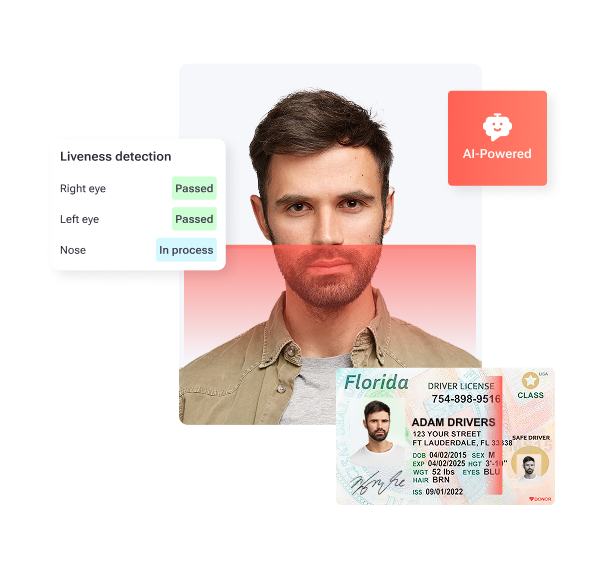
IDVerify sits directly inside the TenantEvaluation application workflow, so applicants do not need an external portal or separate login. Applicants complete a guided verification step that includes uploading a government-issued ID and completing a selfie verification. The platform then runs automated government ID authenticity validation, AI-powered liveness detection to confirm physical presence, and facial landmark biometric matching that compares the selfie to the ID photo.

CAMs see the verification results inside the screening report, including ID authenticity confirmation, liveness status, and biometric match result, along with a redacted ID copy for compliance documentation. IDVerify can be enabled per community or configured across a portfolio to match each association’s risk profile.
What does 55+ Communities Verification do for Florida age-restricted HOAs and condos?
55+ Communities Verification is a built-in capability within TenantEvaluation that helps Florida condos and HOAs standardize how age-restricted requirements are handled across applications. It reduces manual work, improves documentation consistency, and strengthens internal operational control by replacing fragmented manual processes that rely on emails, PDFs, and repeated follow-ups. It is designed for Community Association Managers and boards that manage age-restricted communities and need a scalable, documentation-first approach to 55+ application handling. It supports internal compliance-related processes and does not replace legal guidance.
Can TenantEvaluation replace spreadsheets for lease tracking across a large Florida portfolio?
Lease Tracking inside TenantEvaluation provides centralized, real-time lease visibility and lifecycle control from application submission through occupancy. It connects resident onboarding, unit data, approvals, and lease documentation into one streamlined workflow. The platform delivers real-time lease status visibility, including active, pending, expired, or missing, automated lease document collection during onboarding, unit-level tracking tied to occupancy records, and a searchable digital history of lease records and document trails.
CAMs, boards, and community operations teams access this information inside the same platform used for screening and approvals. This unified access removes the need for disconnected spreadsheets, scattered email chains, and manual expiration tracking. The result is audit-ready digital lease records and faster administrative workflows that scale with portfolio growth without adding headcount.
Conclusion: Selecting the Right Background-Check Integration for Florida Associations
Florida CAMs and boards evaluating Verify Screening Solutions or any TazWorks-based tool should measure their current integration against four criteria. These criteria include FCRA compliance depth, operational automation from intake to lease tracking, board transparency through a dedicated review and voting dashboard, and biometric fraud prevention that sits inside the screening workflow.
Verify Screening Solutions delivers background check data through a TazWorks intermediary layer, which leaves many association-specific needs to manual processes. TenantEvaluation delivers an end-to-end resident onboarding platform built exclusively for community associations, with FCRA compliance as the foundation rather than an afterthought. The integration gap between a standalone background check tool and a purpose-built association platform is where compliance exposure, administrative cost, and board frustration accumulate.
CAMs can close that gap by seeing the full workflow in a live environment. Compare TenantEvaluation to your current integration across every dimension that matters to Florida community associations in 2026.
