Written by: Luis Teran, Co-founder, CEO, TenantEvaluation | Last updated: June 28, 2026
Key Takeaways
- Manual FCRA disclosure processes create timing errors, incomplete audit trails, and legal exposure for Florida community associations handling tenant screening.
- TenantEvaluation automates pre-report authorization, CFPB Summary of Rights delivery, and timestamped consent workflows to close compliance gaps before background checks begin.
- Automated adverse action notices include all required FCRA elements, enforce recommended waiting periods, and maintain clear separation between association decisions and data provision.
- Permissible purpose controls, electronic delivery receipts, and five-year record retention create defensible audit trails for every application and board inquiry.
- TenantEvaluation provides Florida CAMs and boards with an all-in-one platform that automates FCRA-compliant disclosure delivery and lease tracking from application to occupancy.
Step-by-Step FCRA Authorization and Summary of Rights Delivery
The FCRA requires a standalone written disclosure and written authorization before any consumer report is obtained. The disclosure must appear in a separate document, not buried in a lease or application form, and the CFPB Summary of Rights must accompany it. The sequence below shows how electronic delivery should occur to stay compliant.
- Present a standalone FCRA disclosure document to the applicant before initiating any background or credit check. This separate format helps the applicant clearly understand that a consumer report will be obtained.
- Deliver the CFPB Summary of Your Rights Under the Fair Credit Reporting Act alongside the disclosure so the applicant knows how to dispute inaccurate information.
- After both documents are presented, obtain explicit written authorization from the applicant. Electronic signature is acceptable when the applicant has consented to electronic communication.
- Before ordering the report, timestamp and store the signed authorization with the application record. This creates an audit trail that proves consent came first.
- Confirm that permissible purpose is documented and tied to the specific unit and application, which establishes the legal basis for accessing the consumer report.
Automating FCRA Authorization Before Background Checks
Manual written authorization through email attachments, printed forms, or PDF uploads creates version-control problems and gaps in the audit record. TenantEvaluation removes these risks by embedding the standalone FCRA disclosure and CFPB Summary of Rights directly into the applicant-facing onboarding flow. Applicants review and e-sign both documents before the application advances to the screening stage.
The platform timestamps each signature, stores a versioned copy against the application record, and blocks report ordering until authorization is confirmed. This structure prevents a CAM from pulling a report before consent is secured, which is a common source of FCRA liability in manual workflows.
Required Content for an FCRA Adverse Action Notice
When a community association takes adverse action based in whole or in part on a consumer report, the FCRA requires the notice to include every element listed below. A notice that omits even one of these elements does not meet FCRA standards.
- Name, address, and phone number of the consumer reporting agency (CRA) that supplied the report.
- A statement that the CRA did not make the adverse decision and cannot explain why it was made.
- Notice of the applicant’s right to obtain a free copy of their consumer report from the CRA within 60 days.
- Notice of the applicant’s right to dispute inaccurate or incomplete information in the report.
- The specific reason or reasons for the adverse action. Vague language such as “poor credit history” does not satisfy this requirement.
- If a credit score was used: the score itself, the score range for the model used, up to four key factors that adversely affected the score, the date the score was created, and the name of the company that provided the score.
Automated Two-Step Adverse Action Notices for Tenant Screening
The FCRA adverse action process for tenant screening follows a two-step structure. The pre-adverse action notice must be sent before the final decision is made and must include a copy of the consumer report, the CFPB Summary of Rights, and notification that the applicant has the right to dispute the report’s accuracy. There is no statutory minimum waiting period between the pre-adverse and final adverse notice, but the FTC has indicated five business days as the minimum recommended interval, and most compliance attorneys recommend allowing five to seven business days.
TenantEvaluation’s automated adverse action workflows generate both the pre-adverse and final adverse notices with all required elements pre-populated from the screening report data. The platform enforces the recommended waiting interval before the final notice is released and maintains a clear separation between the association’s decision-making role and TenantEvaluation’s data provision role. Notices are delivered through the applicant’s confirmed communication channel, and every delivery event is timestamped and stored in the application’s audit record. The same timestamping and audit trail approach described earlier applies here, so every adverse action step is documented.
Schedule a demo today to see TenantEvaluation’s automated adverse action workflows in action.
Permissible Purpose Controls and Detailed Audit Logging
The FCRA restricts consumer report access to parties with a defined permissible purpose. For community associations, that purpose is the evaluation of a prospective resident’s application for tenancy. TenantEvaluation enforces permissible purpose at the platform level by tying each report request to a specific application, unit, and applicant record.
Access is restricted to authorized users within the association’s account so that only appropriate staff can view report details. Versioned electronic records capture who requested the report, when the request occurred, and what documented purpose applied. This structure creates a defensible, board-visible audit trail for every application, which manual email-and-spreadsheet workflows cannot match.
Electronic Delivery and Five-Year Record Retention
Electronic delivery of FCRA disclosures and notices is permissible when the applicant has consented to electronic communication. TenantEvaluation delivers all disclosures, authorizations, and adverse action notices through its secure platform and generates a delivery receipt and timestamp for each event. Records are stored in searchable, board-accessible logs that connect every disclosure to its corresponding application.
Associations should retain FCRA-related records for a minimum of five years to support any dispute or regulatory inquiry. TenantEvaluation’s centralized Lease Tracking capability connects lease documentation, onboarding records, and disclosure logs into one audit-ready workflow. This unified system replaces scattered email chains and disconnected spreadsheets with real-time lease status visibility from application to occupancy.
Board Dashboard Integration for Florida Community Associations
Florida community association boards need direct visibility into the screening and approval process without becoming the party responsible for data interpretation. QuickApprove provides real-time application tracking, a board-ready review panel, and a voting workflow inside one connected platform. Board members access AI-generated application summaries, review screening outcomes, and cast votes within TenantEvaluation.
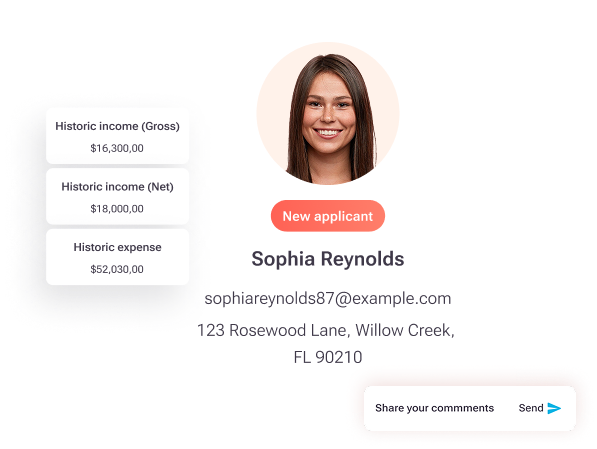
Board members do not receive raw consumer report data outside the compliant workflow, which keeps sensitive information contained. Every board action is timestamped and logged, supporting the clear separation between association decision-making and TenantEvaluation’s data provision role that FCRA compliance requires. QuickApprove accelerates resident approvals while preserving control, compliance, and visibility for high-volume seasons and communities with complex onboarding requirements.
Florida-Specific Screening, Fair Housing, and 55+ Community Needs
Florida’s Fair Housing Act (Chapter 760) prohibits refusing to rent or discriminating in terms or conditions based on protected classes, including race, color, national origin, sex, disability, familial status, and religion, when community associations conduct tenant screening. FCRA adverse action obligations apply in parallel. When an HOA or condominium association uses consumer reports and takes adverse action, federal FCRA rules require an adverse action notice regardless of the state-level framework.
Associations must maintain consistent screening criteria across all applicants to avoid disparate-impact exposure under fair housing law. TenantEvaluation is built specifically for Florida condos and HOAs, with configurable screening criteria, consistent application workflows, and structured documentation that supports uniform treatment across every application. For age-restricted communities, 55+ Communities Verification standardizes application handling, reduces manual work, supports documentation consistency, and improves operational efficiency across Florida condos and HOAs that manage age-restricted requirements.

Frequently Asked Questions
When must written authorization be obtained before a tenant screening report?
Written authorization must be obtained before any consumer report is ordered, not after and not at the same time as the report request. The FCRA requires a standalone written disclosure that is separate from any other document, such as a lease or rental application. The applicant must provide explicit written consent before the association or its screening provider initiates the background or credit check.
Electronic authorization is acceptable when the applicant has agreed to electronic communication. TenantEvaluation automates this step by embedding the standalone disclosure and CFPB Summary of Rights into the applicant workflow and blocking report ordering until a timestamped authorization is confirmed.
What exact elements are required in a final FCRA adverse action notice?
A final FCRA adverse action notice must include the name, address, and phone number of the consumer reporting agency that provided the report. It must also state that the CRA did not make the adverse decision and cannot explain why the decision occurred. The notice must describe the applicant’s right to a free copy of their consumer report within 60 days and the applicant’s right to dispute inaccurate or incomplete information.
The notice must list the specific reasons for the adverse action, not vague descriptions. If a credit score was a factor, the notice must also include the score used, the score range for the model, up to four key factors that negatively affected the score, the date the score was created, and the name of the score provider.
How long must electronic FCRA disclosure records be retained?
The FCRA does not specify a single universal retention period for all disclosure records. A five-year retention standard is widely recommended by compliance practitioners to cover the statute of limitations for many FCRA civil claims. Florida community associations should retain signed authorizations, pre-adverse notices, final adverse notices, consumer report copies, and delivery receipts for at least five years and longer for applications involving disputes.
TenantEvaluation stores all disclosure and notice records in searchable, audit-ready digital logs connected to each application. This structure supports fast retrieval for regulatory inquiries or legal proceedings without manual file searches.
How do permissible purpose controls differ across community association types?
The permissible purpose for obtaining a consumer report in a residential context is the evaluation of a prospective tenant or resident. This standard applies consistently across condos, HOAs, and age-restricted 55+ communities. Documentation requirements and access controls can vary in practice, because governance structures differ.
In a condo association, the board may be the decision-making body, while in a management company portfolio, a CAM may initiate the report request on behalf of multiple associations. TenantEvaluation enforces permissible purpose at the account and application level by tying each report request to a specific unit, applicant, and authorized user, regardless of association type. This control prevents report access outside the defined purpose and creates a defensible record for every request across the portfolio.
Conclusion: Automated FCRA Compliance for Florida Community Associations
Manual FCRA disclosure processes expose Florida community associations to timing errors, incomplete notices, and weak audit records. The two-step adverse action process, standalone authorization requirements, permissible purpose documentation, and electronic record retention standards each create a separate compliance obligation and a potential failure point in a manual workflow.
TenantEvaluation provides an all-in-one platform for automated FCRA-compliant disclosure delivery in Florida community associations. The platform combines direct credit bureau reseller relationships with TransUnion and Equifax, built-in adverse action automation, strict permissible purpose controls, and board-visible audit trails inside a system built for condos, HOAs, and management companies rather than generic rentals. With 5,000+ communities and approximately 100,000 applications processed annually, TenantEvaluation delivers the compliance infrastructure Florida CAMs and boards need without adding headcount or manual follow-up. Its audit trails support the five-year retention standard discussed earlier and maintain the compliance-required separation between board decisions and data provision.
Schedule a demo today and see how TenantEvaluation automates every FCRA disclosure step for your Florida community association.
