Written by: Luis Teran, Co-founder, CEO, TenantEvaluation | Last updated: June 22, 2026
Key Takeaways
- Florida HOAs and condos must replace blanket criminal bans with narrowly tailored written criteria and individualized assessments to comply with HUD fair housing guidance.
- Standardized screening policies should cover income, credit, rental history, and clearly defined criminal convictions, and boards must apply them uniformly to every applicant.
- Background checks must be ordered through FCRA-compliant providers like TenantEvaluation that deliver bureau-grade data, automated adverse-action notices, and complete audit trails.
- Boards should layer background checks with physical security measures, visitor management, and resident engagement programs to build a comprehensive safety strategy beyond screening alone.
- TenantEvaluation centralizes compliant screening, board approvals, biometric ID verification, and lease tracking in one platform, and you can schedule a demo today to protect your Florida community.
Fair Housing Rules That Shape Florida Screening Policies
HUD’s 2016 Office of General Counsel Guidance established that blanket bans on applicants with criminal records violate the Fair Housing Act because they create unjustified discriminatory effects on protected classes. Arrest records alone cannot serve as a basis for denial. Only convictions and relevant conduct qualify as permissible screening factors. HUD’s November 2025 policy letter reinforced this framework and requires individualized assessments for convictions while prohibiting automatic blanket denials. The letter also reiterates that arrests without resulting convictions must not be used as denial grounds.
HUD’s April 2024 guidance on tenant screening raised additional concerns about AI-generated risk scores and algorithmic criminal screening. The guidance notes risks of inaccurate information and discriminatory effects on Black and other protected applicants. Florida community associations that use automated scoring tools must evaluate whether those tools introduce disparate-impact liability.
Under the Florida Information Protection Act (FIPA), covered entities must implement reasonable security measures to protect personal information and carry breach notification obligations when breaches create a risk of financial harm.
Legal Callout: Screening criteria must be narrowly tailored, applied uniformly to every applicant, and directly tied to legitimate safety concerns. Blanket criminal exclusions and arrest-only denials expose Florida associations to Fair Housing Act liability. Always consult legal counsel before finalizing any screening policy.
Once boards understand the federal and state legal framework, they can translate those compliance requirements into operational screening criteria that the association applies consistently.
Written Screening Criteria Florida Boards Can Defend
Written screening criteria must be established before any applications are reviewed and applied uniformly to every applicant so decisions stay consistent and defensible. For Florida CAMs and boards, this means building a written matrix that covers the following elements. These five criteria form the foundation of a defensible screening policy because they provide objective, measurable benchmarks that apply uniformly to every applicant.
- Income requirements: A standard threshold of 2.5–3x monthly rent is widely used and provides a documented, objective benchmark.
- Credit score minimums: A minimum score such as 620 should appear in writing and apply consistently across all applicants.
- Rental history standards: No evictions within the past 3–5 years is a common written benchmark. Eviction filings must not be treated the same as judgments.
- Criminal conviction criteria: Criteria must be narrowly tailored, clear, specific, and directly tied to legitimate safety concerns. Boards should define which convictions trigger mandatory denial versus further individualized review and establish a defined lookback period.
- Uniform application: Screening criteria must be applied consistently to all applicants, clearly documented, and regularly reviewed for unintended bias to avoid Fair Housing Act violations.
Florida board governance adds a layer of complexity because criteria must align with the association’s governing documents and bylaws. TenantEvaluation configures each community’s specific screening criteria directly into the platform. This configuration ensures the written matrix operates consistently across every application instead of depending on individual manager interpretation.
Individualized Assessments for Criminal Records
Expert guidance recommends moving away from blanket exclusions and instead using individualized assessments that consider the nature, severity, and recency of the offense, plus evidence of rehabilitation and other relevant circumstances. Every application involving a criminal record that triggers review, rather than mandatory denial, requires documented consideration of the following factors.
- Nature and severity of the offense
- Recency of the conviction and time elapsed since release
- Evidence of rehabilitation, including employment history and community ties
- Whether the offense directly relates to the safety of residents or property
- Mitigating circumstances presented by the applicant
Landlords should keep copies of criminal background check reports and write notes explaining how the information was weighed in context, such as giving less weight to a decade-old misdemeanor than a recent felony conviction. This documentation requirement extends to every decision. Every approval, conditional approval, and denial should be tied to written criteria with the specific basis recorded to protect against challenges under Fair Housing and FCRA rules. The reason this specificity matters is that vague denial language such as “not a good fit” creates significant liability exposure.
FCRA-Compliant Screening Providers for Florida Associations
Criminal background checks must be run through a licensed consumer reporting agency with written applicant consent under the FCRA, and failure to confirm local rules before including them exposes landlords to Fair Housing and FCRA liability. Not all screening providers carry the same compliance infrastructure, and the differences matter significantly for Florida community associations.
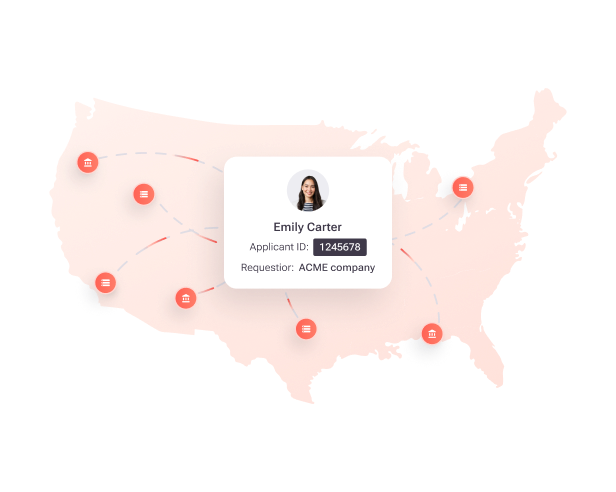
TenantEvaluation is built specifically for community associations and management companies, with FCRA compliance as the foundation, not an afterthought. As a legitimate reseller of TransUnion and Equifax data accessed under strict bureau rules, TenantEvaluation eliminates the gray-market data risks associated with generic providers. Key compliance differentiators include direct credit bureau reseller relationships, strict permissible-purpose controls, automated adverse-action workflows, clear separation between decision-making by the association and data provision by TenantEvaluation, and built-in audit trails for every application. Generic screening vendors that aggregate data through third-party scraping or offshore sources cannot offer the same level of audit defensibility or bureau-grade data integrity.
Protecting Applicant Privacy and Screening Data
Florida’s 2026 enforcement priorities under the FDBR focus on sensitive data, disclosures around data sales, and profiling and automated decision-making. These priorities directly affect resident screening workflows that collect identity data or use automated scoring. FIPA imposes breach notification obligations and requires reasonable security measures for all personal information collected during screening.
TenantEvaluation addresses these obligations through PCI Level 1 compliance, end-to-end encryption, and automatic redaction of sensitive personal identifiable information including Social Security numbers and banking details. IDVerify adds a biometric identity verification layer embedded directly into the screening workflow. It uses government ID validation, AI-powered liveness detection, and biometric facial matching to confirm applicant identity before approval. This approach moves communities from document-based review to biometric-backed identity confirmation, reduces fraud exposure, and maintains a redacted ID copy for compliance documentation inside the same platform.

Layered Safety Measures Beyond Background Checks
Evidence-based place management strategies that combine operational practices, tenant engagement, and environmental design are recommended over reliance on any single tactic for crime prevention in apartment communities. Background checks form one layer of protection. Physical and operational measures create the remaining layers.
Crime Prevention Through Environmental Design (CPTED) measures such as well-lit pathways, trimmed landscaping, clear sightlines, deadbolts, and layered security systems create barriers that discourage crime in residential communities. Apartment watch programs, crime-prevention meetings, and building captains turn residents into active participants who report suspicious activity and follow security protocols. Visitor management, delivery protocols, and contractor background check requirements function as operational controls that extend layered protection beyond hardware alone.
Lease Tracking inside TenantEvaluation connects this layered approach to real-time occupancy visibility. By linking resident onboarding, unit data, approvals, and lease documentation in one centralized workflow, CAMs and boards maintain real-time lease status visibility, including active, pending, expired, or missing. Occupancy records stay accurate and audit-ready from application through occupancy, and operational blind spots created by disconnected spreadsheets and scattered email chains are replaced with a single, searchable digital record.
Board-Friendly Review and Approval Workflows
Approval bottlenecks represent one of the most common operational failures in Florida community associations. Applications stuck in email chains, boards without clear visibility into pending decisions, and manual follow-ups during peak seasons all slow the process and increase liability exposure from inconsistent decision-making.
QuickApprove is TenantEvaluation’s accelerated approval workflow built for CAMs, boards, and property management teams inside one connected platform. It delivers real-time application tracking, a board-ready approval process with a dedicated voting panel, automated communication support, customized approval letters, and a personalized welcome package. Boards keep control, compliance, and visibility while replacing email chains and spreadsheets with a connected, auditable approval process designed for high-volume seasons and communities with complex onboarding requirements.

For age-restricted communities, 55+ Communities Verification standardizes how age-restricted application requirements are handled across applications. This standardization reduces manual work, improves documentation consistency, and strengthens operational efficiency and internal controls for Florida condos and HOAs managing 55+ requirements.

Frequently Asked Questions
Can a Florida HOA or condo association deny an applicant based solely on a criminal record?
No. Blanket denials based on any criminal record violate the Fair Housing Act’s disparate-impact principles under HUD guidance. Florida community associations must use narrowly tailored written criteria that identify specific conviction types tied to legitimate safety concerns, establish a defined lookback period, and conduct individualized assessments for convictions that fall into a review category rather than a mandatory denial category. Arrest records without a resulting conviction must not be used as a basis for denial. Associations should consult legal counsel to ensure their written screening policy aligns with current HUD guidance and Florida law before implementation.
What does FCRA compliance require from a Florida community association running background checks?
The Fair Credit Reporting Act requires that background checks be ordered through a licensed consumer reporting agency, that written applicant consent be obtained before running any report, and that adverse action notices be provided to applicants denied based on screening report findings. The adverse action process includes a pre-adverse action notice with a copy of the report, a waiting period, and a final adverse action notice identifying the consumer reporting agency used. Florida associations that use non-compliant providers or skip adverse action steps face direct FCRA liability. TenantEvaluation automates the adverse action workflow and maintains built-in audit trails for every application, which reduces this exposure significantly.
What is an individualized assessment and when is it required in resident screening?
An individualized assessment is a documented review of the specific circumstances surrounding a criminal conviction rather than an automatic denial triggered by the conviction category alone. It considers the nature and severity of the offense, how much time has passed since the conviction or release, evidence of rehabilitation such as stable employment or community ties, and any mitigating circumstances the applicant presents. HUD guidance requires individualized assessments for convictions that do not meet the threshold for mandatory denial under a community’s written policy. The assessment and the factors considered must be documented in writing for every application where it is conducted, which creates a defensible record against Fair Housing challenges.
How does TenantEvaluation differ from generic background screening vendors for Florida community associations?
Generic screening vendors are built for broad rental markets and lack the governance infrastructure Florida community associations require. Unlike generic vendors, TenantEvaluation’s association-specific design, described in the “FCRA-Compliant Screening Providers” section above, includes bureau-grade data sourcing, automated adverse action workflows, and governance controls aligned with CAM and board needs. Beyond the core screening and approval capabilities detailed earlier, TenantEvaluation also includes purpose-built tools for Florida-specific governance challenges that generic vendors cannot address within a single platform.
Conclusion
Improving community safety in Florida HOAs and condos requires more than ordering a background check. A defensible, compliant program combines written standardized criteria, individualized assessments for criminal records, FCRA-compliant data sourcing, applicant data protection, physical and operational security layers, and audit-ready approval workflows applied consistently across every application.
TenantEvaluation is the definitive Florida solution for this framework. It serves more than 5,000 communities and processes approximately 100,000 applications annually, and it is the only platform built exclusively for community associations and management companies with FCRA compliance as its foundation. The platform capabilities covered in this article, from biometric identity verification to board-ready approval workflows to age-restricted documentation support, work together to reduce manual work, accelerate approvals, and protect associations from liability.
This article is educational and does not constitute legal advice. Florida community associations should consult qualified legal counsel before implementing or modifying any screening policy.
